



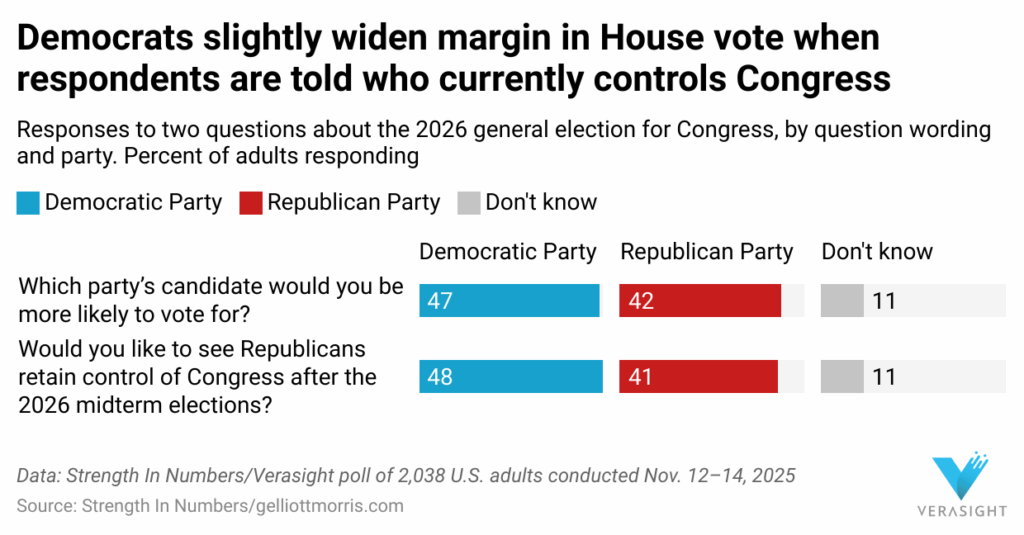
Democrats’ latest surge in the generic ballot — their biggest lead since 2017 — didn’t come out of nowhere. It is the result of narrative discipline, message consistency, and political strategy that has gone unmatched by Republicans all year. And the proof of their strategy’s success was visible in the most recent election: a blue wave, from school boards to statehouses, where Democrats ran the board in race after race — often in places where Republicans should have been competitive.
The win wasn’t driven by Democratic policy achievements. It was driven by their mastery of the storyline. Democrats controlled the narrative of the government shutdown even after it was publicly documented that they voted 15 times to keep the government closed. It didn’t matter. They repeated one message: Republicans were holding the country hostage. Meanwhile, Republicans had no unified message at all. They were too busy arguing among themselves to communicate with the public.
The Republican brand became chaos; the Democratic brand became consistency. And voters responded exactly as you would expect.
Then the Epstein files entered the national spotlight, offering an opportunity to expose elite misconduct across both parties. But instead of using the moment to bring clarity, Republicans delivered confusion. Infighting, scattered messaging, and contradictory statements turned a story of bipartisan corruption into yet another example of Republican dysfunction.
The Marjorie Taylor Greene–Trump fallout made matters worse. Greene went on progressive platforms like The Viewand publicly questioned Trump’s innocence — even though the attorney representing many of the Epstein victims explicitly cleared Trump of any wrongdoing. That contradiction was a gift to Democrats. It didn’t matter that Trump was exonerated. Greene’s comments validated the left’s narrative that he must have been involved. Republicans handed Democrats the ammunition.
And beneath all of this was a deeper ideological fracture: the war inside the GOP between America First and Israel First. This split isn’t theoretical. It showed up in voter behavior. A large number of young conservatives — especially those aligned with Turning Point USA — simply sat out the election. Not because they’re unmotivated or apolitical, but because they’re disillusioned. They are no longer sure whether the Republican Party’s priorities line up with their own. When the base feels the party is fighting harder for foreign interests than for American interests, enthusiasm collapses.
Democrats capitalized on that confusion. They unified around one message: stability. Republicans, meanwhile, couldn’t tell the public what they stood for — or who they stood with.
This is how Democrats engineered the blue wave. Not by inspiring voters, but by convincing them Republicans were too fractured to govern. And Republicans helped them do it by fighting each other on camera, contradicting their own leadership, and failing to present even a basic message of unity.
This generic-ballot lead is not an ideological shift. It’s the result of a disciplined political machine running against a party that can’t agree on a sentence, much less a platform. Democrats stayed on message. Republicans didn’t have one.
In politics, consistency beats chaos every time. A false narrative, repeated long enough and loud enough, becomes accepted as truth. Democrats understood that. Republicans ignored it. Today’s polling is not a reflection of what voters believe — it’s a reflection of what they hear.