



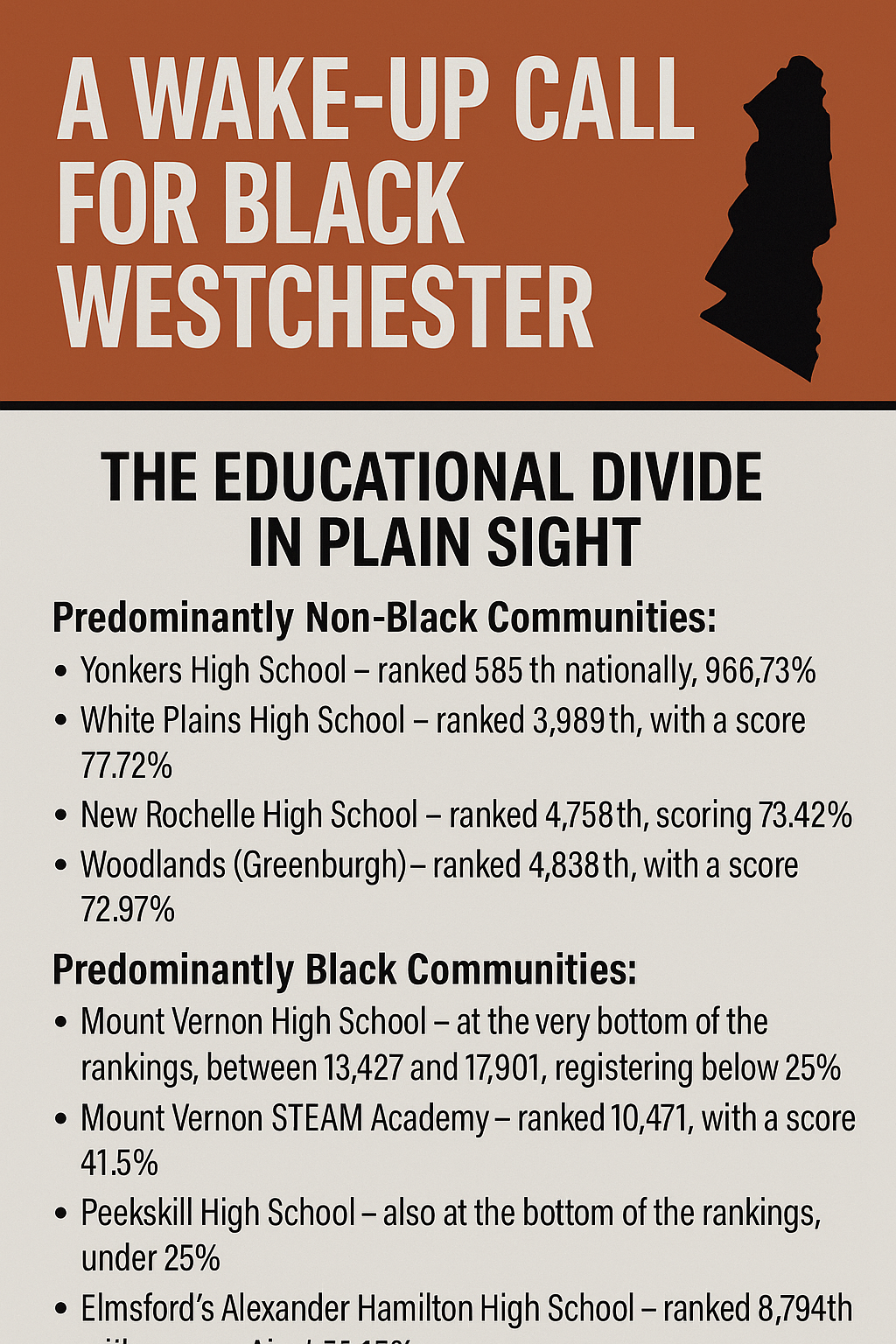
If you asked a teenager at Yonkers High School where their school ranks, you’d hear pride: 585th nationally, scoring 96.73%. Just a few miles south in Mount Vernon, the story is shameful. Mount Vernon High School ranks between 13,427 and 17,901 nationally, with less than a 25% score. Mount Vernon STEAM Academy is ranked 10,471, at just 41.5%. These aren’t just numbers. They are the visible proof of educational apartheid in Westchester County. While some schools thrive, Black-majority districts like Mount Vernon and Peekskill languish at the bottom. For Black parents and residents across this county, this must be a wake-up call. Our children are not getting the education they deserve, and if we don’t demand change, we are complicit in their failure.
The divide could not be clearer:
- Yonkers High School – Ranked 585 nationally, 96.73% score (very strong).
- Lincoln High School – Ranked 4,285, 76.06% score (mid-level performance).
- Saunders Trades & Technical High School – Ranked 6,049, 66.21% score (average performance).
- Roosevelt High School – Ranked 11,507, 35.72% score (low performance).
- Gorton High School – Ranked 10,016, 44.05% score (low performance).
- White Plains High School – ranked 3,989th, with a score of 77.72%.
- New Rochelle High School – ranked 4,758th, scoring 73.42%.
- Woodlands (Greenburgh) – ranked 4,838th, with a score of 72.97%.
These schools, while not in the elite tier of Scarsdale or Bronxville, are steady, competitive, and provide a real pathway to higher education.
Now compare those results to predominantly Black communities:
- Mount Vernon High School – at the very bottom of the rankings, between 13,427 and 17,901, registering below 25%.
- Mount Vernon STEAM Academy – ranked 10,471, with a score of 41.5%.
- Peekskill High School – also at the very bottom of the rankings, under 25%.
- Elmsford’s Alexander Hamilton High School – ranked 8,794th, with a score of just 50.87%.
The disparities are not marginal — they are gaping. In one Westchester school district, students compete with the best in the nation; in another, just a few miles away, children are statistically locked out of opportunity before they ever set foot in a college admissions office.
The disparities are not the fault of our children. They are symptoms of structural inequities. New York has one of the most inequitable school funding systems in the country, disproportionately shortchanging districts that serve Black, Brown, and low-income students. Westchester’s zoning practices only deepen the divide, creating school district borders that wall off resources along racial and economic lines. Mount Vernon itself has been flagged as being under “severe fiscal stress” by state oversight agencies, a condition that bleeds into every corner of its schools, from teacher retention to extracurricular opportunities. Yet the state has failed to intervene in any meaningful way. Meanwhile, districts like Scarsdale or Bronxville maintain elite status because their funding is protected, their infrastructure is maintained, and their parents demand accountability. The political dysfunction in cities like Mount Vernon only makes matters worse. School boards are too often dominated by infighting, mismanagement, and misplaced priorities. Instead of focusing on curriculum, teacher support, and facilities, too many administrators and politicians have treated education as another opportunity for patronage and personal ambition. The result is visible in the rankings — systemic neglect and political failure have translated directly into lost futures for Black children.
The cost of underperforming schools is not just measured in test scores. It plays out in fewer scholarships earned, fewer college seats secured, and fewer pipelines to trade programs or technology careers. It drags down property values in Black-majority cities like Mount Vernon and Peekskill. It leads to higher unemployment, deeper poverty, and a growing cycle of disenfranchisement that begins not in adulthood, but in the classroom. It also plays out in the lack of economic development. If we as adults are failing to teach our children, then we are failing the Black businesses of tomorrow. We cannot be blind to the correlation between the fact that only two percent of businesses in Westchester are Black-owned and the reality that so many of our students are graduating without even the basic skills needed to survive. Educational failure and economic weakness are directly connected, and unless we address one, the other will continue to wither.
Black residents of Mount Vernon, Peekskill, Elmsford, and beyond must stop treating poor education as normal. Our children’s futures cannot be collateral damage in the games of politicians or the inertia of state funding formulas. We have to hold school boards accountable and demand transparency in budgets, hiring, and curriculum. We need coalitions of parents who will organize, attend meetings, and refuse excuses. We must push Albany to overhaul the formulas that consistently disadvantage poor and Black districts. Without systemic reform, no amount of local effort will be enough. Equally important, we cannot allow the political dysfunction that has crippled Mount Vernon for decades to keep distracting us from the true issue. Children’s futures must come before the ambitions of mayors, trustees, and political operatives. And beyond demanding reform, we must invest in our children directly through tutoring, mentorship, and afterschool programs that supplement what the schools are failing to provide.
There is reason for hope. Yonkers High proves that even in diverse, urban settings, schools can excel with the right leadership and investment. White Plains demonstrates how a mixed-income district can deliver consistent, stable results. The lesson is clear: when communities demand excellence and leadership delivers, the children rise to the challenge. But hope without responsibility is worthless. Black Westchester must refuse to accept that our children are destined to be last. As Malcolm X once said, “Education is the passport to the future, for tomorrow belongs to those who prepare for it today.” Right now, our children are being denied that passport. The question is whether we as parents, residents, and leaders will fight to put it back in their hands. This is not just about education policy. It is about survival. A community that accepts failing schools accepts a failing future.
References: The Education Trust–New York: New York ranks near bottom of states in analysis of school funding disparities (2023). The Century Foundation: How Zoning Drives Educational Inequality: The Case of Westchester County (2019). NY Senate District Report: Mount Vernon City School District – Severe Fiscal Stress (2024). Alliance for Quality Education NY: The Impact of Funding Discrepancies on Educational Opportunities: Peekskill vs. Scarsdale(2018). US News Best High Schools Rankings – Mount Vernon, Peekskill, Yonkers, New Rochelle, White Plains, Greenburgh, Elmsford (2025).