


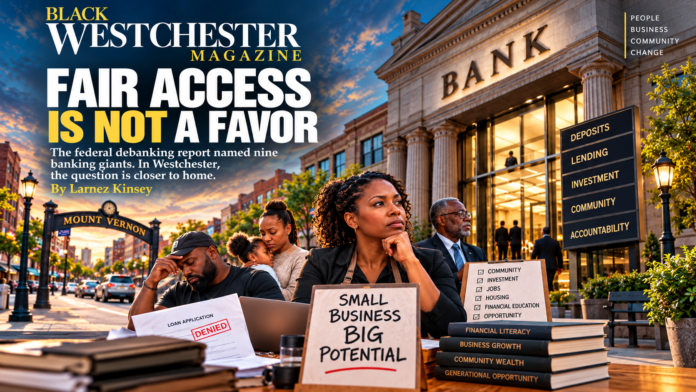
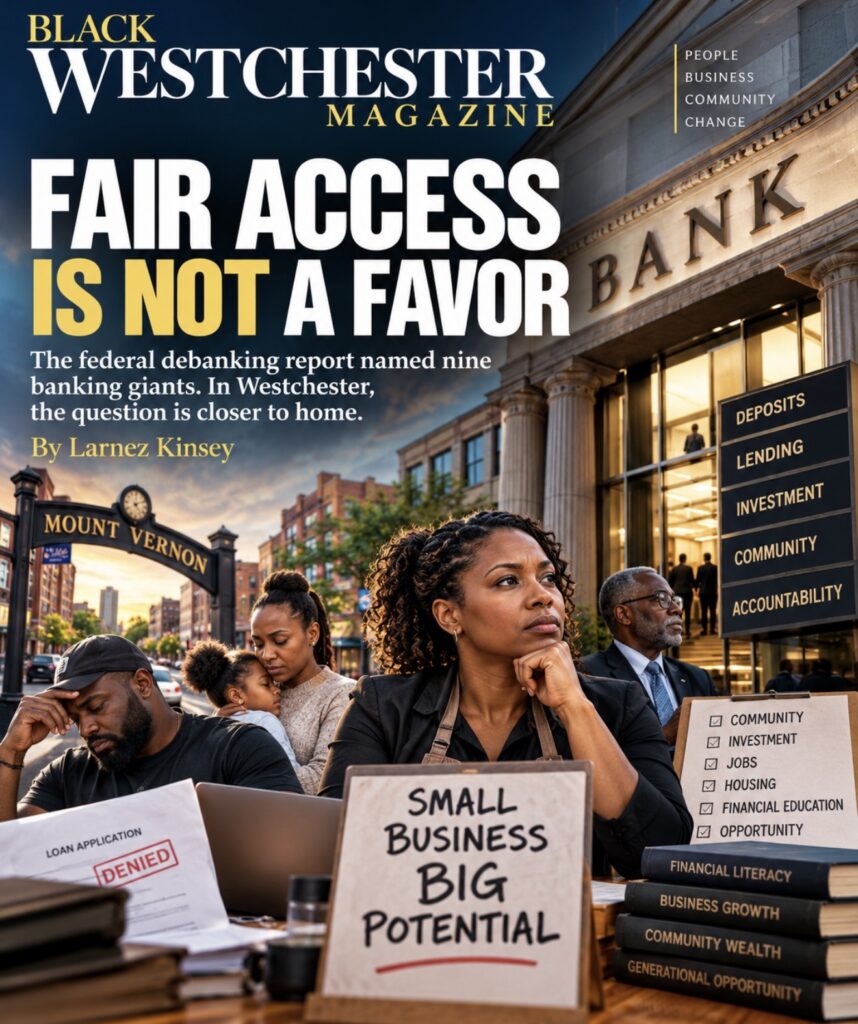
The federal debanking report named nine banking giants. In Westchester, the question is closer to home.
Washington has found a new word for an old experience: debanking. Black communities did not need a federal report to understand what happens when a financial institution decides that a person, a business, or an entire neighborhood is too risky, too complicated, or simply not worth the investment. Our grandparents knew redlining. Our parents knew what it meant to be denied and told to try somewhere else. Our entrepreneurs know the loan that never came through, the branch that never opened, and the partnership that never moved beyond a polite conversation. Different generations, different explanations, familiar consequences.
On October 14, 2026, the Office of the Comptroller of the Currency released a report titled Guaranteeing Fair Banking for All Americans. The OCC examined policies and practices at nine major national banks: JPMorgan Chase, Bank of America, Citibank, Wells Fargo, U.S. Bank, Capital One, PNC Bank, TD Bank, and BMO Bank. According to the report, between 2020 and September 2025, all nine maintained policies or practices that may have influenced decisions to deny or limit financial services based on customers’ political or religious beliefs or lawful business activities.
The report raised concerns about broad reputational-risk policies that lacked sufficiently clear, objective standards. It also examined restrictions affecting industries such as fossil fuels, firearms, tobacco, detention facilities, and digital assets. Comptroller Jonathan V. Gould declared, “Fair access to financial services is not a mantra. It is a mandate.” The Consumer Financial Protection Bureau subsequently announced that it would examine whether the institutions identified in the report, and potentially others, complied with applicable federal consumer financial laws.
The OCC report did not impose fines or establish that every questioned decision violated the law. Banks maintain that they must consider legitimate legal, financial, compliance, and reputational risks. Those distinctions matter. But so does the larger question: Who gets labeled a risk, who gets recognized as an opportunity, and who gets to challenge the standards being applied? When Washington raises concerns about financial exclusion affecting lawful businesses and politically controversial customers, communities that have struggled with unequal access to capital have every reason to pay attention. Fair treatment cannot depend on whose exclusion attracts national attention.
The African American Chamber of Commerce of the Hudson Valley has been asking a related question closer to home. What does meaningful financial access look like when a bank operates in a community, accepts deposits, builds customer relationships, and benefits from local economic activity? Consider Trustco Bank. According to figures from its previous Community Reinvestment Act evaluation for the New York combined statistical area, the bank held approximately $424 million in deposits. During the evaluation period, examiners identified three community development loans totaling approximately $1.1 million, twelve charitable donations totaling approximately $36,000, and no branches in low-income census tracts within the assessment area. Lending and service received Low Satisfactory ratings, alongside concerns about the geographic distribution of home mortgage lending. These figures describe specific aspects of the bank’s CRA performance, not the entirety of its lending or community investment activity. But they raise legitimate questions about whether the credit needs of underserved neighborhoods are being adequately addressed.
Behind those numbers is the entrepreneur in Mount Vernon who has customers waiting but cannot purchase another piece of equipment. The mother operating a business from her kitchen table, hoping to leave her children something more than bills. The nonprofit director who knows which families need food, which young people need employment, and which small businesses need assistance, but spends more time searching for funding than delivering services. These are not abstract economic indicators. These are lives, livelihoods, and opportunities that can disappear when access to capital remains out of reach.
The Chamber presented Trustco Bank with its Prosperity Circle initiative, a proposed six-month entrepreneur development and capital-readiness program. The model includes cohorts of 10 to 15 entrepreneurs, a four-week Capital Readiness Bootcamp, business coaching, and a proposed pathway to $1,000 microloans through a participating financial institution, subject to independent underwriting and approval. The Chamber offered recruitment, education, coaching, program management, and relationships within the communities the program would serve. We were asking a financial institution to consider contributing the expertise and financial partnership that a community organization cannot provide alone. To date, no partnership has been approved and no financing has been committed.
That outcome does not, by itself, establish discrimination or a CRA violation. But it illustrates why community organizations must document both their needs and their efforts to build solutions. On October 20, the Chamber submitted a formal CRA public comment concerning Trustco’s performance and requested engagement with its community development leadership. The question is not whether a bank must approve every proposal. The question is whether underserved communities can see a meaningful pathway from identifying a financial need to receiving serious consideration for a solution.
Our experience with Apple Bank raised another concern. On August 27, 2026, the Chamber sponsored a community networking event, How to Plan, Pay & Execute a Trip, at Double Door Event Space in Mount Vernon. We had communicated with Ruby Zayas, an Apple Bank assistant vice president and branch manager at its Larchmont branch, who had indicated several weeks earlier that she would attend and present a financial literacy session. During our confirmation the day before the event, we received an email explaining that she was on vacation. Apple Bank did not attend, no substitute was provided, and the promised financial literacy presentation did not take place.
Forty-five people attended that gathering, including elected officials. Forty-five people who could have benefited from a conversation about budgeting, credit, savings, and financial planning. The absence of a promised educational session may appear small inside a financial institution, but it matters to a community organization that invested time, relationships, and credibility in bringing people together. When we subsequently raised the matter with Ms. Zayas, we found her response dismissive of our concerns. That is our characterization of the exchange, and the bank should have an opportunity to provide its perspective.
On October 20, the Chamber submitted a public comment to the New York State Department of Financial Services, with copies to Apple Bank and a comment addressed to the FDIC, concerning the bank’s community reinvestment performance ahead of its anticipated fourth-quarter federal CRA examination. According to the state evaluation cited in our comment, Apple Bank’s Investment Test was rated Low Satisfactory, with approximately $665,000 in qualified grants across its nine-county assessment area. Community development lending was also rated Low Satisfactory, and the one Westchester branch opened during the evaluation period was located in an upper-income census tract. Those findings deserve public examination alongside the bank’s broader lending, investment, and service record.
A missed presentation is not the same as unlawful debanking. An unapproved partnership is not proof of discrimination. And a CRA rating must be understood within the full examination record. But these experiences raise a question that connects national banking policy to local economic reality: What does accountability look like when financial institutions benefit from a community but the community struggles to secure meaningful engagement, investment, and access?
In September, I sat in a Westchester County budget meeting and listened as County Executive Ken Jenkins discussed the financial pressure created by federal budget cuts. The message I took away was that local government would have to do less with fewer resources. I thought about the families already stretching groceries until payday, the youth programs struggling to keep their doors open, and the small-business owners whose next contract could mean employment for someone living right down the block.
When public resources shrink, the needs of our communities do not disappear. They become heavier for the people already carrying the most. We cannot tell families to survive with less while allowing millions of dollars to circulate through our communities without asking how those financial institutions are helping those same communities build wealth.
The Community Reinvestment Act exists to encourage banks to help meet the credit needs of the communities they serve, including low- and moderate-income neighborhoods, consistent with safe and sound banking practices. It does not guarantee every entrepreneur a loan or every nonprofit a grant. It does, however, establish a framework for examining whether banks are responding to community credit needs through lending, investment, and services.
And that is where the public has a role.
When a bank undergoes its CRA examination, regulators review its performance and can consider relevant public comments received within the applicable examination process. This is an important opportunity for residents, entrepreneurs, nonprofit leaders, and community advocates to document what financial access looks like in their neighborhoods. The examination will move forward whether we participate or not. The question is whether the record will reflect the people who live with the consequences of these decisions.
Have you struggled to obtain financing for your business? Does your neighborhood lack accessible banking services? Has your organization identified a need for affordable housing, financial education, or small-business investment? Have you approached a financial institution with a community development proposal and received no meaningful response? These experiences deserve to be documented accurately, supported by evidence when possible, and presented to the appropriate regulators.
You do not need a law degree to explain what your neighborhood lacks. You do not need to own a million-dollar business to describe the barriers standing between your work and your next opportunity. But your experiences are more powerful when they become part of a documented public record rather than conversations that never leave the kitchen table, the barbershop, the church basement, or the community meeting.
That is why the African American Chamber of Commerce of the Hudson Valley is inviting residents, entrepreneurs, nonprofit organizations, and community advocates to participate in our next Community Reinvestment Comment Lab. Through the Lab, participants learn how to examine public banking records, understand the CRA process, identify community credit needs, and prepare informed public comments that regulators can consider.
I am encouraging you to help the Chamber build a pathway connecting financial institutions doing business in our communities with the residents, entrepreneurs, and organizations seeking access to capital, financial education, and community development opportunities. We should not have to wait until another business closes, another family loses economic stability, or another community program disappears before asking whether the institutions collecting deposits in our neighborhoods are doing enough to support their future.
Contact the African American Chamber of Commerce of the Hudson Valley to learn about our next Community Reinvestment Comment Lab. Email info@aacchudsonvalley.org, call 914-953-0877, or visit www.aacchudsonvalley.org. Public comments should be submitted early enough to meet the applicable regulator’s examination deadlines.
The banks have their financial statements. The regulators have their examination procedures. Our communities have generations of experiences that deserve to be heard. Let Washington investigate the nine banking giants. Let regulators examine whether the law has been followed. But do not allow the national conversation about fair access to end before it reaches the entrepreneur in Mount Vernon, the family in Yonkers, or the neighborhood organization trying to build something that will outlast the next budget cut.
Fair access is not a favor. It is an obligation. And accountability begins when our communities refuse to remain outside the conversation.