


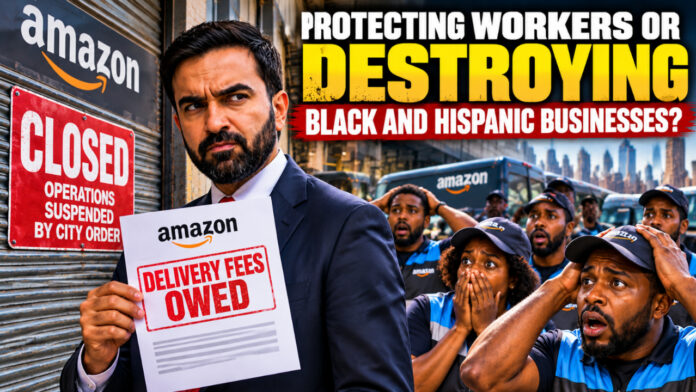

NYC’s Delivery Protection Act Raises Serious Questions About Jobs, Entrepreneurship, and Economic Opportunity
Something is fundamentally troubling about government policies that claim to protect working people while potentially destroying the very businesses that employ them. That is the concern surrounding New York City’s proposed Delivery Protection Act, which could dramatically change how Amazon operates its delivery network throughout the five boroughs. While supporters argue that the legislation will improve working conditions, wages, and accountability, another side of this debate deserves considerably more attention: the potential destruction of Black- and Hispanic-owned businesses and the thousands of jobs connected to them.
For decades, politicians have told Black and Hispanic communities that entrepreneurship is essential to economic empowerment. We have been encouraged to start businesses, create employment, build generational wealth, and become less dependent on government assistance. Yet here we are, watching another government proposal that could threaten minority-owned companies that have done precisely what elected officials have repeatedly encouraged them to do. The contradiction deserves a serious public examination.
THE BUSINESSES BEHIND AMAZON’S DELIVERY NETWORK
Most people see an Amazon delivery van driving through their neighborhood and assume the driver works directly for Amazon. What many do not realize is that a substantial portion of Amazon’s delivery operations is managed through its Delivery Service Partner program, which contracts with independently owned companies that hire drivers, manage employees, and operate delivery fleets.
These are real businesses with owners, employees, payroll obligations, operating expenses, and financial obligations. Their owners have invested time, capital, and resources to build companies that provide jobs and contribute to local economies. They are not merely workers making deliveries under another name, although their dependence on Amazon as a major customer raises legitimate questions about how much independence they have.
According to Amazon’s public statements about the proposed legislation, about 25 percent of its New York City delivery partners are Black- or Hispanic-owned. The company says more than 40 delivery businesses and over 5,000 workers could be affected by the proposed changes. These figures come from Amazon, which has a financial interest in opposing the legislation, and should be independently verified by the City Council.
Even if we accept these figures only as preliminary estimates, the implications still deserve attention. We are discussing minority entrepreneurs who have built companies, created jobs, and participated in an industry where ownership can be difficult to obtain. The possibility that government legislation could disrupt those businesses should not be dismissed as an unfortunate but acceptable consequence of labor reform.
WHAT HAPPENS TO BLACK AND HISPANIC BUSINESS OWNERS?
Black business ownership has historically faced significant obstacles, including limited access to financing, unequal opportunities for commercial contracts, and difficulty securing the capital needed to expand operations. Hispanic entrepreneurs have encountered many of these same challenges, particularly when competing with larger companies that possess substantially greater financial resources.
For an independent delivery company, an Amazon contract can be an opportunity to enter the logistics industry, establish a payroll, gain management experience, and build an asset that supports the owner’s family. Business ownership is not a guarantee of wealth, and dependence on a single large corporate customer carries significant risk. Still, ownership offers opportunities that simply collecting a paycheck does not.
When policymakers propose eliminating or substantially restricting a business model, they must consider the fate of those who have already invested in it. Will these owners receive compensation for investments that become unusable? Will they have opportunities to compete for alternative contracts? Will they be offered a meaningful transition, or will years of effort be lost because the government decided that their business structure was no longer acceptable?
These questions become even more important when minority business ownership is at stake. New York cannot continue promoting minority entrepreneurship through speeches, government programs, and ceremonial celebrations while failing to assess whether its own legislation could undermine existing minority-owned businesses.
THOUSANDS OF JOBS COULD BE AT RISK
The employment implications are equally concerning. Amazon has warned that its delivery network could face major disruptions if the proposed legislation becomes law, including possible warehouse relocations outside New York City. Reports have cited thousands of delivery jobs and additional warehouse-related positions that could be affected by such decisions.
Let us be clear about one important fact: these are projected risks, not confirmed layoffs. Amazon has not established that every threatened job will disappear, and the company’s warnings should be scrutinized as carefully as the city’s promises about the legislation’s benefits. However, policymakers should not dismiss potential employment losses simply because the projections come from a corporation opposing the bill.
For working-class families, losing a job is not an abstract political argument. It means worrying about rent, mortgage payments, groceries, transportation, health insurance, and the ability to provide for children. A worker who loses a steady income does not necessarily benefit from being told that the government intended to improve working conditions.
Amazon could also relocate delivery operations to surrounding counties or neighboring states rather than eliminate them entirely. But that would not necessarily preserve opportunities for New York City residents, particularly workers who rely on public transportation or cannot afford longer commutes. A job that moves beyond a worker’s practical reach can become a lost job for that household, even if the position technically continues to exist.
PROTECTING WORKERS SHOULD NOT MEAN ELIMINATING ENTREPRENEURS
Supporters of the Delivery Protection Act raise legitimate concerns about Amazon’s delivery system. They argue that the company exerts substantial influence over routes, productivity expectations, and operational requirements, even though drivers are formally employed by subcontractors. They contend that a corporation exercising significant control should also accept greater responsibility for wages, workplace safety, and employment protections.
That argument deserves consideration. Workers should not be forced to sacrifice their health, safety, or dignity because they are employed through a subcontracting arrangement. Companies should not be allowed to use complex business structures to evade responsibilities imposed by labor law.
But recognizing those concerns does not automatically mean eliminating independent delivery companies is the appropriate solution. There is a difference between regulating a business relationship to prevent abuse and restructuring an entire industry in ways that could render existing businesses economically unviable.
Why not strengthen enforcement of existing labor protections? Why not establish enforceable safety standards, reasonable delivery expectations, transparent contracting requirements, and meaningful penalties for companies that violate workers’ protections? Why not examine shared accountability between Amazon and its delivery partners without automatically excluding the independent businesses from the equation?
Those alternatives deserve serious consideration before legislation produces consequences that may be difficult to reverse. The government should be able to protect workers while recognizing that entrepreneurship, employment, and economic opportunity are connected.
ECONOMIC EMPOWERMENT CANNOT EXIST WITHOUT BUSINESS OWNERSHIP
One of the most persistent economic challenges facing Black America is the gap between earning income and owning productive assets. Employment provides the resources needed to survive, but business ownership can create opportunities to accumulate wealth, build business relationships, employ others, and transfer economic value to the next generation.
This is why the debate over Amazon’s delivery contractors should concern anyone serious about Black economic advancement. If government policy reduces the number of independently owned businesses while concentrating more economic activity directly under a multinational corporation, we must ask whether that constitutes progress for communities seeking greater economic independence.
The question is not whether Amazon deserves protection from regulation. Amazon is a multibillion-dollar corporation with resources that small business owners cannot match. The question is whether the government has adequately distinguished between holding Amazon accountable and potentially eliminating smaller businesses that depend on its contracts.
Black and Hispanic entrepreneurs should not become collateral damage in a dispute between a major corporation, organized labor, and city government. Their businesses, investments, employees, and economic futures deserve independent consideration, not merely a passing reference during legislative hearings.
WHERE IS THE MINORITY BUSINESS IMPACT ASSESSMENT?
Before the City Council advances legislation that could substantially restructure New York City’s delivery industry, residents deserve a detailed economic impact assessment. That assessment should identify how many independent delivery companies operate in the city, how many are Black- and Hispanic-owned, how many workers they employ, and the financial consequences they could face under the proposed law.
We also need to know whether affected workers would actually receive direct employment with Amazon, what wages and benefits those positions would offer, and whether the legislation would provide a realistic transition for existing business owners. A requirement to offer employment to displaced drivers is not the same as guaranteeing that every worker will retain a comparable job.
Equally important, city officials should publicly examine alternatives that could improve working conditions without unnecessarily eliminating independent entrepreneurship. The objective should be measurable worker protections and sustainable employment, not simply passing legislation that sounds appealing in a political speech.
THE BLACK COMMUNITY MUST EXAMINE THE ECONOMICS, NOT JUST THE POLITICS
Too often, economic policy debates are reduced to whether someone supports workers or supports corporations. That framing overlooks the small business owner who is neither a multinational corporation nor an employee of one. It also overlooks the workers whose livelihoods depend on these businesses remaining economically viable.
Black communities have a direct interest in both sides of this discussion. We need strong worker protections, but we also need more Black-owned businesses, greater access to commercial contracts, more employment opportunities, and stronger pathways toward generational wealth. These priorities should not automatically be treated as competing interests.
The political identity of the mayor, the influence of labor organizations, or the reputation of Amazon should not determine whether this legislation receives serious scrutiny. What matters is whether the final policy improves the economic circumstances of working families without unnecessarily destroying opportunities for independent business ownership.
CONCLUSION: WHO REALLY PAYS THE PRICE?
New York City’s Delivery Protection Act presents a serious test of how government balances labor protections with economic opportunity. Supporters believe the legislation will improve accountability and working conditions, while opponents warn that it could force independent businesses to close and encourage Amazon to move delivery facilities outside the city.
Neither side should be permitted to substitute political messaging for measurable economic evidence. Amazon must substantiate its warnings about potential job losses, and city lawmakers must demonstrate that their proposed protections can be implemented without unnecessarily sacrificing minority-owned businesses and working-class employment.
For Black and Hispanic communities, the stakes extend beyond a disagreement over delivery contracts. We are talking about ownership, employment, family income, entrepreneurship, and the ability to build something that can be passed to the next generation.
If the legislation ultimately protects workers while preserving meaningful opportunities for independent businesses, that outcome deserves recognition. But if it eliminates minority-owned companies, displaces thousands of workers, and shifts economic activity outside New York City, the consequences cannot simply be dismissed as the cost of progress.
The fundamental question remains: What good is a policy designed to protect workers if its implementation leaves those workers unemployed and the businesses that employed them out of business?
That is a question every New York City Council member should be prepared to answer before casting a vote.