









I volunteered my time. I walked away. Six months later, why am I still being pulled into a campaign I left behind?

Imagine getting up in the morning, preparing to handle your responsibilities, checking on your family, answering business emails, and planning another day of community work. Then you come across a news article about a political campaign you walked away from six months earlier. Somehow, your former position is still part of the conversation about its problems. You read it again, trying to understand why a chapter you deliberately closed keeps finding its way back into your life. At some point, exhaustion stops looking like exhaustion and starts looking like a boundary that needs to be enforced.
Since leaving Kisha for Westchester, the political campaign of Kisha D. Skipper, people have approached me with troubling accounts of negative statements allegedly made about my character. Some have attributed those statements to Skipper. I cannot verify conversations I did not witness, and I will not pretend otherwise. But when I encountered an article discussing the campaign’s filing problems, I felt that the reporting left readers with an incomplete understanding of my involvement. I had already spent months separating myself from that campaign. I did not expect to find myself explaining that separation again.
Let’s establish the facts, because the timeline deserves more attention than the assumptions.
On January 21, 2026, I accepted the unpaid position of campaign treasurer. What began as one responsibility expanded into event planning, communications, outreach, relationship management, and countless tasks that had little to do with the title I originally accepted. I was doing this while working demanding hours inside a maximum-security forensic psychiatric facility, raising a family, and maintaining my commitments to community organizations. I was volunteering my professional experience, not auditioning to become somebody’s permanent problem solver.
There were nights when I finished a difficult shift and still had campaign calls waiting. My feet hurt. My mind was tired. My family deserved my attention, but another responsibility always seemed to need something from me. I kept showing up because I believed the work mattered. Eventually, I had to confront the difference between supporting an organization and becoming the person expected to compensate for everything it lacked. Sometimes the system isn’t working. You are.
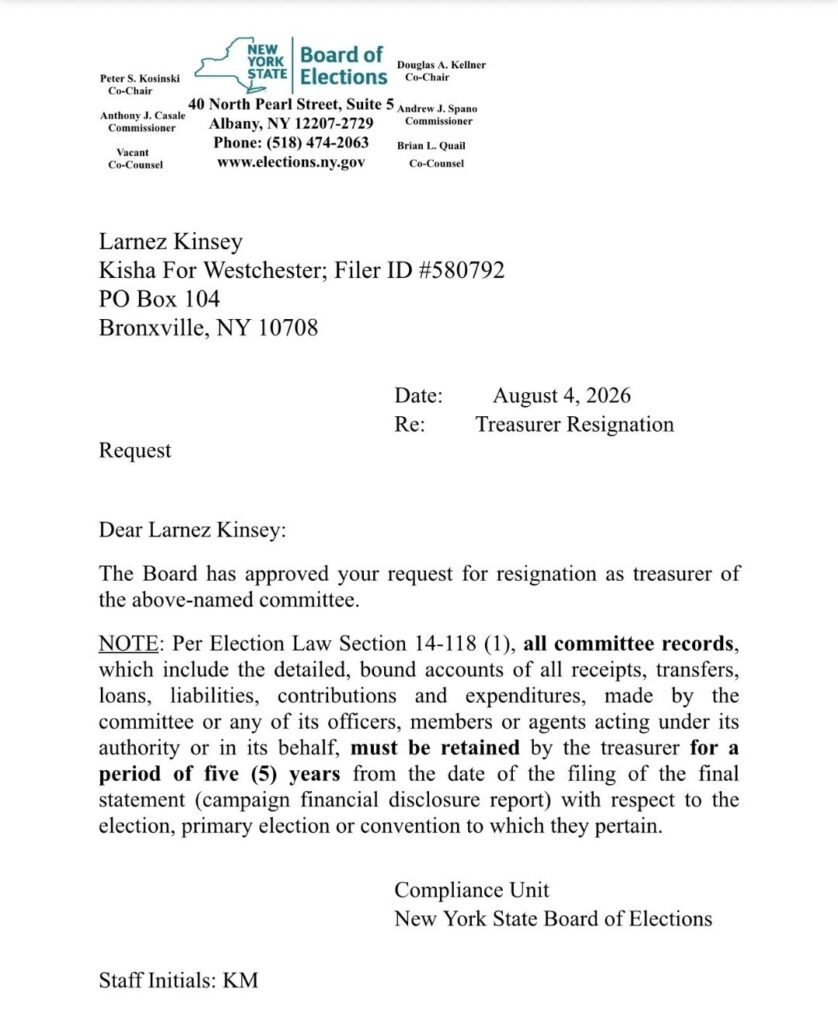
I verbally resigned on March 29. My final day of campaign involvement was April 2. I returned the campaign bank card on April 14. Skipper was aware of my departure. I submitted formal resignation paperwork on May 14, resubmitted documentation on June 22, and received approval from the New York State Board of Elections on August 4. Those dates are not opinions. They are part of a documented sequence of events.
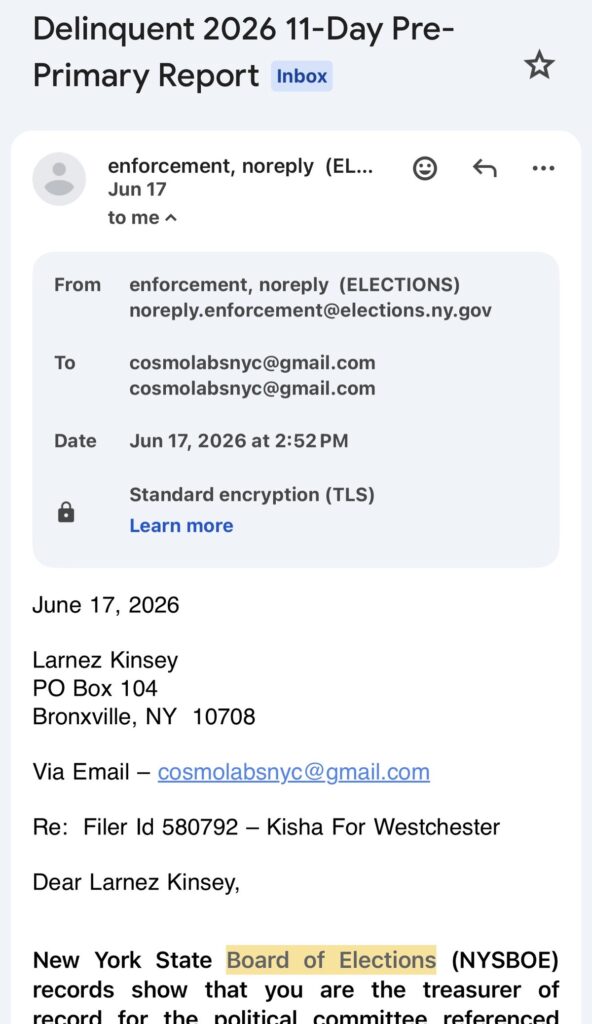
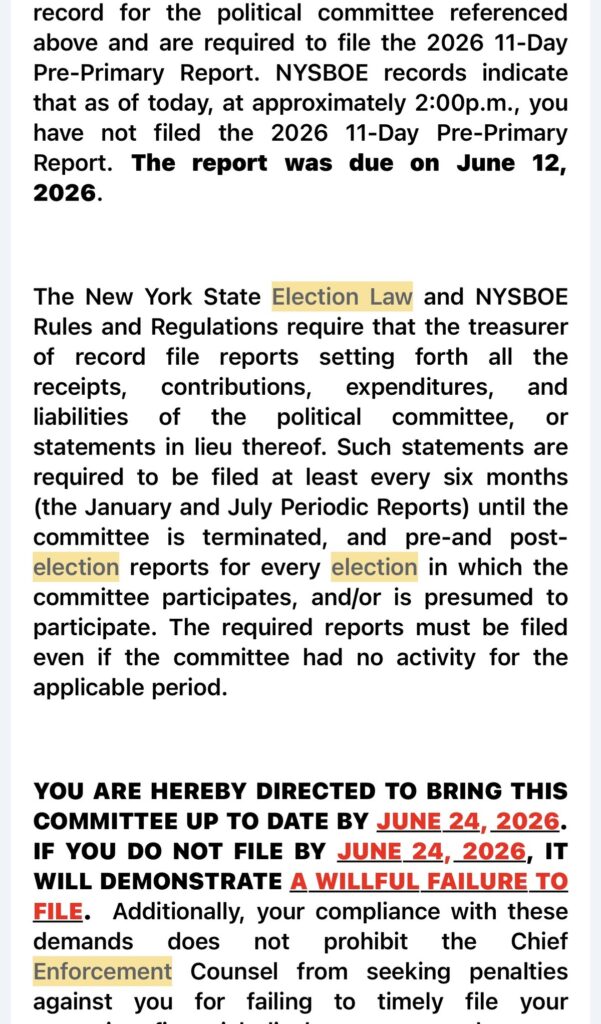
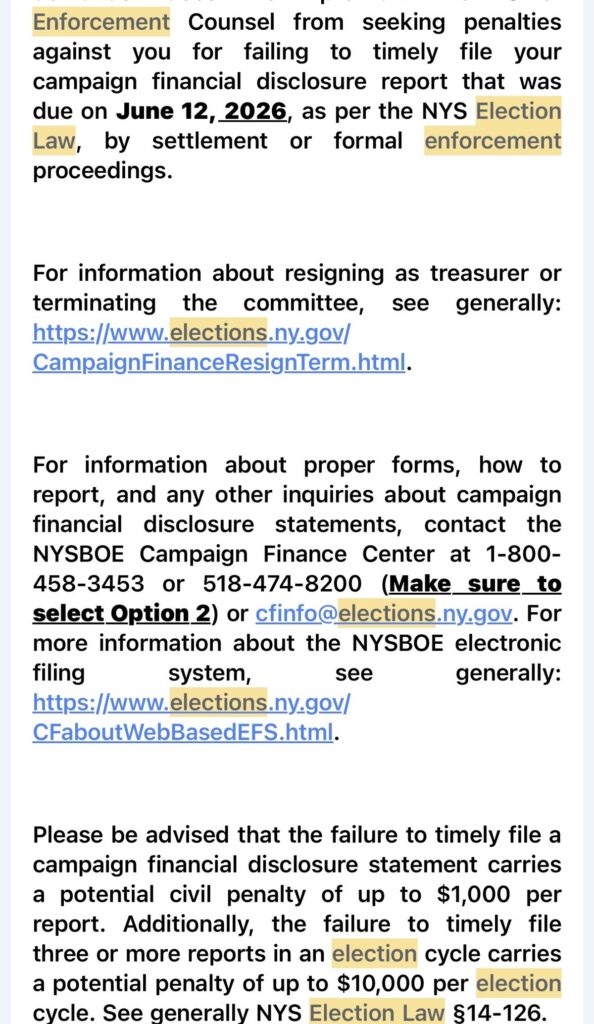
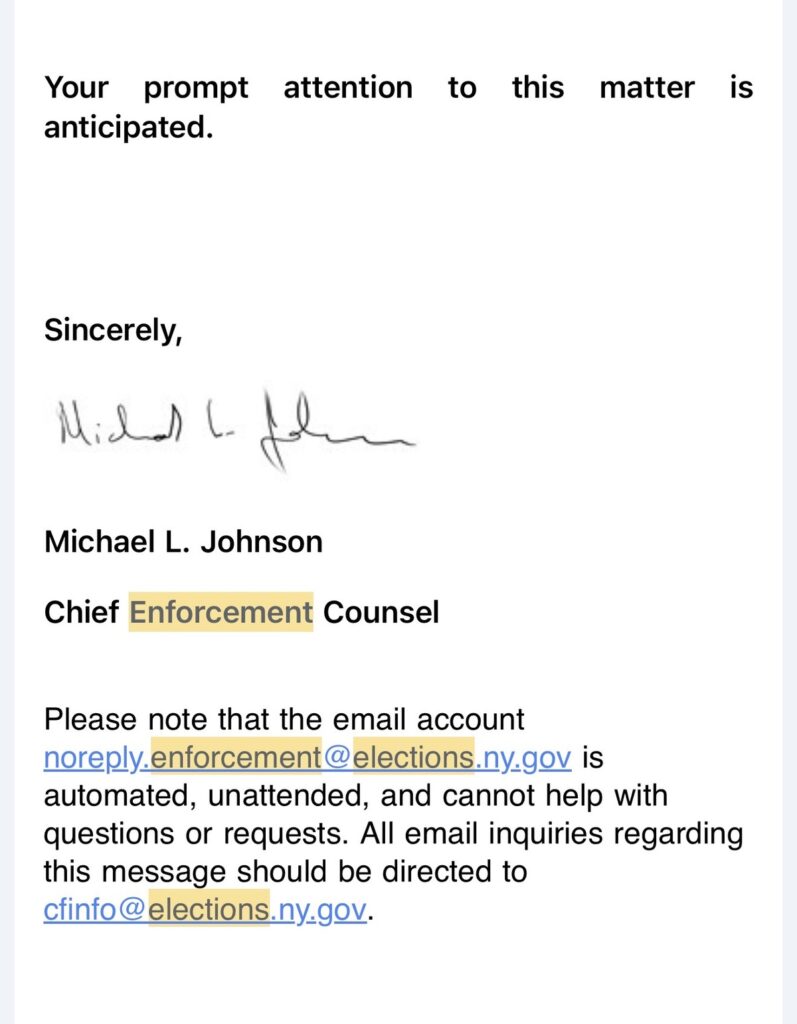
On June 17, while the Board’s records still identified me as treasurer, I received correspondence from its enforcement counsel concerning the campaign’s 11-Day Pre-Primary Report, which was due June 12. The correspondence warned of potential personal penalties. I had already submitted resignation paperwork more than a month earlier. I responded that same day and continued pursuing formal removal. That experience showed me how consequential it can be when an administrative record does not reflect a person’s actual departure. It does not automatically resolve every legal reporting obligation, but it is essential context.
The June report and the October 2 filing discussed in the Ledger article are separate matters. The October filing came due after the Board had approved my resignation. That distinction deserves attention. Anyone examining the campaign’s reporting history should identify the relevant reporting period, who was legally responsible, what records were available, and what occurred after my involvement ended. A former title alone cannot answer those questions.
During my time with the campaign, I was not provided complete access to its banking information and financial records. I worked with the documentation available to me. I am prepared to discuss those limitations and provide supporting correspondence. I understand that accepting a treasurer position carries responsibilities, and I am not claiming that resignation automatically erases obligations incurred during service. But accountability must be established through evidence, not inferred from the convenience of having one familiar name attached to a problem.
And since we’re correcting the record, let me address something else. Kisha Skipper and I were not friends. She may have understood our relationship differently, but I viewed it as professional. I entered that campaign to contribute my skills, not to establish a personal bond. I have since heard suggestions that my concerns stem from the end of a friendship. That explanation does not reflect my experience. My decision to leave was about my professional boundaries and the circumstances I encountered, not wounded feelings.
What troubles me most is the expectation that a woman should continue carrying an organization’s weight after she has decided to put it down. I gave my time without compensation, shared relationships I had spent years developing, and accepted responsibilities beyond my original role. Those were choices I made in good faith. But generosity is not an unlimited contract, and being capable does not mean being permanently available.
I am still building the next chapter of my life in Westchester, expanding relationships and creating opportunities rooted in service. What saddens me is the possibility that people in Yonkers may encounter an incomplete account of my character before getting to know me through my own work. I came here to build something meaningful. I did not come to spend my energy defending myself against conversations I was never invited into.
There are things I witnessed and experienced during my involvement that I have chosen not to discuss publicly. That is a deliberate decision. Serious matters deserve documentation, context, and a fair examination of the facts. I have no interest in making unsupported accusations or reopening every disagreement. But choosing restraint does not mean accepting responsibility that has not been established.
This experience has also made me question how we define leadership. It is easy to praise volunteers when they are answering calls, filling gaps, and making things happen. But what happens when one of them says, “I can no longer do this”? Does the organization acknowledge the contribution and respect the departure, or does the person who left become part of the explanation for everything that follows? Leadership is tested not only by how people are welcomed, but by how their boundaries are respected.
I welcome the opportunity to sit down with the journalist, share my correspondence, and answer questions about my actual involvement. I am prepared to acknowledge mistakes supported by evidence. I am equally prepared to challenge conclusions that overlook relevant dates, records, and responsibilities. I do not need special treatment. I expect accuracy.
I have a family to love, businesses to build, and a community to serve. My work did not begin with this campaign, and my future will not be defined by it. I have already given more than enough of my energy to an experience I chose to leave behind.
So if my name is going to appear in another conversation about this campaign, examine the complete timeline. Ask who had access to the records. Distinguish my period of service from what happened afterward. And give readers the context necessary to understand the difference.
I will take responsibility for what I did. I will not accept blame for what has not been established.
I gave my time. I did not give anyone ownership of my reputation.
My name is not a favor. My integrity is not negotiable. And my departure is not your excuse.

Larnez Kinsey is a writer for Black Westchester Magazine, a public-health advocate, and a seasoned New York State civil servant with two decades of service, including the last ten years as a Security Hospital Treatment Assistant in a maximum-security forensic psychiatric facility. With deep expertise in crisis management inside one of the state’s most demanding environments, she brings unmatched frontline insight into trauma, safety, human behavior, and the systemic gaps that influence community outcomes.
A lifelong supercreative, Larnez is also the Co-Founder and CEO of BlackGate Consulting Group, where she uses her multidisciplinary skill set to drive transformative change for businesses, nonprofits, and community-based organizations. Her work bridges policy, protection, and healing, grounded in a clear understanding of cybernetic ecology, New York’s cultural landscape, and the interplay between mental health and community resilience.
Larnez is additionally a co-host on Black Westchester Magazine’s flagship shows, People Before Politics and The Sunday Rundown, where she elevates community voices and engages in conversations that challenge systems and amplify truth.
She also serves as the Economic Development Chair for the Yonkers NAACP and is a Reiki Master Teacher, integrating holistic wellness with strategic advocacy. Through every role, Larnez remains committed to empowering individuals, strengthening communities, and moving resources to the places where they can create the greatest impact.