


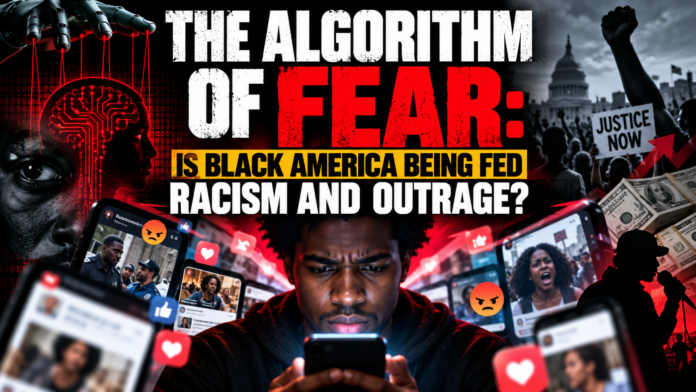

What Social Media Algorithms, Digital Mind Manipulation, and Protest Profiteers May Be Shaping the Black American Experience
Every morning, millions of Black Americans pick up their phones, open social media, and scroll through what they believe is the news. Before breakfast, we may encounter videos of racial confrontations, discrimination, police misconduct, political arguments, violence, and people at their absolute worst. By the time we put our phones down, we have consumed enough negativity to question whether society is making any progress.
But what if the problem is not simply the news itself? What if the problem is the invisible system deciding which news receives our attention?
I recently began examining Black news organizations, including The Root, TheGrio, and Atlanta Black Star, to understand whether Black media was informing our communities or increasingly emphasizing racism, fear, and political outrage. When I visited one publication’s social media page, something caught my attention. Its content was more diverse than the stories I frequently encountered on my timeline.
The articles covered Black achievement, business, education, culture, and community development. That observation raised a serious question: Are Black news organizations producing a broader range of information than social media algorithms deliver to us?
THE NEWS YOU SEE IS NOT NECESSARILY THE NEWS THAT EXISTS
Many people assume that when they open social media, they see the latest updates from the pages and people they follow. That is not necessarily true. Major social media platforms use recommendation systems to determine which stories appear, where they appear, and how often similar content is suggested.
These systems examine our viewing habits, previous interactions, comments, shares, and predicted interests. They are not simply delivering the news. They are organizing an individualized information experience, partly based on what they predict will capture our attention.
A story about a Black entrepreneur opening a manufacturing business and creating 50 jobs may receive less engagement than a video of someone making racist remarks at a restaurant. Both may be legitimate news, but the latter can spark immediate anger, arguments, and repeated sharing.
When engagement helps determine distribution, emotionally charged material can outpace information that may be more useful for our future. The result can be a distorted information environment in which confrontation receives more visibility than opportunity.
IS RACISM BECOMING A TOOL OF DIGITAL MIND MANIPULATION?
Let me be clear. Racism and discrimination exist, and Black Americans have every right to know when their civil rights are violated. Responsible journalism must expose injustice, investigate misconduct, and hold institutions accountable.
However, we must also examine whether repeated exposure to racial hostility influences how Black Americans think, feel, and respond to the world around them. When people encounter the same type of negative information every day, it can affect their perceptions of society, even when individual stories are accurate.
Digital mind manipulation does not necessarily require someone deliberately deciding to make people fearful. It can emerge when recommendation systems repeatedly expose users to emotionally charged content because that content generates attention.
Imagine opening your phone every morning to find another racist confrontation, another disturbing encounter, and another story suggesting that racial hostility is everywhere. Over time, that repeated exposure may encourage people to interpret the world through a narrower emotional lens.
The concern is not that racism should go unreported. The concern is whether an information system can repeatedly draw our attention to racial hostility while providing less exposure to cooperation, achievement, opportunity, and progress.
If we believe we independently choose everything we consume, yet recommendation systems constantly shape what reaches us, we need to examine how much control we actually exercise over our information.
THE BUSINESS OF EMOTIONAL ENGAGEMENT
Social media platforms operate within an attention economy. Advertising revenue, audience retention, and user activity are key components of their business models. Their recommendation systems pursue several objectives, including predicting what people will engage with.
Research on engagement-based ranking has found that emotionally charged content can receive greater visibility under certain conditions. That does not prove that platforms intentionally target Black Americans with fear or racism, but it raises legitimate questions about how engagement incentives shape the information we receive.
Think about how people respond to racial confrontation videos. They comment, argue, share their frustration, and return to see what others are saying. Every interaction provides information that recommendation systems use to determine future content.
Meanwhile, a story about Black homeownership, vocational education, entrepreneurship, or financial literacy may receive less attention. That does not make it less important, but it may make it less competitive in an environment where emotional reactions influence visibility.
We should be asking whether the information that generates the strongest reactions is also the information that helps our communities make better decisions.
THE RISE OF PROTEST PROFITEERS: WHEN RACIAL TRAGEDY BECOMES A BUSINESS MODEL
There is another part of this conversation that Black America needs to confront. I call it the rise of protest profiteers, individuals who present themselves as activists and community defenders, yet whose financial interests may become tied to the continued public attention on racial conflict and tragedy.
Today, activism can generate revenue through monetized social media platforms, donations, organizational fundraising, speaking engagements, sponsorships, and paid appearances. There is nothing inherently wrong with activists earning a living or with organizations raising funds to support legitimate advocacy.
My concern arises when the business of protesting becomes more important than producing solutions. We should examine whether financial incentives might encourage some public figures to prioritize recurring outrage over measurable community progress.
When a racial tragedy occurs, we often see videos circulating, emotional commentary, fundraising appeals, demonstrations, and organizations demanding accountability. Some of this work is necessary and has contributed to meaningful reforms. But what happens after the cameras disappear, the hashtags stop trending, and the donations have been collected?
Where is the financial accountability? What happened to the money raised in the name of victims and their families? What policies changed, what institutions were held accountable, and what improvements occurred in the affected communities?
These questions should not be considered attacks on civil rights activism. They are reasonable expectations of transparency from organizations claiming to represent the interests of Black Americans.
The relationship between algorithms and monetized activism deserves particular attention. An influencer who consistently produces emotionally charged commentary may attract followers, views, donations, and advertising revenue. That creates a potential conflict between financial incentives and the long-term goal of resolving the underlying problems.
Here is the uncomfortable question: What happens when solving the very problems an organization campaigns against could reduce the attention, donations, or revenue supporting its operation?
That possibility does not prove that any particular activist wants injustice to continue. It does mean we should examine organizational finances, stated objectives, documented achievements, and the relationship between advocacy and personal financial benefit.
We cannot measure successful activism only by protest attendance, viral videos, fundraising totals, or social media followers. We must also examine whether the activism produced meaningful policy changes, institutional accountability, legal protections, and improvements in people’s lives.
Black communities deserve leadership that is transparent about its finances and accountable for its results. Our tragedies should never become an unquestioned business model, and those claiming to represent us should welcome reasonable scrutiny.
WHAT HAPPENS TO BLACK ECONOMIC EMPOWERMENT?
While our timelines fill with political arguments and racial confrontations, Black America continues to face serious challenges involving homeownership, employment, education, healthcare, business development, and generational wealth.
How frequently do we encounter stories explaining how Black families can build equity through homeownership? How often do we see successful Black manufacturers, skilled tradespeople, engineers, farmers, technology entrepreneurs, and families creating businesses that can survive for generations?
Those stories exist, and many Black publications report them. The question is whether they receive comparable visibility within our personalized digital experiences.
Imagine if our timelines regularly featured apprenticeship opportunities, financial education, business development programs, career pathways, and examples of successful community institutions. Such information could introduce people to opportunities they might otherwise never discover.
We should not assume these stories are being deliberately suppressed. We should investigate their visibility and determine whether the digital attention economy consistently favors controversy over practical information.
FEAR CAN CHANGE HOW WE SEE OURSELVES
The psychological effects of repeated exposure to negative information deserve serious consideration. Research on media consumption has examined how disturbing content can influence stress, perceptions of danger, and emotional well-being.
Black American history includes slavery, segregation, discrimination, and continuing struggles for equal protection under the law. We must never erase that history or ignore legitimate injustice. But our history also includes entrepreneurship, institution-building, educational achievement, scientific discovery, strong families, and economic accomplishment.
We cannot allow the complete story of Black America to be reduced to what other people have done to us. Our identity must also reflect what we have built, what we are building, and what future generations can accomplish.
When racial confrontation dominates our attention, we risk overlooking the achievements and opportunities that deserve recognition. A complete understanding of our circumstances requires confronting injustice while also recognizing progress and possibility.
WHO IS REALLY CONTROLLING THE NARRATIVE?
For decades, Black Americans have questioned whether mainstream news organizations accurately represent our communities. Digital media introduces another layer of influence because publishers no longer control every aspect of how their reporting reaches audiences.
A Black-focused news organization may produce valuable reporting, but its audience might encounter only a small portion of that content through personalized feeds. Publishers choose what to publish, platforms influence distribution, and audiences contribute through their interactions.
Influencers and advocacy organizations also participate in this information environment. Some provide important education and accountability, while others may rely heavily on emotional commentary and controversy to sustain attention.
That is why we must investigate the entire information system rather than place responsibility on one participant. Publishers, platforms, influencers, advocacy organizations, and consumers all influence what becomes visible.
BLACK AMERICA MUST TAKE CONTROL OF ITS INFORMATION DIET
We have more control over our information habits than we sometimes recognize. We can visit publications directly, subscribe to newsletters, seek multiple perspectives, and intentionally engage with reporting about economic development, education, technology, public policy, and community progress.
We must also recognize how our behavior shapes recommendations. Repeatedly watching, sharing, and arguing about provocative material can signal interest in similar content, even when our original intention was to express disagreement.
Personal responsibility matters because the information we consume shapes our conversations, priorities, and decisions. We should be deliberate about feeding our minds information that expands our understanding rather than letting every controversy dictate our attention.
Publishers should examine their editorial priorities, technology platforms should improve transparency, and advocacy organizations should demonstrate measurable outcomes. Accountability should apply to everyone participating in the information economy.
BLACK AMERICA DESERVES MORE THAN OUTRAGE
I believe Black America needs an honest conversation about the difference between being informed and being emotionally stirred. Knowing that racism exists is important, but understanding economics, education, technology, public policy, and wealth creation is equally essential to our future.
We must recognize injustice without letting every incident define our expectations for life. We must understand the obstacles facing our communities while giving serious attention to the opportunities, achievements, and responsibilities that shape our progress.
This investigation is not intended to excuse discrimination, dismiss legitimate activism, or attack Black journalism. It is about examining whether our digital information systems provide a balanced understanding of society or repeatedly direct attention to subjects most likely to provoke emotional reactions.
It is also about asking difficult questions of those who profit from public attention on racial conflict. Financial transparency, measurable achievements, and genuine commitment to solutions should matter more than popularity, fundraising totals, or the ability to generate outrage.
Black America deserves more than a timeline defined by fear and confrontation. We deserve information that helps us recognize injustice, understand our circumstances, identify opportunities, and build stronger families, businesses, and institutions.
The next time you scroll through social media, ask yourself whether the information you are consuming helps you understand the world or simply fuels another emotional reaction. Then ask whether the people demanding your attention are offering practical solutions or merely asking you to stay outraged.
Because our future cannot be built on an endless cycle of anger. It must be built on knowledge, accountability, responsibility, and the determination to turn information into meaningful progress.