

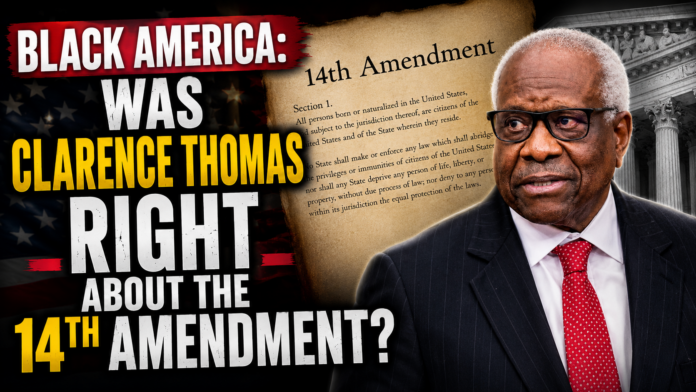




The debate over birthright citizenship has grown so toxic that many refuse to ask the most basic question: What did the Fourteenth Amendment actually mean when the Reconstruction Congress ratified it in 1868?
When Justice Clarence Thomas questioned the prevailing interpretation of the Citizenship Clause, critics immediately denounced him. Some accused him of rewriting history. Others claimed he was undermining the very Amendment that finally secured citizenship for formerly enslaved Black Americans—or even suggested his position implied that Black Americans should lose their citizenship.
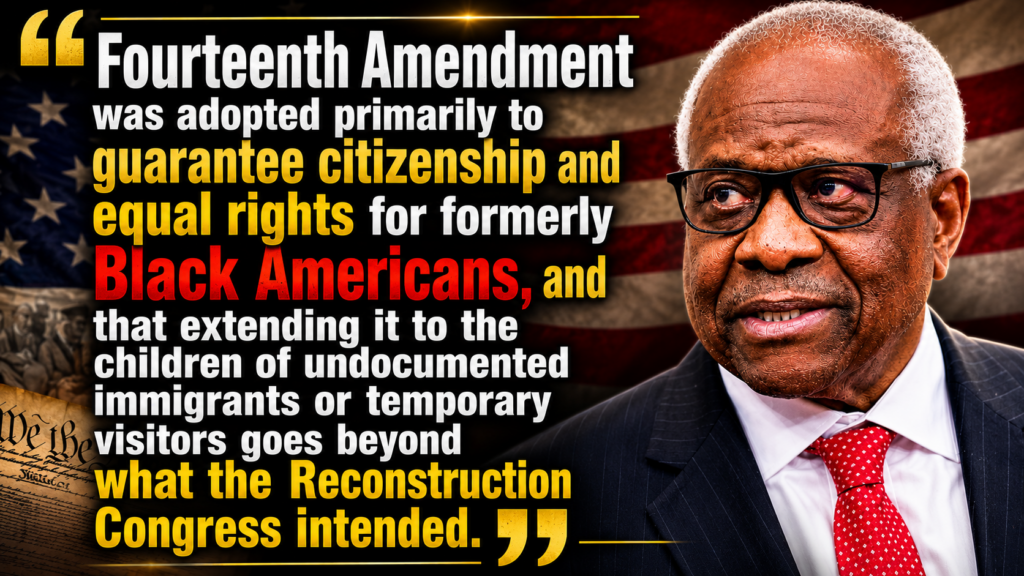
That charge is false. Thomas’s opinion did not question whether Black Americans are citizens. Instead, his analysis focused on the modern interpretation of the Citizenship Clause of the Fourteenth Amendment. The Amendment was adopted in 1868 precisely to overturn the Supreme Court’s Dred Scott decision and to establish citizenship for formerly enslaved people who had been denied it. Thomas’s analysis zeroed in on the historical meaning of the phrase “subject to the jurisdiction thereof.” Whether that interpretation is ultimately correct remains the subject of ongoing legal and historical debate among judges, historians, and constitutional scholars.
No serious person questions whether Black Americans deserve citizenship. The Fourteenth Amendment itself settled that. The real issue is narrower and more precise: Does the modern reading of the Citizenship Clause reflect what the Reconstruction Congress intended when it wrote, “All persons born or naturalized in the United States, and subject to the jurisdiction thereof, are citizens of the United States”?
Those last six words—”subject to the jurisdiction thereof”—are doing the heavy lifting. For decades, courts have treated them as meaning little more than physical presence on U.S. soil, with narrow exceptions like children of diplomats. Justice Thomas argues that, in 1868, the phrase meant something deeper: complete political allegiance and subjection to the full authority of the United States, not mere territorial presence. Dismissing the inquiry itself does not serve truth or history.
Dr. Claude Anderson and Justice Clarence Thomas arrive at similar questions from different directions. Dr. Anderson has argued that the Reconstruction Amendments (13th, 14th, and 15th) were enacted primarily to secure rights, resources, and protections specifically for formerly enslaved Black Americans—native Black people—and no one else. As Dr. Anderson notes, these amendments, along with early civil rights laws, were written strictly and solely for Black ex-slaves to lift the incidents of slavery, guarantee equal treatment with Whites, and provide access to resources for competitiveness (such as the intended 40 acres and a mule). The 13thAmendmentt demanded equal treatment in all respects; the 14th placed an obligation on government to remedy the harms of slavery; and the 15th protected political rights. Early Supreme Court ruling, such as Dred Scott v. Sandford cases (1873,s affirmed that these protections were not intended for other groups. Justice Thomas, meanwhile, argues that the Citizenship Clause should be interpreted according to its original public meaning. While their reasoning differs, both have questioned whether modern interpretations remain faithful to theAdment’sssss original purpose.
The Fourteenth Amendment did not emerge from a vacuum. It was written to guarantee citizenship to those who had been denied it and to protect the rights of the newly freed. That history is not in dispute.
Precisely because of that history, another question deserves equal weight: Has America fully delivered on the constitutional promise made primarily to the people the Fourteenth Amendment was designed to protect?
Nearly 160 years later, Black Americans still face stubborn disparities in wealth, homeownership, family stability, health outcomes, and control over institutions that shape their communities. These facts do not change the legal meaning of the Citizenship Clause, but they demand honest reflection on whether the broader Reconstruction project—economic independence, institutional ownership, and real power—has been realizedAmerica’smerica’smerica’s
America’s demographics have also shifted dramatically since 1868. At the time of thAmendment’s ratificationon and for much of the 20th century, Black Americans were thlargestst minority group and the clear second-largest population overall after White Americans (who comprised roughly 85-90% of the population). Today, following the major immigration reforms of 1965 and expansive birthright citizenship policies, the ranking has changed significantly. As of recent Census data, non-Hispanic Whites remain the largest group (around 57-59%), followed by Hispanics (any race) at roughly 19-20%, with Black Americans (non-Hispanic) at about 12.5-13.5%—now the third-largest group, behind both Whites and Hispanics, and ahead of Asians (around 6-7%). Black Americans have effectively gone from the clear #2 demographic position to near the bottom among major groups.
The modern interpretation of birthright citizenship has extended constitutional protections and access to public benefits—originally crafted in the Reconstruction era to address the unique harms inflicted on formerly enslaved Black Americans—to anchor babies (children born to non-citizen parents) and millions of others without the same historical claim. This has created an expanded inheritance of entitlements, resources, and political leverage that dilutes thAnt’s’o’i’i’snalalalal focus and intensifies competition for jobs, housing, education, and government aid in Black communities.
This is not an argument for or against any particular immigration policy. It is simply historical and policy reality. It raises practical questions about resource competition, political representation, schools, jobs, and whether unlimited birthright citizenship aligns with the original intent or serves the long-term interests of the very communities thAmendmentnt was meant to uplift.
The ramifications for Black America are sobering. Without a deliberate return to the original purpose of the Reconstruction Amendments—coupled with a serious commitment to internal economic self-determination, cooperative ownership, institution-building, and measurable outcomes—Black Americans risk permanent marginalization. Demographic dilution, combined with the sharing of specially intended resources and political power with ever-growing numbers of other groups, will continue to erode relative influence, intensify economic pressures, and leave the promises of true freedom, justice, and equality unfulfilled.
The core constitutional question remains: Should the Fourteentht Amendment interpreted to accord withby its original public meaning in 1868, or by later judicial interpretations and evolving doctrine? That is a debate about fidelity to the text and history—not a proxy for hostility toward immigrants or indifference to Black Americans.
Too often, our public discourse replaces careful analysis with accusations. Question the modern interpretation of birthright citizensh,ip anr’r’rere called anti-immigrant. Defend the prevailing vi,ew anr’r’rere accused of ignoring thAmendment’s’s purpose. Neither charge advances understanding.
The Constitution deserves better. Justice Thomas may be right. He may be wrong. But asking whether courts have stayed true to the original meaning of the Fourteenth Amendment is not an assault on thAmendmentnt—it is the kind of rigorous inquiry a constitutional republic demands from judges, scholars, and citizens alike.
The Fourteenth Amendment is one of the most transformative provisions in our constitutional order. It secured citizenship after centuries of denial and helped extend equal protection under the law. Its text should be read with care. Its history should be studied with precision. Its original purpose—protecting and empowering Black Americans—must never be forgotten.
Whethetoday’s’s interpretation of the Citizenship Clause faithfully carries out that purpose is a question worthy of serious, evidence-based debate. Not slogans. Not personal attacks. Not political theater.
A constitutional republic grows stronger when its people are willing to confront difficult questions honestly. The Fourteenth Amendment deserves nothing less.