



Mayor Mamdani Announces $20M Investment in Congestion Pricing Mitigation Funds to Address Childhood Asthma in the Bronx
On any given night in the Bronx, there’s a mother sitting upright in bed listening to her child breathe.
Not sleeping. Listening.
Listening for that whistle in the chest. That sudden cough. That terrifying silence between breaths that stretches just a little too long. There are parents in Mott Haven and Hunts Point who know the location of the nearest emergency room better than they know the location of a park with clean air. Kids who keep inhalers in backpacks the same way other children carry pencils.
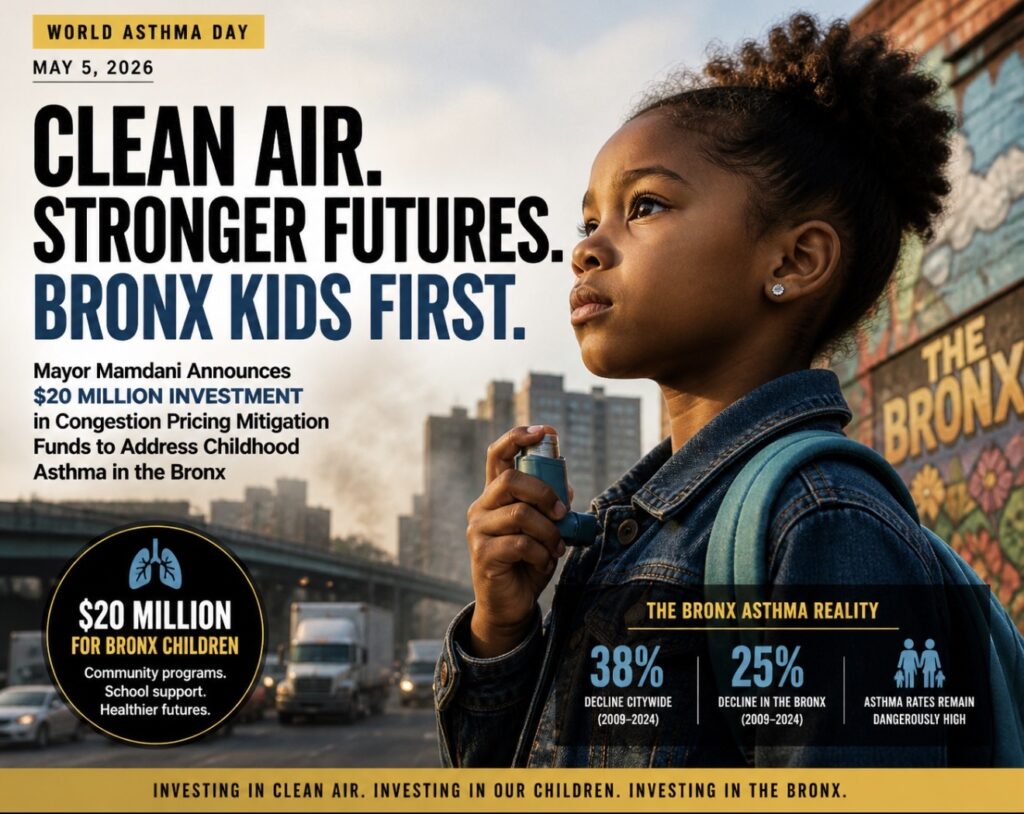
And on May 5, 2026, World Asthma Day, New York City finally announced an investment that acknowledges what Bronx families have been surviving for decades.
Mayor Zohran Kwame Mamdani and the New York City Department of Health announced a $20 million initiative to combat childhood asthma in the Bronx using funds from the city’s congestion pricing mitigation program. The funding comes through a partnership between the Metropolitan Transportation Authority, the New York City Department of Health and Mental Hygiene, and the New York City Department of Transportation.
Now, before somebody from downtown Manhattan starts clutching pearls about tolls again, let’s discuss what the Bronx has been paying all along.
The Bronx consistently records some of the highest childhood asthma hospitalization rates in New York State. In some neighborhoods, children are hospitalized for asthma at rates several times higher than the national average. According to city data, while asthma-related emergency room visits for children ages 5 to 17 declined by 38% citywide between 2009 and 2024, the Bronx only saw a 25% decline, and rates in parts of the borough remain dangerously high.
Translation? Everybody else improved faster, while Bronx kids are still struggling to breathe.
And honestly, how shocking is that when you realize the Bronx has spent generations functioning like New York City’s unofficial pollution storage unit?
Highways slicing through Black and Latino neighborhoods. Diesel trucks rumble through Hunts Point at all hours. Warehouses, refrigeration units, industrial traffic, waste facilities, all concentrated where people with the least political power are expected to absorb the consequences quietly.
This wasn’t accidental urban planning. This was policy.
So yes, it matters that this money is finally being directed toward the communities carrying the heaviest burden.
The city says $8.9 million will support the Bronx Asthma Program, expanding community-based asthma services, and $11.1 million will expand the Asthma Case Management Program in Bronx schools.
Fifteen additional schools will join the initiative, providing students with asthma access to in-school medication administration and self-management education for families. The city will also launch a new electronic system for asthma medication forms before the 2026–27 school year because, apparently, we’ve all collectively agreed children deserve better than folded paper forms stuffed into backpacks next to juice boxes and unfinished homework.
And let’s be clear: this investment is not simply about healthcare.
It’s about educational equity.
Children with uncontrolled asthma miss school more often. Parents miss work more often. Families spend more money on medications, emergency room visits, transportation, and childcare disruptions. Asthma doesn’t just attack lungs; it destabilizes entire households.
“For too many children in the Bronx, asthma means missed school days, emergency room visits, and disrupted learning. This investment will help change that,” said Schools Chancellor Kamar Samuels. “We are committed to ensuring that every student, regardless of their zip code, has access to the health supports they need right in their school building. Thank you to the New York City Health Department and our community partners for recognizing the importance of investing in children’s health.”
That’s why this announcement matters beyond the press conference microphones and government podiums.
Deputy Mayor Dr. Helen Arteaga acknowledged that “historical inequities and injustices” helped create these disparities. Good. Because sometimes New York talks about the Bronx like poor health outcomes materialized out of thin air instead of decades of environmental racism and disinvestment.
“The data shows clearly that childhood asthma disproportionately impacts the Bronx, where rates in several neighborhoods remain alarmingly high—a reminder that historical inequities and injustices in healthcare, environmental, and urban planning policies continue to affect the well-being of far too many New Yorkers,” said Deputy Mayor for Health and Human Services Dr. Helen Arteaga. “Today, we are announcing a $20 million investment, which comes from the MTA’s congestion pricing mitigation program, that will expand asthma services offering support, in-school medication administration, and education to Bronx families. By directing resources to the most at-risk communities, we are taking steps to improve children’s health, help parents spend less on asthma treatment, and address harmful policies that have impacted our fellow New Yorkers for too long.”
And for years, people outside the borough treated congestion pricing like the greatest injustice humanity had ever faced, while Bronx families were literally managing respiratory illness connected to the traffic everyone else wanted convenient access to.
That irony deserves its own billboard.
Mayor Mamdani said every New Yorker deserves cleaner air, and honestly, that sounds obvious until you realize how unevenly this city has distributed the basic quality-of-life resources. Some neighborhoods get waterfront rezoning, boutique fitness studios, and bike lanes lined with baby strollers. Other neighborhoods get asthma clusters and eighteen-wheelers.
“New Yorkers are already benefitting from congestion pricing, and now we’re taking it a step further by investing those funds to improve asthma outcomes for children in the Bronx,” said Mayor Mamdani. “Every New Yorker deserves to breathe cleaner air. This initiative puts public health front and center as we build a cleaner, healthier city.”
So when MTA Chair Janno Lieber calls congestion pricing a “win-win,” Bronx residents are justified in asking: Winning for whom? Because historically, they’ve been the ones paying the hidden costs.
“Reducing air pollution has always been one of the core goals of New York’s Congestion Pricing program,” said MTA Chair and CEO Janno Lieber. “The data shows it’s already succeeding, and now we’re taking the next step by using revenues to fund additional improvements for Bronx residents.”
Now, to be fair, this investment is significant. It’s the third major announcement under the congestion pricing mitigation initiative, following: $15 million to replace polluting refrigeration units in Hunts Point, and $20 million for NYC DOT’s Clean Trucks Program, promoting cleaner fuel and electric vehicles.
Those are meaningful steps. But nobody should confuse progress with completion.
A $20 million investment cannot undo generations of infrastructure decisions that treated Black and Brown lungs as expendable. It cannot erase decades of environmental neglect overnight. But it does represent something many Bronx families have rarely experienced from City Hall: targeted acknowledgment.
Not pity.
Not performative sympathy.
Acknowledgment.
And on World Asthma Day 2026, that acknowledgment finally arrived attached to actual dollars.
Because the truth is simple: children in the Bronx should not have to fight harder to breathe simply because of their zip code.
And if congestion pricing money can help change that? Then maybe the real traffic problem was never just cars.
Maybe it was whose suffering New York decided was acceptable.