






There’s a particular kind of silence Black and minority women in New York know too well.
Not the city silence, we don’t really have that.
Not with sirens, subways, and somebody always yelling down the block.
I’m talking about the silence in exam rooms.
In delivery rooms.
In those moments where something feels off, but you’re calculating how to say it so somebody actually listens.
That pause?
That second-guessing?
That quiet fear of being dismissed?
That’s not in your head.
That’s history.
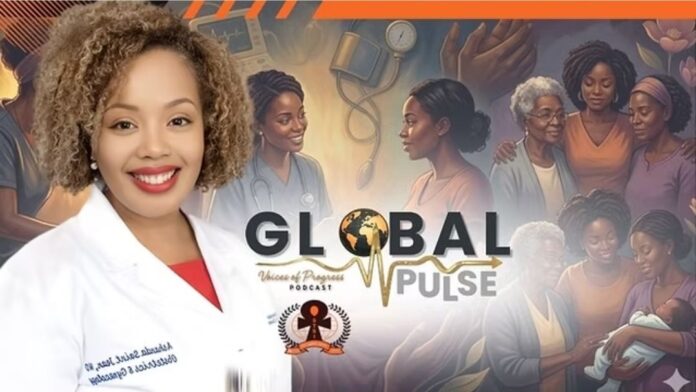
And that’s exactly why Global Pulse: Voices of Progress, Episode 1, “Reclaiming Joy”, didn’t just feel like a podcast.
It felt like somebody finally turned the volume up on what Black and minority women have been saying all along.
THIS WASN’T JUST A WATCH PARTY, THIS WAS WITNESSING
April 13th, 2026. 6:30 PM. Zoom.
But this wasn’t one of those “log in, cameras off, multitask” situations.
You could feel it, people were present.
Because what was happening inside that space wasn’t performance.
It was recognition.
Stories weren’t rushed.
Truth wasn’t softened.
And for once, Black and minority women weren’t being translated for comfort, they were being heard as they are.
That matters.
Especially in a state like New York, where access is high, but equity still isn’t guaranteed.
“RECLAIMING JOY” HIT DIFFERENT HERE
Let’s talk about that theme, Reclaiming Joy.
Because in New York, joy for Black and minority women, especially in healthcare spaces, often comes with conditions.
You walk into an appointment already prepared:
Prepared to advocate.
Prepared to repeat yourself.
Prepared to stay calm enough to be taken seriously.
That’s not care.
That’s strategy for survival.
So when this episode centered joy, it didn’t feel soft.
It felt like a correction.
A reminder that joy should not be something you earn after being ignored.
It should be part of the experience from the beginning. And the conversation didn’t dance around it.
Black women and women of color, have been central to advancing gynecology.
Our bodies have been studied.
Our experiences have informed research.
Our pain has shaped the field.
And still, we are too often the last to benefit from that progress.
Still more likely to be dismissed.
Still more likely to face preventable complications.
That contradiction lives right here in New York.
From the Bronx to Westchester, the disparities are real and they are not accidental.
DR. ASHANDA SAINT JEAN BROUGHT THE BRIDGE
Featuring Dr. Ashanda Saint Jean, M.D., F.A.C.O.G., the episode grounded the conversation in something we don’t get enough of, alignment.
Not just medical expertise.
Understanding.
You could hear it in how she spoke, clear, informed, but connected to the reality Black and minority women face every day.
Because representation alone isn’t enough.
It’s about how you show up when you’re in the room.
And this felt like a bridge between:
- The medical system
- And the lived experiences of the women navigating it
That bridge? That’s where change starts.
THIS ISN’T JUST GLOBAL, IT’S LOCAL
Sister to Sister International (STSI), led by Dr. Cheryl Brannan, didn’t just create a podcast.
They created a pathway.
From the Zoom room to real-life spaces across New York, like gatherings in Westchester and wellness-centered events in White Plains, this work is rooted in community.
Because transformation doesn’t just happen online.It happens when people show up in real life.
When conversations turn into relationships.
When awareness turns into action.We are past the point of just being informed.
New York has the resources.
The hospitals.
The institutions.
What’s needed now is accountability and participation.
If this conversation moved you, even a little, don’t stop at listening.
Step into the work.
Be part of Sister to Sister International’s
Day of Action, Education & Recognition 2026:
https://www.s2si.org/event-details/day-of-action-education-recognition-2026
Show up.
Learn something.
Connect with people doing the work on the ground.
Because change doesn’t happen from observation.
It happens from involvement.
Global Pulse: Voices of Progress didn’t just start a conversation.
It clarified something many Black and minority women already knew:
We have always been at the center of progress,
even when we were not centered in care.
Now that the voices are amplified…
now that the truth is being spoken clearly…
The responsibility shifts.
Not just to listen.
But to act.
Because You Read this.
Now You Have to move