




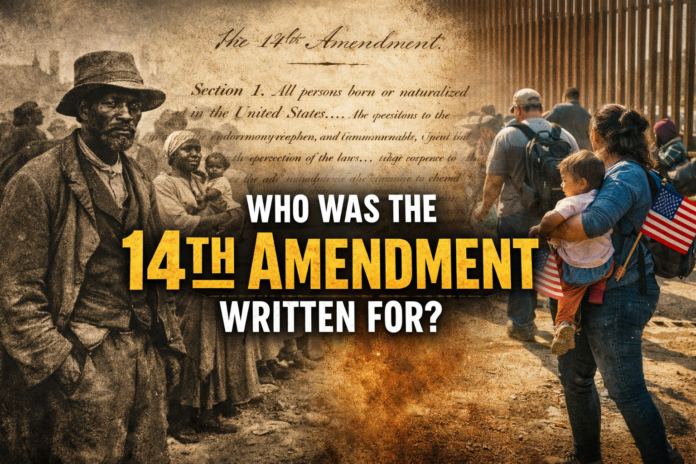




The 14th Amendment was born in the ashes of slavery. It has since been borrowed by nearly everyone except the people it was meant to protect.
When the Supreme Court recently heard arguments about birthright citizenship, the justices spent considerable time debating domicile, allegiance, and the finer points of 19th-century common law. What received almost no serious attention was the blunt historical fact sitting at the center of the entire controversy: the 14th Amendment was written for Black Americans. Specifically, it was written for the descendants of enslaved people who had been declared non-persons by the very government now debating the reach of its protections.
This is not a matter of interpretation. It is a matter of record. The Amendment was a direct response to Dred Scott v. Sandford (1857), in which the Supreme Court ruled that Black people, free or enslaved, could never be citizens of the United States. The framers of the 14th Amendment said so explicitly on the floor of Congress. Senator Trumbull, the principal author of the Civil Rights Act of 1866, the Amendment’s legislative predecessor made clear the singular purpose: to establish the citizenship of freed slaves and close the door on any future government that might try to strip it away.
That door has not stayed closed. It has simply been widened to let in almost everyone else.
A provision designed to put Black citizenship beyond the reach of hostile governments has become the legal foundation for a debate that rarely mentions Black Americans at all.
Within decades of the Amendment’s ratification, corporations were invoking its Equal Protection Clause more successfully than the Black Americans it was written to protect. By the late 19th century, while Black citizens were being systematically disenfranchised, lynched, and driven from economic life with legal impunity, the Amendment stood largely silent for them — and loudly active for business interests. This is not a coincidence. It is a pattern.
The pattern has repeated itself with disciplined consistency. The Civil Rights Act of 1964, driven into existence by the blood and sacrifice of the Black freedom movement, was extended to cover sex discrimination — an addition inserted by opponents who believed it would sink the bill. The protections that Black Americans marched, bled, and died to secure became an umbrella under which many others sheltered, sometimes leaving the original occupants standing in the rain. Affirmative action programs, conceived to address the specific, documented, centuries-long economic suppression of Black Americans, became general diversity initiatives. Fair housing laws remain on the books while the Black homeownership gap persists at levels that would have been recognizable to someone living in 1968.
Now the 14th Amendment, written in the wreckage of the Confederacy, ratified to make citizens of people who had been legally classified as property, is the centerpiece of a debate about whether the children of undocumented immigrants should receive birthright citizenship. Both sides invoke the Amendment with confidence. Neither side spends much time asking what the men who wrote it would have thought about that application.
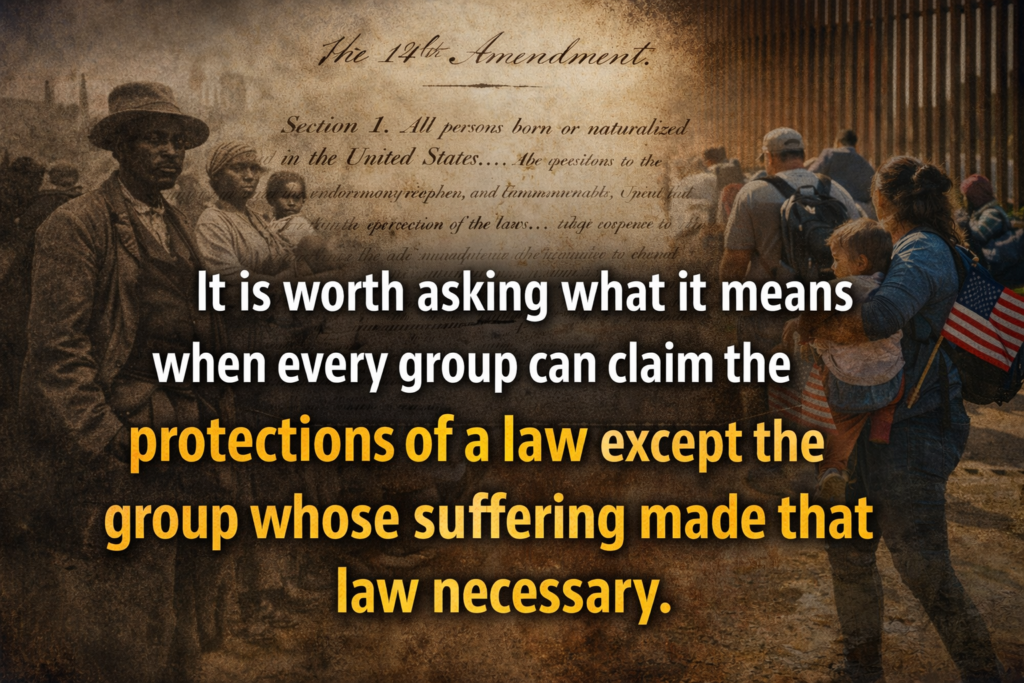
It is worth asking what it means when every group can claim the protections of a law except the group whose suffering made that law necessary.
To be clear about what this argument is not saying: extending constitutional protections broadly is not inherently wrong. A law that protects human dignity should protect it consistently. But there is a difference between principled extension and systematic deflection — and the history of legislation aimed at Black Americans has been characterized far more by the latter than the former.
The question that no one in that Supreme Court chamber asked is the one most worth asking: if the 14th Amendment was specifically designed to prevent any government from determining the citizenship of Black Americans, why have Black Americans had to fight — repeatedly, expensively, and often unsuccessfully — to claim its protections in the 157 years since its ratification? The Amendment did not fail because its text was weak. It failed because the institutions charged with enforcing it found other priorities.
There is a distinction worth making that almost no one in these debates will make. An immigrant who builds wealth in America retains options that a descendant of American slavery does not. Capital is portable. A family that accumulates resources here can return to a home country where that capital commands considerably more. In this framework, citizenship functions as an instrument — a means of access to the world’s largest economy, with the exit door left open.
The numbers make this concrete. The United States is the world’s largest source of outbound remittances. According to World Bank data, Americans sent approximately $79 billion abroad in 2022 alone — capital earned inside the American economy, transferred to strengthen households and communities in other countries. Mexico received over $62 billion from the United States in 2024. India received an estimated $129 billion globally, with the United States as its largest single source. In several countries, remittance inflows from the United States exceed 20 percent of national GDP. The wealth-building capacity of American citizenship is being actively converted into prosperity in dozens of other nations — by people who retain the legal and cultural infrastructure to receive it.

Birth tourism is the logical extreme of this calculation — and it surfaced directly during the Supreme Court arguments. Chief Justice Roberts asked the government’s attorney whether he had data on how common the practice was. The response cited media reports estimating 1.5 million birth tourists from China alone, and noted that by 2015 there were reportedly 500 companies operating inside China whose sole business was bringing pregnant women to the United States to give birth and return home — children born as American citizens, raised entirely abroad, with no meaningful connection to the country whose founding tragedy made their citizenship possible. Roberts then asked the question that should have stopped the entire room:
CHIEF JUSTICE JOHN ROBERTS — ORAL ARGUMENT, 2025
“Having said all that, you do agree that has no impact on the legal analysis before us?”
When Sauer suggested the world had changed since the 19th century, Roberts replied: “It’s a new world. It is the same Constitution.” He is correct, constitutionally. But that answer also reveals what the legal framework refuses to reckon with, that the same Constitution written to remedy one specific, historic wrong is now being applied in ways its framers never imagined, serving interests they never considered, while the people they were actually thinking about remain the least served by it.
Descendants of enslaved people have no equivalent calculation available to them. The deliberate and systematic destruction of African language, tribal identity, and geographic origin during centuries of slavery did not leave a homeland to return to. There is no remittance economy for people whose connection to any other country was severed before their ancestors could document it. There is no village back home where accumulated American dollars stretch further. There is no family network abroad waiting to receive a wire transfer that will build a house or fund a school. The exit door that remains open for so many others was bricked shut centuries ago, not by choice, but by the same institution whose aftermath the 14th Amendment was written to address.
This is not a complaint. It is a structural fact, one that makes the question of who benefits from American citizenship protections considerably more specific than the current debate pretends. When the descendants of slaves invoke the 14th Amendment, they are invoking the only country they have ever had, the only country their ancestors were permitted to build, and the only country that has any legal or moral obligation to them rooted in what was actually done to them on its soil. That is a different relationship to citizenship than the one being debated in the current case. It deserves to be named as such.
The current birthright citizenship debate is a legitimate constitutional question. But it is being conducted as though the 14th Amendment arrived from nowhere a general philosophical statement about human belonging rather than a precise legal remedy for a specific historical atrocity. When we forget who a law was written for, we should not be surprised when they are the last to benefit from it.
History does not grade on intention. It grades on outcome. The outcome here has been consistent enough, for long enough, that calling it accidental requires a determined refusal to look at the evidence.


Holy fucking racist. This was made for us so punish everyone else. Your grandma would whip your ass for this bullshit.