





There was a time when professional sports claimed to be neutral ground. A place where performance determined value, and what you did on the court mattered more than what you believed off of it.
That standard no longer applies.
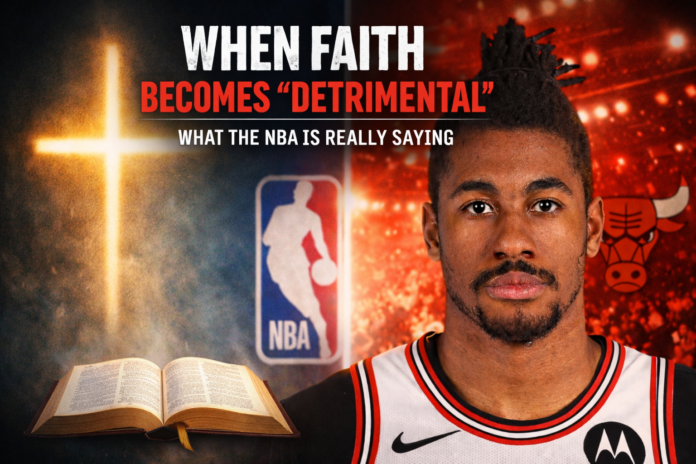
The situation involving Jaden Ivey and the Chicago Bulls makes that clear.
In March 2026, Ivey was released for what the organization described as “conduct detrimental to the team.” The reason was not an on-court incident. It was not a violation of league rules. It was not a disruption inside the locker room.
It was a speech.
Specifically, his speech was rooted in his religious beliefs.
That distinction matters because the phrase “conduct detrimental” has historically meant something measurable. It referred to behavior that directly impacted team operations. Something that could be observed, documented, and evaluated within the organization’s structure.
What we are now seeing is an expansion of that definition.
“Detrimental” is no longer limited to action. It now includes expression.
And once expression becomes subject to discipline, the standard shifts from performance to alignment.
This is where the contradiction becomes unavoidable.
Professional leagues, including the NBA, actively promote forms of expression. Pride Nights are not passive acknowledgments. They are organized, visible initiatives that communicate a clear message about identity and values. Courts change. Jerseys change. Messaging is consistent across the league.
To be precise, players are not formally required to personally agree. That distinction should be acknowledged.
But institutions do not need to force speech to shape behavior. They establish what is affirmed and what is not. Over time, that becomes clear to everyone involved.
Some messages are reinforced.
Others carry consequences.
That is not neutrality. That is selection.
And once selection becomes the standard, the question is no longer whether expression belongs in sports. It is whose expression belongs.
The league would argue that this approach is about inclusion. That maintaining an environment where all players and fans feel respected requires setting boundaries around certain forms of speech. That argument is not irrational. It reflects a legitimate concern about cohesion and perception.
But it does not resolve the central issue.
Because inclusion, once defined, is no longer neutral. It becomes a framework. And frameworks draw lines.
Those lines determine which beliefs are acceptable and which are not.
And when those lines consistently favor one set of expressions while penalizing another, the outcome is not balanced inclusion.
It is selective tolerance.
And, in practice, selective tolerance functions as exclusion for those on the outside of that framework.
This is not an abstract concern. It is reflected in outcomes.
Take Miles Bridges as a point of contrast.
In 2022, Bridges was involved in a domestic violence case that resulted in felony charges. He later entered a plea, received probation, and was suspended by the NBA. He missed significant time, faced reputational damage, and ultimately returned to the league.
That case involved documented physical harm.
And yet, it resulted in discipline followed by reinstatement.
The Ivey situation involves speech.
And the outcome was removal.
These are not identical cases, and they should not be treated as such. One involves criminal conduct. The other involves expression.
But that distinction is precisely why the comparison matters.
Because it raises a question about consistency.
If physical conduct can be punished and rehabilitated, but speech can result in exclusion, then the hierarchy of what is considered “detrimental” has changed.
The issue is no longer just behavior.
It is alignment with institutional priorities.
That shift has consequences beyond one player or one team.
It signals to every athlete that there are boundaries that exist not in written policy, but in outcome. Boundaries that define what can be expressed without risk and what cannot.
Over time, those boundaries become understood without needing to be stated.
You are free to believe.
But not every belief belongs in the space you represent.
That is the message.
And whether that message is intentional or not is ultimately irrelevant.
Because in institutional systems, outcomes—not intentions—are what define reality.