


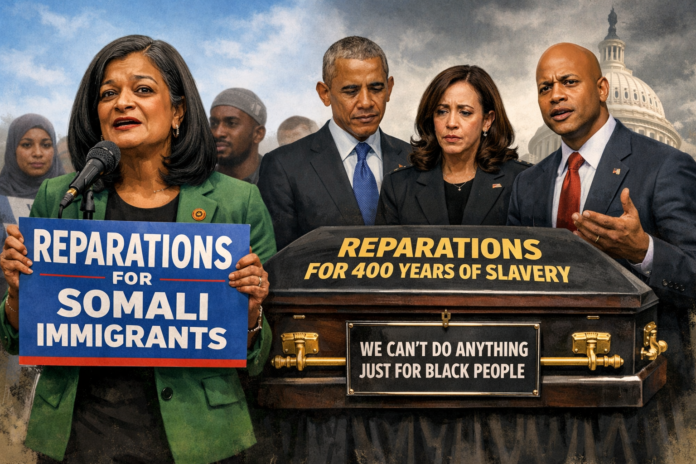




When Pramila Jayapal argued that immigrants harmed by aggressive immigration enforcement policies, including individuals within Somali communities, should receive compensation, she was making a case grounded in government accountability. The principle was clear. When the government causes harm, there should be a remedy.
At the same time, she has not been a leading sponsor of H.R. 40, a bill that does not even authorize payments but proposes a commission to study the long-term effects of slavery and discrimination on Black Americans.
Taken together, these positions raise a broader question about systemic barriers. Why does compensation seem more actionable in some policy contexts, while in others, especially those involving Black Americans’ history, it remains in prolonged study and debate?
A Policy That Never Arrives
H.R. 40 has been introduced repeatedly since the late 1980s. Its purpose is limited and procedural. It would establish a commission to examine the enduring effects of slavery, segregation, and systemic discrimination, and to propose potential remedies.
Despite decades of introduction, shifting political majorities, and increased national attention to racial justice, the bill has never become law.
From an outcomes-based perspective, that raises a fundamental question.
How does a policy with decades of advocacy and consistent electoral support fail to pass even its earliest stage?
Political Support vs. Political Outcomes
For decades, Black Americans have remained one of the most politically loyal voting blocs in the United States, with roughly 85 to 90 percent supporting Democratic candidates in national elections. That level of consistency suggests not just preference, but expectation that political support will translate into policy outcomes.
Yet voting patterns alone do not determine legislative success. Laws require majorities in both chambers of Congress, alignment within parties, and often a threshold high enough to overcome procedural barriers such as the Senate filibuster.
The filibuster is a major obstacle, requiring 60 votes in the Senate to pass most legislation. This procedural barrier has repeatedly blocked bills with majority support from becoming law, creating a structural ceiling for legislation like H.R. 40, regardless of House backing.
This shifts the issue from one of stated support to one of strategy.
Signals from Leadership
Leadership priorities matter, particularly when they involve decisions about which issues receive sustained political capital.
Barack Obama governed with Democratic majorities early in his presidency and successfully advanced major legislative priorities, particularly in healthcare and economic recovery.
Reparations were not among them, nor were executive tools used to elevate the issue.
Similarly, Kamala Harris has supported studying reparations but has stopped short of advocating for a clearly defined, race-specific policy framework. This reflects a broader pattern in national leadership, where acknowledgment does not consistently translate into legislative urgency.
At the state level, similar patterns can be observed. Wes Moore vetoed a Maryland reparations bill that would have established a commission to study the issue and issue a formal apology. The bill did not mandate payments, but focused on examination and acknowledgment. The veto, even in that limited form, highlights a recurring frustration that reparations efforts often stall early, emphasizing the need for strategic persistence.
The Jayapal example is not dispositive on its own. Members of Congress vary widely in influence and focus. However, it illustrates a recurring perception. Compensation tied to more immediate policy harms can be framed as urgent and actionable. Compensation tied to long-standing historical injustice remains more often procedural and deferred.
The Broader Policy Pattern
One explanation often offered is that broad, universal policies such as healthcare expansion, economic stimulus, and social programs benefit Black Americans indirectly and therefore serve as a substitute for targeted policies like reparations.
There is evidence that these policies have produced measurable benefits. Following the Affordable Care Act, uninsured rates among Black Americans declined significantly, and poverty rates fell during periods of economic growth.
However, long-term structural indicators suggest more limited progress. The median wealth of Black households remains a fraction of that of white households, often estimated at roughly one-tenth. Black homeownership rates remain significantly lower and have not fully recovered from the 2008 financial crisis. Black Americans also experience disproportionately high rates of homicide victimization.
These outcomes suggest that while universal policies can improve baseline conditions, they have not substantially closed structural gaps rooted in historical inequality.
A Question of Consistency
This leads to a central analytical question.
The U.S. government has, at times, enacted policies that directly addressed harms experienced by specific groups. The Civil Liberties Act of 1988 provided financial compensation and a formal apology to Japanese Americans interned during World War II. These targeted remedies demonstrate that addressing specific harms with concrete actions is possible, encouraging belief in similar approaches for Black Americans.
These examples demonstrate that targeted remedies are not without precedent.
Given that, the question becomes clear.
Why has a similarly targeted approach not advanced in the case of Black Americans, despite the scale and documentation of the harm?
Patience and Political Reality
For many Black Americans, the repeated introduction of H.R. 40 without passage reinforces a familiar message. Wait.
Wait for the right political moment. Wait for a broader consensus. Wait for conditions to align.
From an outcome’s perspective, waiting without measurable progress raises concerns about whether the issue is being deferred rather than actively pursued.
Reevaluating Strategy
An outcomes-focused approach requires moving beyond alignment and toward strategy.
If the filibuster is a primary barrier, one path is to pursue reform or its elimination. Another is to build a coalition large enough to overcome it. If neither is being actively pursued, then the likelihood of legislative success remains low regardless of rhetorical support.
Accountability can also take more concrete forms. Voters can evaluate candidates based not only on stated support, but on sponsorship, legislative prioritization, and efforts to advance policy through committees or broader bills. Advocacy can shift toward measurable commitments, including timelines and coalition-building strategies.
There is also the question of political leverage. Consistent voting patterns provide influence within a party, but they may also reduce pressure to deliver specific outcomes. At the same time, shifting or withholding that support carries risks, including reduced influence and unintended policy consequences.
A results-oriented analysis must weigh both sides of that equation.
Conclusion: From Support to Strategy
The debate over reparations is not only about historical acknowledgment. It is about whether political support can be translated into policy under real institutional constraints.
The debate over reparations is no longer about raising awareness; it is about translating political support into concrete policy action within institutional limits. The key challenge now is execution, not acknowledgment.
That requires clearer answers to practical questions. What legislative path exists, given the constraints of the Senate? Is filibuster reform part of that path? What actions are elected officials taking beyond statements of support? And what forms of political pressure are most likely to produce measurable results?
Until those questions are addressed with concrete strategies, the gap between support and outcomes is likely to remain.