





There is a tendency in American politics to confuse visibility with value.
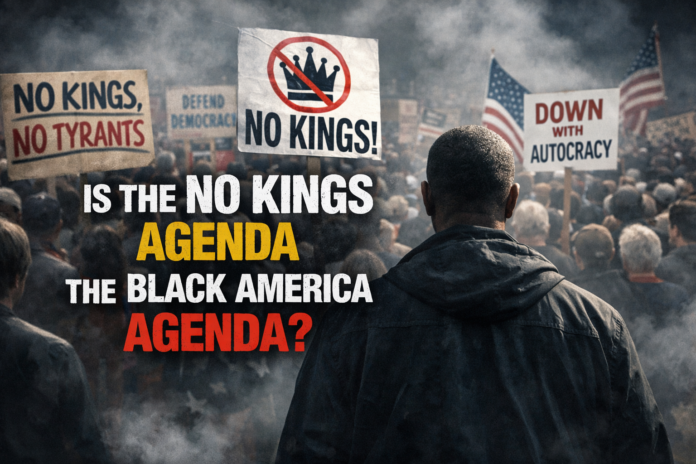
The recent “No Kings” rallies were large, loud, and widely covered. The message was simple: opposition to concentrated power. The imagery was familiar—signs, slogans, crowds invoking the language of democracy. But beneath the noise was a quieter, more revealing fact: Black America was largely absent.
That absence is not accidental. It is not apathy. It is not ignorance. It is a reflection of priorities shaped by experience.
For decades, Black Americans have been among the most politically engaged people in this country, particularly when the issue at hand produces tangible outcomes. Civil rights were not a slogan; they were a demand tied to law. Voting rights were not symbolic; they were structural. Those movements produced change because they were rooted in specific, measurable objectives.
By contrast, “No Kings” is not a policy. It is a posture.
And posture, no matter how morally satisfying, does not lower crime rates, increase homeownership, improve failing schools, or expand access to capital. These are the issues that shape daily life in Black communities. These are the outcomes that determine whether political participation has value beyond expression.
When a movement fails to address those realities directly, it should not be surprising that the people most affected by those realities choose not to center themselves in it.
There is also a deeper pattern at work, one that history has repeated with remarkable consistency. Broad political movements often invite Black participation in the name of moral urgency. They benefit from the credibility, the imagery, and the cultural weight that Black involvement brings. But when policy is written and resources are allocated, the results rarely align with the level of participation.
In other words, the return does not match the investment.
Now consider an even more revealing question: What exactly is the “No Kings” agenda?
There isn’t one.
Not in any structured, policy-driven sense. There is no legislative framework. No economic plan. No defined set of demands that can be negotiated, funded, or implemented. What exists instead is a collection of sentiments—opposition to executive overreach, concern about federal authority, and broad calls to “protect democracy.”
But sentiment is not structure. And in politics, what is not defined cannot be delivered.
Movements that produce results do not rely on slogans. They rely on specifics. They name the problem, define the solution, and pursue measurable outcomes. Without that, a movement may generate attention, but it cannot generate change.
This is where the absence of Black America becomes even more telling.
Because increasingly, there is a recognition that participation without a clear agenda is not power—it is performance.
If there is no policy tied to the protest, there is nothing to negotiate. If there is nothing to negotiate, there is nothing to gain. And if there is nothing to gain, then the most rational decision is to withhold participation until the terms become clear.
That is not disengagement. That is discernment.
There is a difference between opposing something and building something. One is reactive. The other is strategic.
If Black political energy is to produce different outcomes in the future, it will not come from attaching itself to broad, undefined movements. It will come from defining clear priorities, demanding measurable results, and aligning participation with outcomes.
Until then, rallies will continue to make noise.
But noise, by itself, has never built power.