





There was a time when sports organizations claimed to be neutral spaces, places where performance, discipline, and results mattered more than personal ideology. That claim no longer holds.
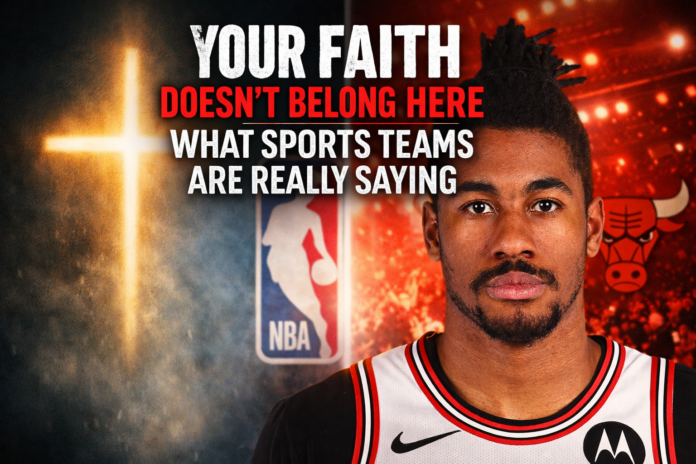
The recent situation involving Jaden Ivey and the Chicago Bulls makes that shift visible.
In March 2026, Ivey was waived by the Bulls for what the team described as “conduct detrimental to the organization.” The move followed a series of livestreams in which he spoke openly about his religious beliefs, including his interpretation of scripture.
But Ivey did not stay silent.
Responding on social media, he questioned the basis of the decision itself. If he had not been actively with the team and had been away in recovery, how could his conduct be considered detrimental to team operations?
That question matters more than the answer the team did not give. Because traditionally, conduct detrimental referred to actions that disrupted team function, violated league rules, or affected performance. However, as social and cultural shifts occur, this standard now increasingly considers public statements and beliefs, reflecting a broader societal influence on what is deemed ‘detrimental.’
This situation suggests a shift.
The standard is no longer limited to what happens inside the locker room. It now extends to what a player says publicly, even outside the immediate scope of team activity.
That expansion matters.
It means the definition of “detrimental” is no longer tied strictly to performance or participation. It is tied to perception.
And once perception becomes the standard, the boundaries become far less clear.
That exchange, brief and unresolved, captures the moment more clearly than any policy ever could.
Because the issue is not whether expression exists in sports.
It clearly does.
Leagues across professional sports, including the NBA, actively promote messages tied to identity, culture, and social values. Pride Nights are one example. Teams organize themed events, incorporate symbolic visuals, and align their public messaging with broader cultural initiatives.
To be precise, organizations typically do not compel individual players to voice their personal agreement. That distinction matters. There is a difference between institutional messaging and forced individual speech.
But that difference does not eliminate the underlying dynamic.
Institutions do not need to compel speech to shape it. They only need to establish what is affirmed, what is protected, and what is treated as risk.
Leagues would argue, fairly, that these initiatives are about inclusion. Maintaining a workplace where all players and fans feel respected requires setting boundaries around expression, especially when that expression is perceived as targeting or marginalizing others. From that perspective, the issue is not religion versus culture, but cohesion versus conflict.
That argument is internally consistent.
But it leads directly to the more difficult question.
Who defines inclusion?
And once defined, who decides which beliefs fit inside it and which fall outside?
Because inclusion, once institutionalized, is no longer a neutral concept. It becomes a standard. Standards draw lines.
Those lines do not remain fixed. They shift with culture, leadership, public pressure, and economic realities. What is considered inclusive today may not have been ten years ago. What is excluded today may not be excluded tomorrow.
That fluidity is not inherently wrong, but recognizing its consequences helps the audience see how shifting boundaries can affect perceptions of fairness and inclusion.
When inclusion is defined in a way that affirms certain identities and expressions while treating others, particularly those rooted in longstanding religious doctrine, as a potential source of harm, the result is not the absence of boundaries.
It is the presence of selective ones.
And selective tolerance is difficult to distinguish from exclusion when you are the one outside the line.
That is the reality modern athletes are navigating. Not a ban on belief.
Not a prohibition on speech.
But a narrowing of what can be expressed without consequence impacts athletes’ rights to free expression, raising questions about fairness and the balance between individual voice and organizational cohesion.
Over time, the lesson becomes clear through pattern.
Some forms of expression are reinforced.
Others are managed.
And in that environment, neutrality is no longer the standard.
Alignment is!