


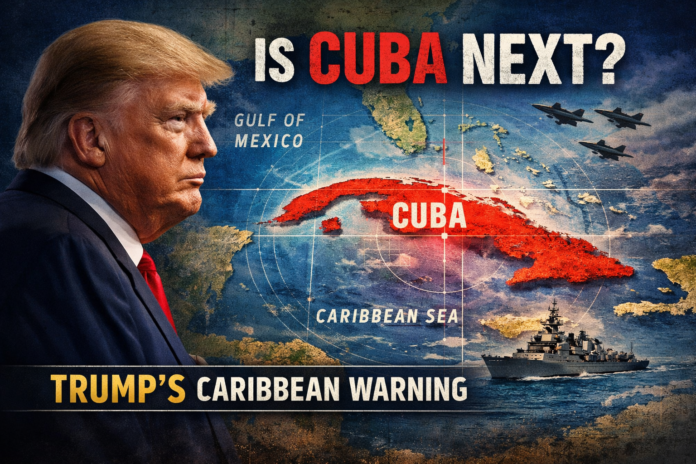





While the official purpose of the White House event was to celebrate the 2025 MLS Cup champions Inter Miami and soccer star Lionel Messi, President Donald Trump used the moment to hint at something much larger: Cuba.
In the middle of remarks focused largely on Iran and global security, Trump made a brief but revealing statement suggesting that once the current conflict stabilizes, Washington’s attention could turn toward the Caribbean.
“We want to finish this one first,” Trump said while referencing the situation with Iran. “But that will be just a question of time before you and a lot of unbelievable people are going to be going back to Cuba.”
He later added that Cuban leadership “wants to make a deal so badly,” suggesting negotiations or political changes could be approaching.
For many observers, the comment sounded less like casual rhetoric and more like a signal that the administration may soon shift its geopolitical focus closer to home.
Why Cuba Matters in U.S. Caribbean Strategy
For decades, Cuba has been the central geopolitical anchor of the Caribbean basin.
Located just 90 miles from Florida, the island sits at the crossroads of major shipping lanes connecting the Gulf of Mexico, Central America, and the Atlantic. That position has historically made Cuba a focal point of U.S. national security policy.
The strategic importance of the island was most dramatically demonstrated during the Cuban Missile Crisis, when Soviet missiles placed in Cuba brought the United States and the Soviet Union to the brink of nuclear war.
While the Cold War ended decades ago, Cuba remains influential across the region through diplomacy, medical aid programs, and ideological alliances with governments in Latin America and the Caribbean.
A Shift Back Toward Pressure
During Trump’s first administration, U.S. policy toward Cuba reversed the normalization efforts begun under Barack Obama. Travel restrictions were tightened, sanctions expanded, and Havana was placed back on the U.S. list of state sponsors of terrorism.
Trump’s latest comments suggest that the administration may again be preparing to exert pressure on the Cuban government.
That possibility carries major implications not just for Cuba but for the broader Caribbean.
Many Caribbean nations maintain close diplomatic and economic relationships with Havana. Cuban doctors, teachers, and technical workers operate across the region, particularly in smaller island states that rely on foreign expertise to support public services.
A dramatic shift in U.S.–Cuba relations could therefore ripple across regional politics, forcing Caribbean governments to navigate between Washington and Havana.
The Venezuelan Connection
Trump’s remarks also referenced developments in Venezuela, another key player in Caribbean geopolitics.
For years, the governments of Cuba and Venezuela have maintained a close alliance, with Venezuela supplying subsidized oil to Cuba and other Caribbean nations through regional energy programs.
Changes in Venezuela’s political or economic alignment could alter the balance of power throughout the Caribbean basin.
If Washington succeeds in reshaping relationships with either Cuba or Venezuela, the regional political map could shift quickly.
Why Caribbean Leaders Are Watching Closely
Caribbean governments have traditionally tried to balance relationships with both the United States and Cuba.
The United States remains the region’s largest trading partner and security provider, while Cuba maintains strong cultural, diplomatic, and humanitarian ties throughout the Caribbean Community.
Trump’s suggestion that developments in Cuba may be “just a question of time” will likely attract close attention from leaders across the region.
For small island nations, geopolitical shifts between major powers can quickly affect trade, migration patterns, and economic stability.
A Regional Story, Not Just a U.S. One
Trump’s comments came during a celebratory event for Inter Miami and Messi, but they carried echoes of a much larger geopolitical strategy.
If Washington does turn its focus toward Cuba after the current conflict cycle in the Middle East, the consequences will extend well beyond Florida or Havana.
They will reach across the Caribbean basin.
From Jamaica to the Dominican Republic, from Trinidad to the Bahamas, leaders will be watching carefully to see whether the president’s brief comment signals a new chapter in U.S.–Caribbean relations.
Because in geopolitics, sometimes the most important signals are delivered in a single sentence.