


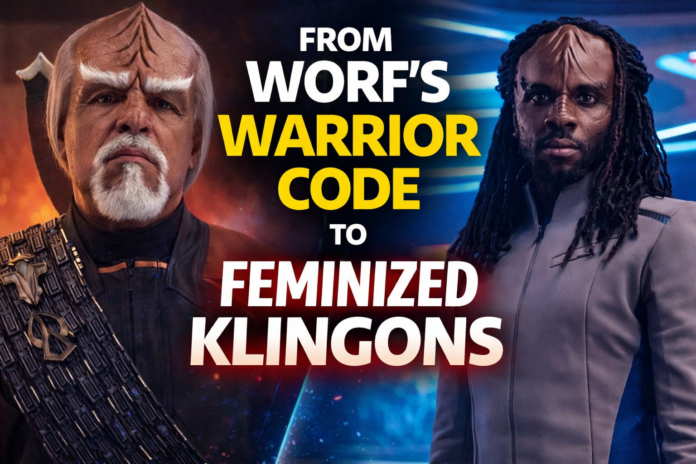




For decades, the Klingons in Star Trek represented one of the most clearly defined warrior cultures in science fiction. Honor, lineage, loyalty, and courage were not just personality traits. They were the foundation of Klingon civilization. No character embodied that culture more clearly than Worf.
When Worf first appeared in Star Trek: The Next Generation, he introduced audiences to a civilization governed by a strict code of honor. Klingons did not define themselves through personal feelings or identity narratives. They defined themselves through bloodline, family houses, and deeds in battle.
A Klingon introduction was not casual. It was a declaration of lineage.
Worf often identified himself with the words, “I am Worf, son of Mogh.” That statement was more than a name. It was a declaration of ancestry and responsibility. In Klingon culture, a warrior carried the reputation of his entire bloodline.
This cultural tradition was displayed again decades later in Star Trek: Picard when Worf introduced himself with a formal declaration of lineage:
“I am Worf, son of Mogh, House of Martok, son of Sergey, House of Rozhenko, bane to the Duras family, slayer of Gowron.”
Every phrase reflects a core principle of Klingon identity. His biological father. His political house. His adoptive family. His enemies. His victories. In Klingon culture, identity is built through ancestry and accomplishment.
This structure made the Klingons one of the most compelling civilizations in science fiction. Their society resembled historical warrior cultures around the world where honor, family reputation, and courage defined social standing.
The Klingon philosophy expressed this worldview clearly. Their famous saying, “Today is a good day to die,” was never about glorifying death. It was a declaration that a warrior should live so honorably that he does not fear the moment when his courage is tested.
Because of this depth, Klingons became one of the most recognizable and respected cultures in the Star Trek universe.
Over time, some fans and cultural critics even observed subtle parallels between Klingon storytelling and real-world honor cultures. The emphasis on bloodline, clan loyalty, and warrior reputation resembled elements found in many historical societies, including African warrior traditions where lineage and family honor defined a person’s standing.
The character of Worf also carried another dimension. Raised by a human family yet fiercely loyal to Klingon traditions, his story explored the tension between assimilation into broader institutions and maintaining one’s cultural identity. That struggle made Worf one of the most respected characters in the entire franchise.
But the upcoming series Star Trek: Starfleet Academy appears to be taking Klingon representation in a different direction.
Instead of emphasizing the traditional warrior ethos that defined Klingon storytelling for decades, early discussions around the new show suggest a shift toward a more modern character framework. In particular, the introduction of new Klingon characters has sparked debate among fans who believe the portrayal reflects a broader trend in modern entertainment: the softening or feminization of traditionally masculine warrior archetypes.
For many viewers, the concern is not the presence of female characters or emotional depth. Klingon women have always been formidable figures within the franchise. Characters such as K’Ehleyr and Grilka were strong, commanding, and deeply rooted in Klingon warrior tradition.
The concern being raised by some longtime fans is different. They argue that the new portrayal appears to reshape the very tone of Klingon identity, presenting characters with a softer demeanor, less emphasis on martial discipline, and a personality structure that feels more aligned with contemporary human social dynamics than with the hardened warrior code historically associated with the Klingon Empire.
To these critics, the issue is not representation but cultural consistency.
Klingons were originally written as a civilization that stood in contrast to the Federation. The Federation represented diplomacy, restraint, and political order. Klingons represented strength, honor, and the uncompromising expectations of a warrior society.
That contrast created philosophical tension that made the storytelling compelling.
When that warrior identity is softened or reinterpreted through a modern lens, many fans believe something important about the Klingon mythology is lost.
The early reaction to Star Trek: Starfleet Academy has reflected a broader frustration among longtime fans of the Star Trek franchise. Even before the series fully launched, trailers, casting announcements, and early promotional images triggered waves of negative commentary across fan forums, YouTube reviews, and social media. Critics of the new direction argue that the show appears disconnected from the cultural foundations that originally defined the universe. Comment sections across fan communities have been filled with complaints about the tone, the writing direction, and what some viewers describe as a continued departure from the core themes that made earlier series successful. In many discussions, viewers compare the new series to earlier eras of Star Trek—particularly the storytelling seen in shows featuring characters like Worf—and argue that the newer productions prioritize contemporary messaging over the mythological consistency that once grounded the franchise. Whether that criticism proves fair over time remains to be seen, but the early ratings reactions and audience feedback make one thing clear: the new show enters the franchise facing a skeptical and divided fan base.
Franchises endure for generations because they maintain the internal logic of the worlds they create. Audiences may welcome new characters and evolving storylines, but they also expect the foundational cultures of those worlds to remain recognizable.
The Klingons once represented one of the most disciplined and honor-driven warrior civilizations in science fiction.
The debate now unfolding among fans is not simply about a television show. It is about whether one of the most iconic warrior cultures in modern storytelling is being evolved—or quietly rewritten.
Because in the original vision of Star Trek, the Klingons were never meant to mirror everyone else.
They were meant to stand apart.