







Whenever American forces engage in combat abroad, the same constitutional alarm is triggered: Who has the authority to take the nation into war?
With the recent military operation in Iran, critics immediately declared that President Donald Trump violated the War Powers Resolution. Supporters responded that he acted within his authority as Commander-in-Chief. As is often the case in Washington, certainty arrives long before careful analysis.
The War Powers Resolution of 1973 was passed after Vietnam, as Congress attempted to reclaim authority it believed had shifted to the executive branch. The law does not prohibit a president from initiating military action. It requires notification to Congress within forty-eight hours and allows military engagement for up to sixty days without formal authorization. If Congress does not approve continued hostilities within that period, forces are to be withdrawn.
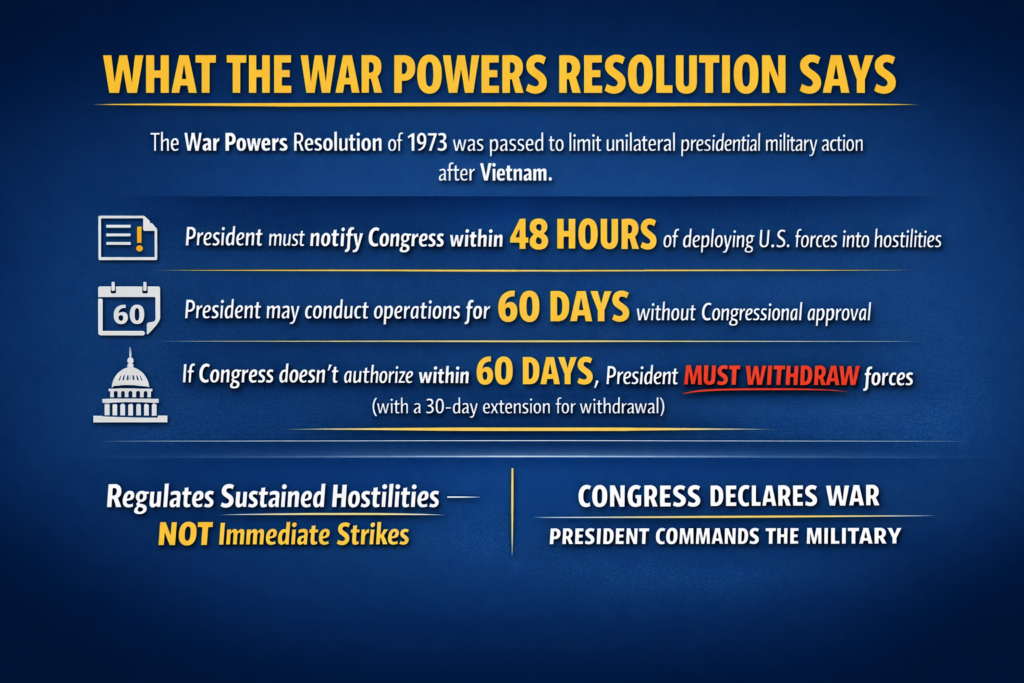
The law regulates duration, not immediacy.
If the administration notifies Congress and the operation remains within the 60-day window, then, under the statute itself, the president is operating within the temporary authority the law permits. That may not satisfy those who believe Congress should vote before any military strike occurs, but disagreement with the structure of the law is not proof of violation.
The constitutional argument strengthens not on day one, but on day sixty-one.
If hostilities continue beyond the statutory limit without congressional authorization, the issue moves from interpretation to confrontation. At that point, Congress must decide whether it will assert its authority through funding restrictions or formal disapproval. Historically, that is where institutional resolve often weakens.
This debate is not new, nor is it unique to one administration.
President Barack Obama authorized military action in Libya in 2011 without a declaration of war. His administration argued that the operation did not constitute “hostilities” under the War Powers Resolution because U.S. forces were in a supporting role. That interpretation was controversial, yet Congress ultimately did not force withdrawal.
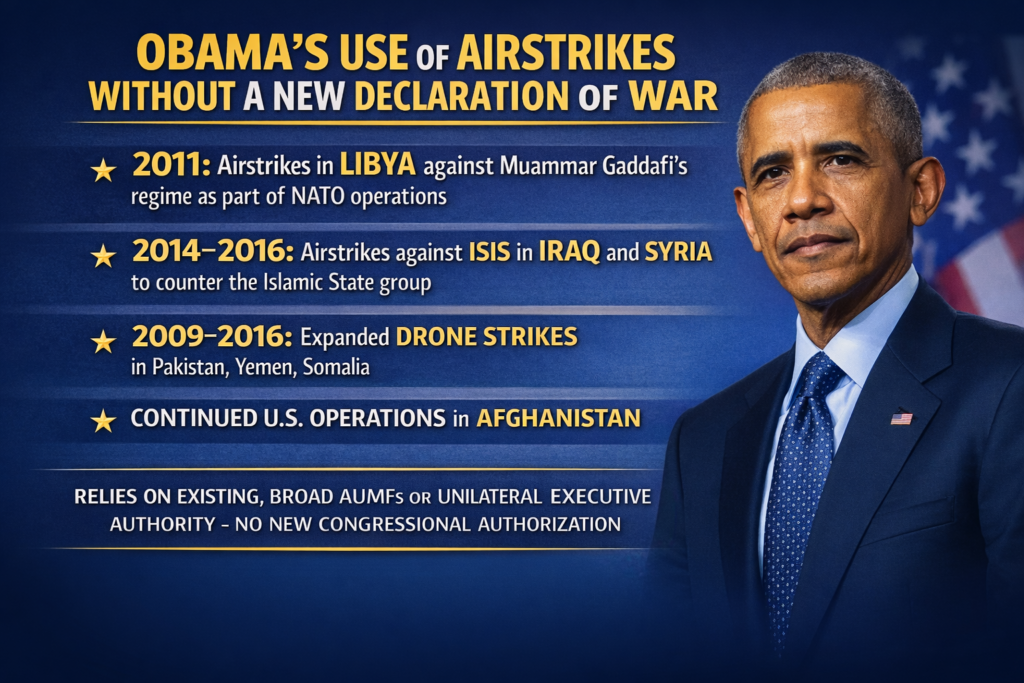
Obama also initiated airstrikes against ISIS in Iraq and Syria beginning in 2014 without seeking a new declaration of war. Instead, he relied on the 2001 and 2002 Authorizations for Use of Military Force passed after 9/11 and during the Iraq War. Drone campaigns in Yemen, Pakistan, and Somalia were similarly conducted under existing authorizations rather than new congressional declarations.
No modern president has relied on a formal declaration of war for major military engagements. Over decades, Congress has objected rhetorically but rarely exercised its most powerful tool — control over funding — to halt operations.
Over time, practice becomes precedent.
The deeper issue, then, is structural. Has Congress gradually ceded its war-declaring authority through inaction? If so, outrage directed at a single president misses the institutional reality that both parties have operated within — and benefited from — expanded executive authority.
The Constitution assigns Congress the power to declare war and the president the authority to command the military. The War Powers Resolution attempted to mediate that tension by creating a clock. Whether that clock has real force depends not on presidential rhetoric, but on congressional enforcement.
The outcome now hinges on duration and escalation. If the Iran operation remains limited and concludes within the statutory framework, it will join the long list of executive actions that tested but did not legally exceed the boundaries of the War Powers Resolution. If it evolves into sustained conflict beyond the sixty-day threshold without authorization, then the constitutional confrontation becomes unavoidable.
In American government, power rarely shifts because one branch acts boldly. It shifts because another branch chooses not to respond.
The law provides the framework. The outcome will reveal whether that framework still governs — or whether precedent has quietly rewritten it.
References
U.S. Constitution, Article I, Section 8 (Congressional War Powers)
U.S. Constitution, Article II, Section 2 (Commander in Chief Clause)
War Powers Resolution of 1973, 50 U.S.C. §§ 1541–1548
Authorization for Use of Military Force (AUMF), Pub. L. 107–40 (2001)
Authorization for Use of Military Force Against Iraq, Pub. L. 107–243 (2002)
Congressional Research Service Reports on Presidential War Powers and the War Powers Resolution
Obama Administration Office of Legal Counsel Memorandum on Libya (2011)
Congressional debates on ISIS authorization (2014–2016)