







How Sound Pollution Quietly Steals Sleep in Black Communities
Harold came to see me a while back with the kind of sleep complaint I hear often. He was logging seven, sometimes eight hours a night, but waking up feeling like he had barely closed his eyes. His blood pressure had been creeping up, and his focus at work was slipping.
We went through the usual questions about caffeine, screens, alcohol, supplements, medications, and stress. Everything checked out reasonably well. His sleep hygiene was solid. His primary care doctor had already run the basics, and his blood work was unremarkable. A sleep study showed no apnea, no significant limb movements, nothing that explained why his sleep felt so hollow.
Then one afternoon, almost in passing, Harold mentioned how convenient his apartment was. He could walk to the train station in under five minutes and loved that he never had to call an Uber. He said it like it was a selling point.
I paused. How close is the train?
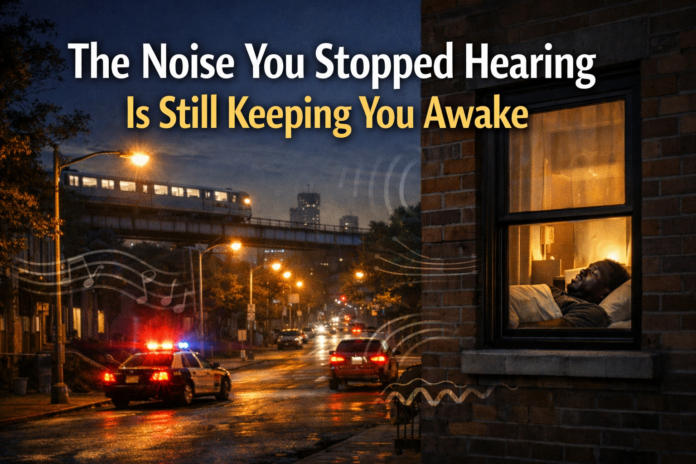
Close enough that freight trains passed through at 2 and 4 a.m. most nights. He had lived there for years. He did not hear them anymore.
Or at least, he did not think he did.
(Harold is a composite patient. Details have been changed to protect privacy.)
That conversation changed how I ask about sleep. Because it surfaced something I now see far more often than I expected: people whose bodies are reacting to sound environments their conscious minds stopped registering a long time ago.
Noise-fractured sleep is a health issue across many communities. But in neighborhoods shaped by highway placement and zoning decisions, the exposure burden often begins before anyone turns out the lights.
What Your Nervous System Needs at Night
Sleep is a nervous system event. We live between two gears: the sympathetic system that keeps you alert and reactive, and the parasympathetic system that handles repair, relaxation, and restoration. Sleep is what happens when our nervous system can shift into repair mode and stay there long enough for the work to get done. Heart rate slows and blood pressure dips and stress hormones quiet down. The brain clears metabolic waste that built up during the day.
When that shift gets blocked or interrupted, we get the worst of both worlds. We are tired and wired. We logged the hours, but the tissue never got what it needed. Focus slips, reactions slow, and our fuse shortens in ways that can cost us at work, in relationships, and in how we feel about ourselves over time.
The Sound Your Brain Never Stops Hearing
Light, sound, timing, and workload all shape how the nervous system behaves at night. Light is usually the loudest signal. But sound may be the most underestimated, because of one uncomfortable fact: we can adapt to noise consciously, and our body cannot.
There is an evolutionary reason for this. Our brains evolved to treat sounds during sleep as possible threats. In an older world, that sensitivity kept us alive. Different sleepers in a group would cycle through lighter and deeper stages at different times, so someone was almost always semi-alert, scanning for danger. That system worked well when the sounds that woke you meant something. It becomes a liability when the predator is not a lion but a garbage truck.
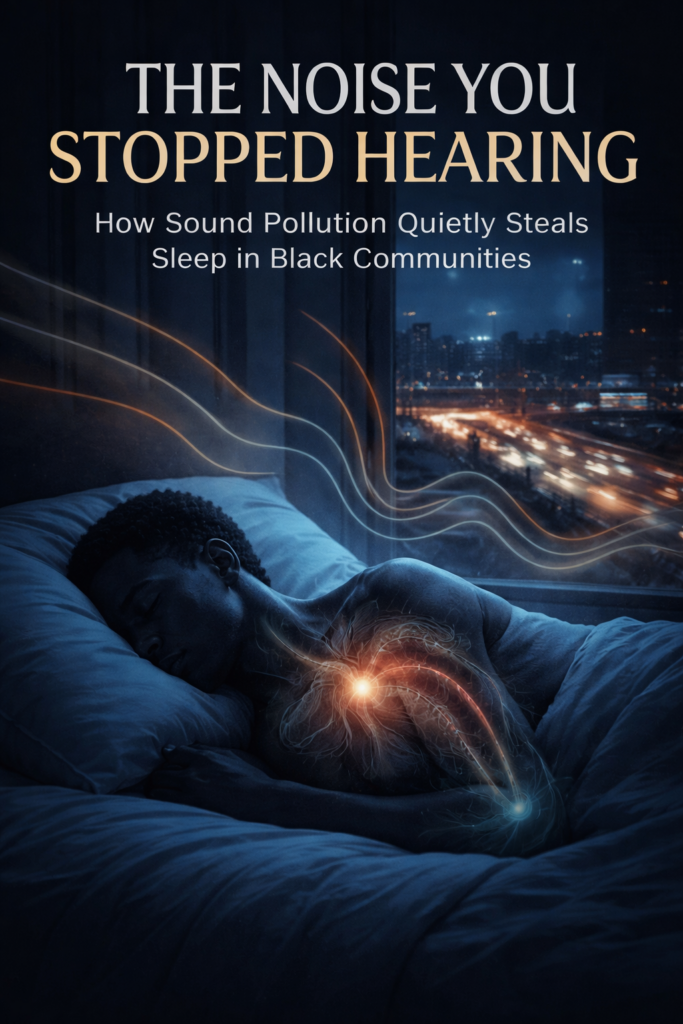
A siren at 2 a.m. can trigger a micro-arousal, bump cortisol, nudge heart rate upward, and pull us out of deep sleep without us ever remembering it happened. Our brain’s auditory processing does not shut off at night. It keeps scanning, and the circuits that feed into arousal centers in the brainstem are set up to respond before we ever become conscious of the sound.
Research confirms the biology: nocturnal noise triggers measurable increases in stress hormones, heart rate, and blood pressure during sleep, and most of these responses go completely unnoticed by the sleeper.
Even sounds as quiet as 33 decibels can provoke cortical arousals. The World Health Organization recommends nighttime noise stay below 40 decibels outside the bedroom. In many urban neighborhoods, that threshold is exceeded on most nights.
Each noise event nudges the sympathetic system back online. The deeper stages of sleep get shortened or skipped. Over months, blood pressure that should dip during sleep stays elevated. Inflammation creeps upward. And the person wakes up feeling like something is wrong but cannot name it, because the cause happened while they were unconscious.
Harold near the train tracks had adapted beautifully on the surface, but his brainstem never did. It kept receipts.
Where the Volume Gets Turned Up
Environmental noise is not spread evenly across a city.
A nationwide study using over one million hours of sound data found that neighborhoods with at least 75 percent Black residents — many of which overlap with historically redlined areas or major highway corridors — had median nighttime noise levels 4 decibels higher than neighborhoods with no Black residents. Four decibels may sound modest. But even relatively small increases in nighttime sound exposure can meaningfully alter sleep architecture across an entire community.
The reasons trace back to decisions made decades ago. Highways routed through Black neighborhoods. Industrial zones placed next to residential blocks. Rail corridors and airports built near communities that lacked the political power to redirect them. Redlining concentrated families into areas already closer to these sources, and the infrastructure that followed only intensified the exposure.
A 2025 University of Michigan study confirmed that historically redlined neighborhoods still carry higher noise levels today. This is a story about zoning and infrastructure patterns, not about any one family or block. The patterns trace to policy decisions that shaped physical environments over decades. Socioeconomic status and race often intersect in these exposure patterns, and both shape who bears the burden. But on average, across the data, Black communities are more likely to live near the kinds of noise sources that fragment sleep and strain the cardiovascular system over time.
And it is worth saying: noise does not only come from outside.
A snoring partner, a loud HVAC system, thin walls between apartments, a television left on in another room. Even in a quiet neighborhood, the sound environment inside the home can fragment sleep the same way. If you are reading this and thinking your block is peaceful enough, the question still applies: how loud is it where you sleep?
What It Costs
Chronic noise-fragmented sleep is associated with higher rates of hypertension, heart disease, stroke, and diabetes. A review in the European Heart Journal described the pathway: nocturnal noise activates the sympathetic nervous system, damages blood vessel lining, and raises oxidative stress, all of which compound over time into measurable cardiovascular harm.
The science is moving quickly. In just the last few years, large-scale reviews have reclassified environmental noise from a nuisance to a modifiable cardiovascular risk factor, with a 2025 umbrella review pooling 20 studies and finding noise associated with increased risks of hypertension, atrial fibrillation, and coronary heart disease. For any one person, the increase in risk may appear modest. Across entire populations, however, those small shifts translate into meaningful differences in who develops disease over time. New research is beginning to measure these effects specifically in Black adults and urban neighborhoods, using objective sleep data rather than self-report alone. The evidence base is no longer thin.
Noise rarely acts alone; it often clusters with air pollution, heat exposure, housing quality, and chronic stress load, amplifying cumulative risk.
The everyday cost of disturbed sleep shows up before the clinical diagnosis.
Thinking gets foggier, reactions slow, and patience with coworkers, partners, and children wears thinner. A shorter emotional fuse we chalk up to stress when it may be something more specific: a nervous system that never completed its repair cycle because the environment would not allow it.
When a community’s sleep is routinely disrupted, the effects ripple into school performance, workplace productivity, and the ability to fully show up in family and civic life.
Why This Belongs in a Black History Month Conversation
There has long been external control over Black communities’ relationship with rest. Forced labor schedules that denied sleep as a basic right. Overcrowded housing that made restoration structurally difficult. Environmental noise reflects the downstream consequences of those structural decisions. The highway routed through a neighborhood in 1958 is still generating sound pressure waves at 2 a.m. tonight. The zoning decision from two generations ago is still fragmenting sleep. The mechanisms are less visible than the ones history books tend to focus on, but the effect on the body is measurable and the consequences are real.
What To Do: From Policy to Pillow
The most important solutions are structural, because the problem is structural.
Zoning policies can be revisited, and noise ordinances can be enforced. Traffic-calming measures, construction timing rules, sound barriers, and building codes that require better insulation in high-noise areas all reduce the volume at the source. These conversations deserve more energy than they currently get.
At the community level, the first step is naming the problem.
Phone apps can measure decibel levels inside your bedroom. Conversations in churches, barbershops, and clinics can start including a question almost nobody asks: How loud is it where you sleep? Tenant associations, neighborhood councils, and local environmental justice groups can turn that documentation into policy pressure. When communities frame nighttime noise as a health issue, it becomes harder for policymakers to treat it as background.
At the individual level, there are things we can do tonight.
Move the bed away from the wall that faces the highway or rail line. Ergonomic earplugs designed for sleep may be the single most effective personal tool available; a 2026 clinical trial found that standard foam earplugs recovered roughly 72 percent of the deep sleep lost to environmental noise, observed under controlled laboratory conditions in a relatively small sample and reflecting short-term intervention effects, and a controlled lab study published in the journal Sleep confirmed they outperformed continuous sound-masking.
For those who cannot tolerate earplugs, a fan or white noise machine can help reduce the contrast between background silence and sudden noise events, though recent research suggests continuous broadband sound may come with its own trade-offs for REM sleep and should be used thoughtfully. And build a wind-down routine that acknowledges a noisy environment. Working with the sound environment you actually have is more effective than pretending it is quiet.
A Final Word
If you work in healthcare, add noise to the conversation when you screen for sleep and blood pressure. Ask where the bedroom sits relative to the street. Ask whether the patient has adapted to sounds they no longer notice. That adaptation is often the clinical clue that something environmental is working against recovery.
If you live in a neighborhood where the nights are louder than they should be, know that quiet is a health resource. It belongs in the same conversation as access to parks, healthy food, and safe streets.
And if you are a parent or an educator, know that a child sleeping through noise may still be losing the deeper sleep stages that support focus, mood, and learning over time.
Sleep is how the body repairs what the day breaks down. Protecting Black sleep, in the homes, neighborhoods, and in policy conversations, is part of protecting Black futures.

Derek H. Suite, M.D., is a board-certified psychiatrist, CEO and Founder of Full Circle Health, and host of The SuiteSpot, a daily podcast exploring science, spirituality, and human performance. Drawing on a decade of teaching Clinical Psychopharmacology at Teachers College, Columbia University, he writes about sleep, recovery, and what allows performance to hold up when it matters most. He is the author of the forthcoming book Sleep as Performance Medicine and a guest contributor to Black Westchester Magazine.
This article is for educational purposes only and is not a substitute for individualized medical advice. Readers should consult their own healthcare professionals regarding sleep concerns
References and Further Reading
Casey JA, Morello-Frosch R, Mennitt DJ, et al. Race/ethnicity, socioeconomic status, residential segregation, and spatial variation in noise exposure in the contiguous United States. Environmental Health Perspectives. 2017;125(7):077017.
Shkembi A, Patel K, Smith LM, Meier HCS, Neitzel RL. Racial and ethnic inequities to noise pollution from transportation- and work-related sources in the United States. Journal of Exposure Science & Environmental Epidemiology. 2025.
Münzel T, Gori T, Babisch W, Basner M. Cardiovascular effects of environmental noise exposure. European Heart Journal. 2014;35(13):829-836.
Tabaei S, Rashki Ghalenoo S, Panahandeh M, Bagheri G, Tabaee SS. The relationship between noise pollution and cardiovascular diseases: an umbrella review on meta-analyses. BMC Cardiovascular Disorders. 2025;25(1):630.
Basner M, Smith MG, Cordoza M, et al. Efficacy of pink noise and earplugs for mitigating the effects of intermittent environmental noise exposure on sleep. Sleep. 2026;zsag001.
Halperin D. Environmental noise and sleep disturbances: a threat to health? Sleep Science. 2014;7(4):209-212.
World Health Organization. Night noise guidelines for Europe. 2009.