


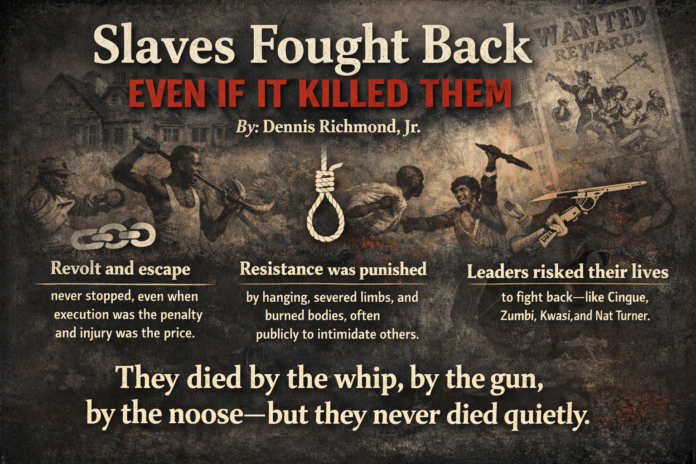




When most Americans think about slavery, the story is often told as one of endurance, suffering, and pain. But Black History Month calls on us to remember another powerful truth: slaves in America did not accept their bondage quietly. From colonial New York to the swamps of South Carolina, slaves fought back— even if it meant death at the end of the fight.
Slave rebellions were among the most direct and dangerous forms of resistance in American history. Though relatively rare due to the extreme violence of the system, these uprisings shook the foundations of slavery and exposed the constant fear that haunted slaveholding society.
One of the earliest revolts occurred right here in New York in 1712, when a group of slaves set fire to a building and attacked white colonists who came to investigate. The rebellion was brutally crushed, and more than 20 Black folks were executed. Yet the message was clear: even in the heart of colonial cities, slavery was never uncontested.
In 1739, the Stono Rebellion in South Carolina became the largest uprising in the British colonies. Enslaved Africans, many of them from the Kingdom of Kongo, marched toward Spanish Florida chanting for freedom. Though defeated, the rebellion terrified slaveholders and led to even harsher slave codes.
The 19th century brought even more organized resistance. In 1800, Gabriel Prosser, an enslaved Blacksmith in Virginia, planned a massive revolt to seize Richmond. The plot was betrayed before it could begin, and Gabriel was executed. In 1811, the German Coast Uprising in Louisiana involved hundreds of enslaved people marching toward New Orleans—the largest slave rebellion in U.S. history.
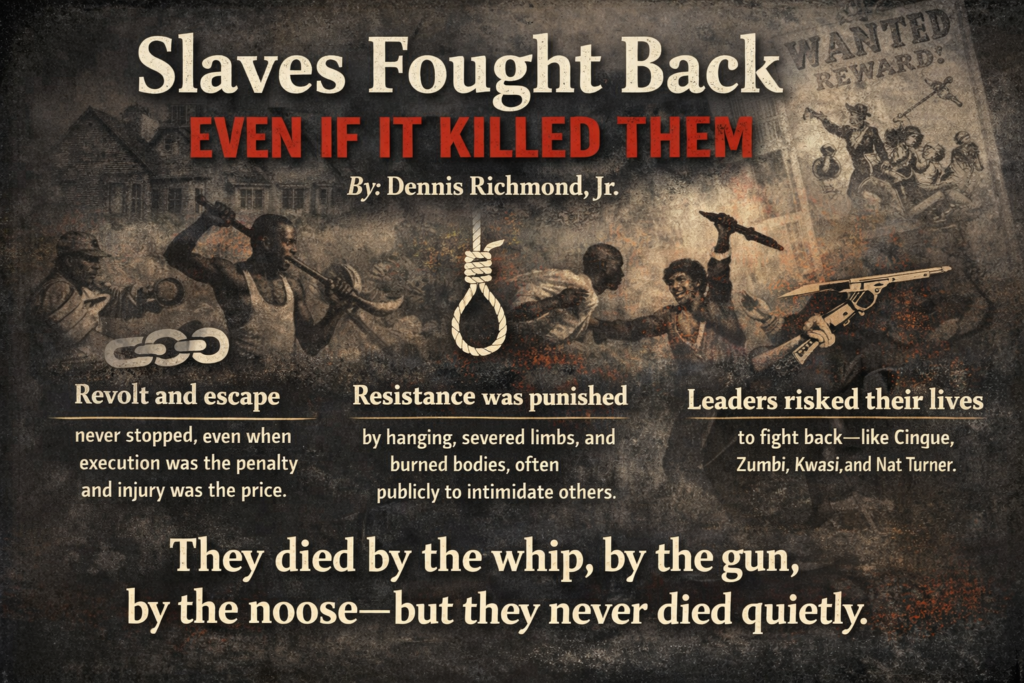
Perhaps the most famous revolt came in 1831, led by Nat Turner. Turner and his followers killed dozens of white slaveholders in Virginia before being captured. The aftermath was wild: over 100 Black people were killed in retaliation, and southern states tightened laws against Black literacy, movement, and worship.
Not all rebellions happened on land. In 1841, enslaved Africans aboard the American ship Creole seized control and sailed to the Bahamas, where British authorities freed them. It remains one of the most successful slave revolts in U.S. history.
These rebellions mattered not because they always succeeded, but because they revealed a hidden truth: slavery survived only through constant violence, surveillance, and fear. Enslaved people were not passive victims—they were political actors who dreamed, planned, and fought for freedom.
Most resistance did not look like open revolt. It took quieter forms: escaping through the Underground Railroad, slowing work, breaking tools, learning to read in secret, and building strong Black communities. Revolts were rare because the consequences were often death, torture, or the destruction of entire families.
Yet every rebellion sent shockwaves through the nation. They inspired abolitionists, terrified slaveholders, and reminded America that freedom was not granted—it was demanded.
This Black History Month, slave rebellions should be remembered not as footnotes, but as acts of revolutionary courage. They stand as proof that from the very beginning, Black folks, our African ancestors, resisted injustice and helped force this country to confront its deepest contradiction.
Happy Black History Month.