




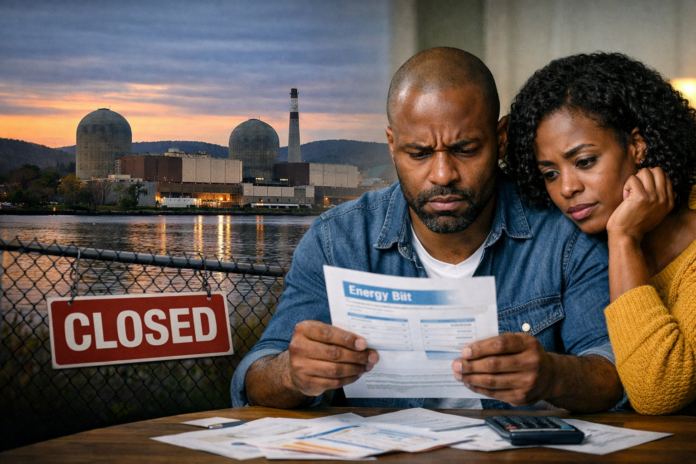





If you live in the Hudson Valley and your electric bill feels abusive, that is not bad luck, weather, or personal consumption. It is the predictable outcome of policy decisions made with full knowledge of who would pay the price.
Across Westchester, Rockland, Orange, Dutchess, Putnam, and Ulster counties, the average homeowner is now paying roughly 30 to 45 percent more for electricity than just a few years ago, even after accounting for changes in regular usage. In many households—especially those relying on electric heat or gas during winter peaks—the increase is even higher.
This did not happen because Hudson Valley residents suddenly became wasteful. It happened because the cost structure changed.
The Hudson Valley sits at the center of New York’s energy contradiction.
This region lost the Indian Point nuclear power plant—a facility that once supplied a significant share of downstate electricity with zero carbon emissions, stable pricing, and round-the-clock reliability. It was located where demand was highest: near Westchester, Rockland, and New York City.
When Indian Point was closed, it was not replaced by an equivalent, constant, low-cost power source in the Hudson Valley. Instead, electricity is now primarily generated by price-volatile natural gas plants and imported from farther away. That shift added transmission costs, congestion fees, and delivery surcharges that now appear on monthly bills regardless of how much electricity a household uses.
This is why many residents have seen bills rise 30 percent or more since 2020, even when usage stayed flat or declined.
The fastest-growing portion of the bill is not the supply. It is a delivery.
In much of the Hudson Valley, delivery charges now account for 50 to 65 percent of a residential electric bill. These charges cover grid congestion, long-delayed infrastructure upgrades, climate compliance mandates, and guaranteed utility returns approved by regulators. Consumers cannot opt out, shop around, or negotiate.
This structure quietly turns energy policy into a regressive tax.
The damage does not stop with homeowners.
Small businesses are being squeezed just as hard—often harder.
Across the Hudson Valley, mom-and-pop shops, restaurants, salons, bodegas, and service businesses are reporting electric bills that have more than doubled in a short period. A small shop that once paid around $400 a month is now seeing bills closer to $900, without expanding hours, equipment, or square footage.
For a small business, that difference is not a nuisance. It is payroll. It is inventory. It is whether the doors stay open.
Unlike large corporations, small businesses cannot hedge energy costs or negotiate special contracts. Electricity is a fixed operating expense. When it jumps by 100 percent, owners are forced to raise prices, cut staff, reduce hours, or shut down entirely. This is one reason Hudson Valley downtowns feel more fragile—more vacancies, fewer independent shops, and higher prices passed on to consumers.
These exact costs also feed directly into rising rents.
Landlords factor higher electricity and gas expenses into rent calculations, whether utilities are included or not. In multifamily buildings, common-area electric costs, heating systems, and compliance upgrades are passed through as higher rents or new fees. When operating costs rise 30 to 40 percent, landlords do not absorb the loss—they raise rents to survive.
Energy policy becomes housing policy.
Contradictory state choices further box in the Hudson Valley. New York restricts new natural gas pipeline capacity while increasing reliance on gas-fired plants to replace lost nuclear power. The result is artificial scarcity. During cold months, prices spike not because fuel is unavailable, but because policy prevents efficient delivery.
Utilities such as Con Edison, Central Hudson, and NYSEG operate as regulated monopolies. When the state mandates system changes, utilities recover costs through rate cases approved by the Public Service Commission. The risk is socialized. The bill arrives monthly at kitchen tables and small business counters.
None of this was unforeseeable. Energy analysts and grid operators warned that closing Indian Point without firm replacement capacity would raise prices and strain reliability. Those warnings were inconvenient, so they were ignored.
The outcome was not an accident. It was arithmetic.
And this is precisely why more and more people are leaving New York—not out of ideology, but necessity. When policy decisions consistently raise the cost of basic survival, working people respond rationally. Families can tolerate high taxes or high housing costs for a time, but when energy, rent, and operating expenses all rise together, the math collapses. Small business owners cannot stay open on slogans, and working households cannot budget around unpredictable utility bills.
The Hudson Valley is not losing residents because people stopped caring about community or climate. It is losing them because poor policy decisions have made everyday life unaffordable for the very people who work, build, and keep the region running.
High electric bills in the Hudson Valley were not an accident. They were the result of choices. And until outcomes, rather than intentions, judge those choices, the exodus will continue.
Electricity is not a luxury. And a policy that treats it as one deserves to be challenged.


Who can we write to complain about this something needs to be done.