




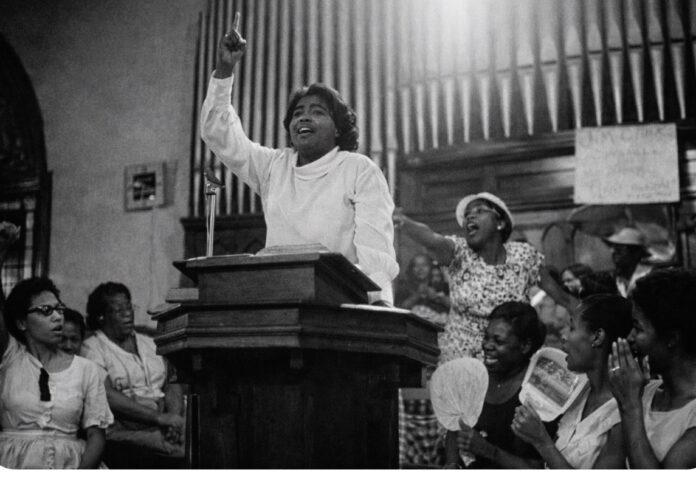




Prathia Hall planted the seed.
Not metaphorically. Not symbolically. Literally.
She planted it in scorched earth.
In 1962, in Terrell County, Georgia, the smell of smoke still clung to the air. Charred wood. Wet ash. The hollowed-out remains of a Black church that had been burned by white supremacists because Black people dared to gather, dare to organize, dared to believe.
People stood close together that night. Not for comfort, for protection. And when Prathia Hall began to pray, it wasn’t soft. It wasn’t ornamental. It wasn’t designed to be remembered.
It was survival speech.
Her voice moved through the crowd like a heartbeat, steady, resolute, refusing collapse.
I have a dream…
I have a dream…
I have a dream…
Not as rhetoric.
As insistence.
That is how seeds are planted, in repetition, in pressure, in faith that outlives violence.
And standing there, listening, absorbing, was Martin Luther King Jr..
From Womb to World Stage
Here’s what history doesn’t like to admit:
That dream language did not originate on marble steps.
It did not come from a podium.
It did not emerge fully formed from masculine genius.
It came from a woman’s prophetic imagination, spoken in community, shaped by grief, nurtured by collective care.
Prathia Hall did not “inspire” the dream like a muse.
She conceived it.
And like so many ideas birthed by Black women in America, it only became “historic” once a man carried it into public view.
That doesn’t diminish King’s brilliance.
It indicts America’s storytelling.
The Gendered Rewrite of Leadership
Watch how the narrative tightens.
One man becomes the voice.
One man becomes the leader.
One man becomes the moral authority.
Meanwhile, the woman who spoke vision into trauma is recast as atmosphere.
This is the same lie we tell about leadership and family.
We say we value the “nuclear family,” but we only legitimize patriarchal leadership, the head, the figurehead, the face. We ignore the womb that holds vision, the hands that feed movements, the voices that stabilize communities before the cameras ever arrive.
Prathia Hall’s leadership was maternal, not submissive.
- She held pain without spectacle
- She named possibility without ego
- She spoke the future without needing credit
That is not secondary leadership.
That is origination.
But origination threatens systems that only know how to crown men.
The Harvest America Remembers
In 1963, when King stood before the world and repeated “I have a dream,” the seed bloomed. The phrase carried moral thunder. It shifted consciousness. It still does.
But history froze the image at the harvest.
And when you only teach the harvest, you teach a dangerous lesson:
That men generate movements
That women merely echo them
That vision becomes legitimate only when filtered through masculinity
That lesson didn’t just distort the past, it trained the future.
Why This Truth Still Disrupts
Because right now, in boardrooms, classrooms, churches, movements, and homes, we are still negotiating:
- Who gets credit
- Who gets amplified
- Who is called a leader vs. “support”
Naming Prathia Hall is not about rewriting history, it’s about correcting the lens.
Movements are not monologues.
They are families, plural, layered, interdependent.
And the dream was never meant to belong to one gender.
Say It Plainly
So let’s say it without flinching:
Prathia Hall planted the seed of the dream.
Dr. King amplified it.
The movement grew because both mattered.
That is not controversy.
That is accuracy.
And accuracy is the most radical form of respect.
If this unsettled you, good.
Truth often does before it liberates.
Who Gets to Dream?
Before we close the book on this story, we have to ask the question history keeps dodging:
Who gets to dream out loud and who gets written out once the dream takes shape?
Because Prathia Hall didn’t whisper her vision. She didn’t think it quietly. She didn’t wait for permission. She spoke her dream in public, in community, in danger and the world only deemed it “historic” after a man repeated it on a larger stage.
And let’s be honest, many of you have never heard her name.
Not because she wasn’t important.
Not because she wasn’t present.
But because history has been curated to feel comfortable, familiar, and male.
That pattern didn’t end in 1963.
It’s still here.
- In classrooms where men are cited and women are summarized
- In movements where women organize and men are crowned
- In families where care is expected, but authority is gendered
So when we ask “Who gets to dream?” we’re really asking:
- Who gets believed?
- Who gets credited?
- Who gets remembered?
The dream was never meant to be owned.
It was meant to be shared, stewarded, and spoken across genders.
And until we tell the truth about who planted the seeds,not just who stood in the sunlight, we will keep mistaking harvest for origin.
If this is the first time you’re hearing her name, let that sit with you.
Let it challenge what you thought you knew.
Because the future doesn’t just need more dreamers.
It needs honest storytellers.
And liberation begins the moment we stop asking permission to name the truth,
and start asking why it took so long to say it out loud.
Supporting Sources & Further Reading
PBS / Public History
- PBS SoCal – Prathia Hall Inspires MLK’s “I Have a Dream”
A concise, authoritative segment explicitly documenting Hall’s prayer and its influence.
https://www.pbssocal.org/shows/black-church/clip/prathia-halls-inspires-mlks-i-have-a-dream
Cultural & Historical Journalism
- Essence Magazine – The Black Woman Who Inspired MLK’s “I Have a Dream” Speech
One of the most accessible mainstream pieces naming Hall and contextualizing her role.
https://www.essence.com/culture/did-you-know-the-black-woman-who-inspired-i-have-a-dream-speech/ - Smithsonian National Museum of African American History & Culture
Context on women of the Civil Rights Movement and the gendered erasure of leadership.
https://nmaahc.si.edu/explore/stories/women-civil-rights-movement
Scholarly & Archival Sources
- Wikipedia – Prathia Hall (Wynn)
Well-sourced overview with citations to academic and historical records.
https://en.wikipedia.org/wiki/Prathia_Hall - SNCC Digital Gateway – Prathia Hall
Archival civil rights history project curated by Duke University, SNCC Legacy Project, and UNC.
https://snccdigital.org/people/prathia-hall/ - Martin Luther King Jr. Research & Education Institute (Stanford University)
Context on King’s speech development and collaborative movement ecosystem.
https://kinginstitute.stanford.edu/encyclopedia/i-have-dream-speech
Gender, Theology & Movement Analysis
- Katie Cannon, Delores Williams, Womanist Theology (Contextual Framework)
Useful for grounding the “maternal leadership / prophetic imagination” analysis.
https://www.bu.edu/sth/profile/prathia-hall-wynn/
(Boston University School of Theology – where Hall later taught)


This is a great article thank you for posting this Larnez