




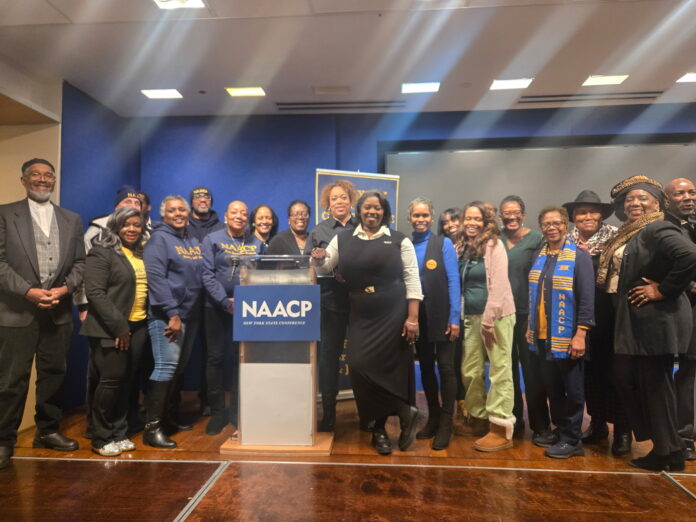




The First Quarterly Meeting of the NAACP New York State Conference opened on Saturday, January 10, 2026, with intention and reverence, at the UFT Headquarters in New York City.
The day began with an opening prayer, followed by a collective singing of Lift Every Voice and Sing. Voices filled the room, steady, familiar, and unified, setting a tone rooted in shared history and purpose before any formal business began.
Immediately afterward, a roll call of branches was taken, those gathered in person at UFT Headquarters and those joining virtually from across New York State. One by one, branch names were called. One by one, voices responded. From Westchester to Long Island, from upstate to New York City, what could have been a routine procedural moment became something far more powerful. You could feel it, the energy of a statewide network present, accounted for, and ready to work.
For Westchester, that roll call carried particular weight. The following branches were represented: Mount Vernon, New Rochelle, Ossining, Peekskill, Port Chester/Rye, White Plains/Greenburgh, and Yonkers, a reminder of the breadth of Black civic leadership active across the county.
Legislative Partnership in Real Time
Following roll call, President L. Joy Williams invited Latrice Walker to speak, underscoring the growing collaboration between the NAACP New York State Conference and the New York State Black, Puerto Rican, Hispanic & Asian Legislative Caucus.
Assemblymember Walker addressed the importance of aligning grassroots organizing with legislative leadership, emphasizing that policy victories are strongest when communities are organized, informed, and engaged. She framed the partnership as a strategic bridge, connecting community concerns directly to policymaking spaces and reinforcing accountability between elected officials and the people they serve.
The collaboration directly supports the Conference’s ambitious goal of adding 25,000 new NAACP members statewide by the end of 2026, expanding organized Black civic power as New York approaches critical elections and redistricting milestones.
President’s Report: Steady Leadership at a Critical Moment
Presiding over her first quarterly meeting since officially assuming the presidency on January 1, after being elected at the State Convention in October, Williams delivered a President’s Report grounded in continuity, stabilization, and readiness.
She outlined her focus on restoring strong governance practices, strengthening communication with branches, and clarifying the role of State Conference leadership in supporting branch-level work. That work included the successful execution of the 2025 State Convention, expanded leadership training, and direct engagement with branches across multiple regions.
Williams also emphasized the importance of building infrastructure that supports long-term power, initiating reviews of financial and operational practices, modernizing digital registration and data collection, and establishing centralized systems to track leadership status, engagement, and participation statewide.
As the Conference enters its 90th year, she framed this moment not simply as an anniversary, but as a responsibility, to honor the legacy by building durable systems capable of sustaining Black civic power for generations to come.
The Executive Director’s Report: Meeting the Urgency Head-On
That foundation was reinforced in the Executive Director’s Report delivered by Chris Alexander. Alexander spoke candidly about the current political landscape, noting that federal rollbacks have made state and local governance the frontline for protecting Black communities.
In response, the State Conference joined the advisory committee of the Hands Off NYC Coalition, a broad alliance of labor, immigration, and civil rights organizations preparing communities for potential federal overreach. That work moved from coordination to action, beginning with a kickoff rally in Brooklyn calling for an end to political prosecutions and standing in solidarity with New York State Attorney General Letitia James.
As branches mobilized locally, including rallies in Yonkers and Middletown, the message evolved from “Hands Off Tish” to Hands Off Our Democracy. Alexander also highlighted sustained advocacy around prison reform, which resulted in new laws signed by the Governor ensuring that individuals who experience abuse while incarcerated can pursue justice after their release, reforms with direct relevance for families across Westchester.
Building the Ecosystem Beyond the Agenda
When the agenda paused for lunch, the work did not.
In that in-between space, I witnessed branch leaders, youth advisors, and state leadership exchanging contact information, comparing notes, and making plans. Conversations moved quickly from introductions to strategy, how to better support branches, align messaging, share resources, and build a stronger, more connected ecosystem heading into 2026.
It was a reminder that power is not built only at microphones. It is built in moments of proximity, when leaders recognize shared challenges, identify complementary strengths, and commit to staying connected beyond the room.
Youth & College Leadership: Power in the Present
Following lunch, and just before attendees broke into afternoon learning sessions, the floor was turned over to youth leaders for the Youth & College Report, delivered under the leadership of Myles Hollingsworth, President of the Youth and College Division.
The report reinforced a core truth: youth leadership is not symbolic or deferred; it is present power. Updates highlighted campus engagement, civic education initiatives, and organizing work underway across the state, underscoring how leadership pipelines are already active and shaping political consciousness in real time.
Their placement in the agenda. At the center of the day, the Conference reflected commitment to continuity across generations and to ensuring that young leaders are integral to the organization’s present and future.
Why This Matters for Westchester
For Westchester, this first quarterly meeting mattered. It connected local branch work, education advocacy, justice reform, and economic equity to a statewide framework designed to amplify impact. It affirmed that Westchester’s Black communities are not peripheral to New York’s civic future; they are central to it.
What emerged from Lower Manhattan was not nostalgia for past victories, but a disciplined commitment to building power where it has too often been fragmented. Across prayer, song, roll call, legislative partnership, leadership reports, youth engagement, and informal exchanges, the message was consistent:
Presence alone is no longer enough.
This moment requires strategy, coordination, narrative alignment, and sustained organizing. As New York enters a new legislative session and approaches consequential elections and redistricting battles, the NAACP New York State Conference is positioning itself not just to respond but to lead.
For those looking to get involved, learn more, or join the work as the Conference marks its 90th year, information and membership opportunities are available at www.nysnaacp.org.
For Black communities across Westchester and beyond, that leadership and that invitation may prove decisive.

Goodevening my name is Joe Andrews. I’m the Youth Advisor for the New Rochelle Youth Council. I found this article very interesting and graciously appreciate the advocacy for Westchester County. I would like to know how can I get in contact with Ms. Kinsey to do a story for my HBCU COLLEGE FAIR EVENT that will happening in New Rochelle on Sat September 11th @ New York Covenant Church 500 Main St New Rochelle. Here’s my email j.andrews2094@gmail.com & my cell 347-942-0091
Thank you Joe. I will make sure she see’s your comment