




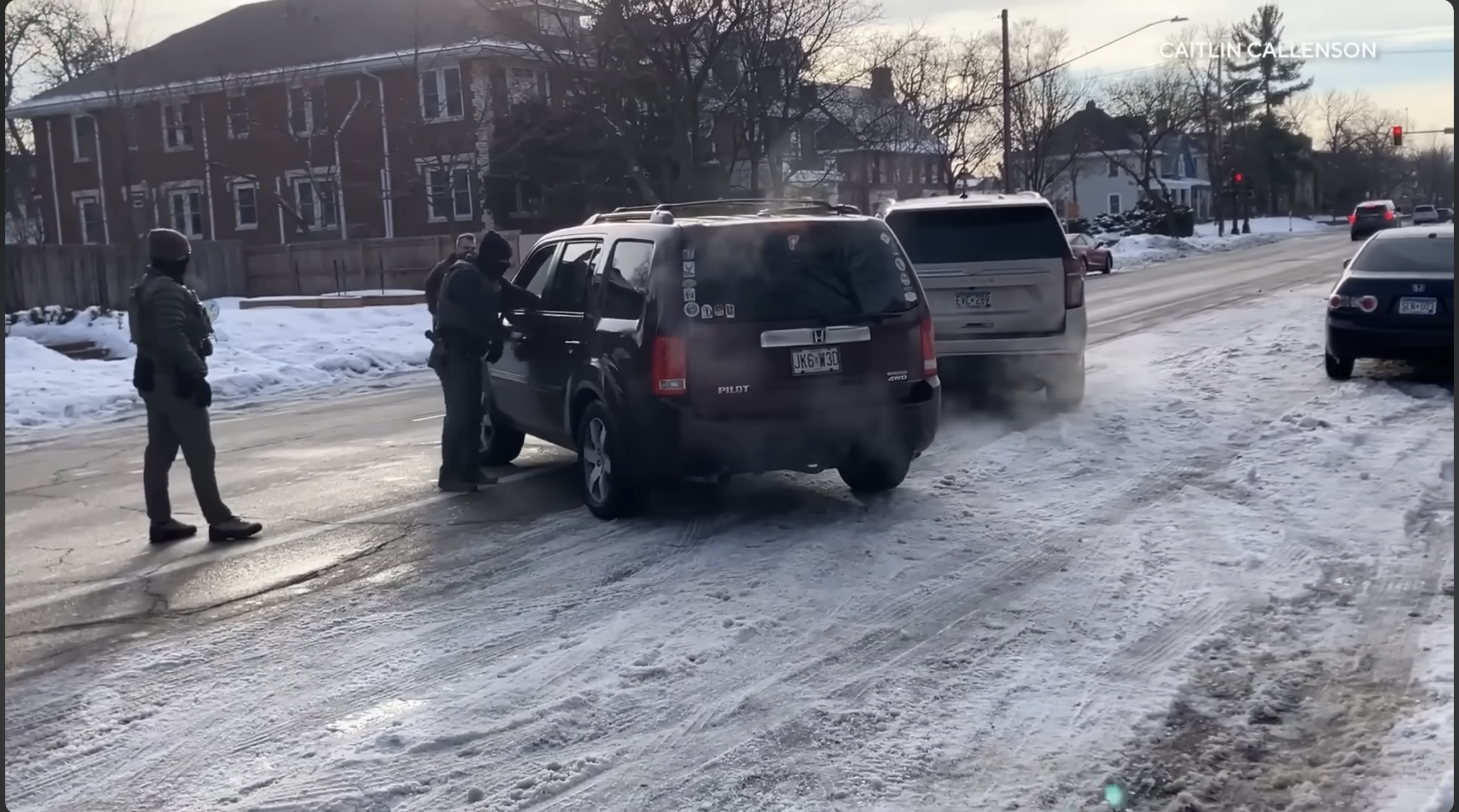





Renee Nicole Good, 37, was inside her SUV on a residential street Wednesday morning when federal immigration officers surrounded her vehicle. Video shows agents positioned around the car, with at least one officer attempting to open her door. When she tried to drive forward, the officer in front fired into the vehicle, killing her. Bystander footage of the encounter spread rapidly across social media, fueling outrage and competing political narratives. But outrage alone explains nothing. The more important question is how a citizen who was not the target of any immigration action ended up trapped inside a federal enforcement operation on an ordinary street — and what political and policy decisions made that outcome possible.
That fact alone should give pause. When civilians can unknowingly drive into active federal operations, the failure begins long before a weapon is discharged.
The agent who opened fire was part of an Immigration and Customs Enforcement Enforcement and Removal Operations team operating within a surge of roughly 2,000 federal agents deployed to the Twin Cities area. However, the specific policies or training guiding their tactical decisions during such operations are not detailed here, leaving questions about whether officers were equipped with clear protocols for de-escalation and safe engagement in high-pressure environments.
Video from the scene raises serious questions about how that discipline was applied. The footage shows three officers positioned around the vehicle: two to the sides and one directly in front of a running, occupied car. From a tactical standpoint, placing an officer on foot in front of a vehicle sharply narrows all available options. Any movement by the driver — whether intended to flee or to escape confusion — can instantly be interpreted as a lethal threat. The officer, having placed himself in that position, is left with few alternatives other than deadly force.
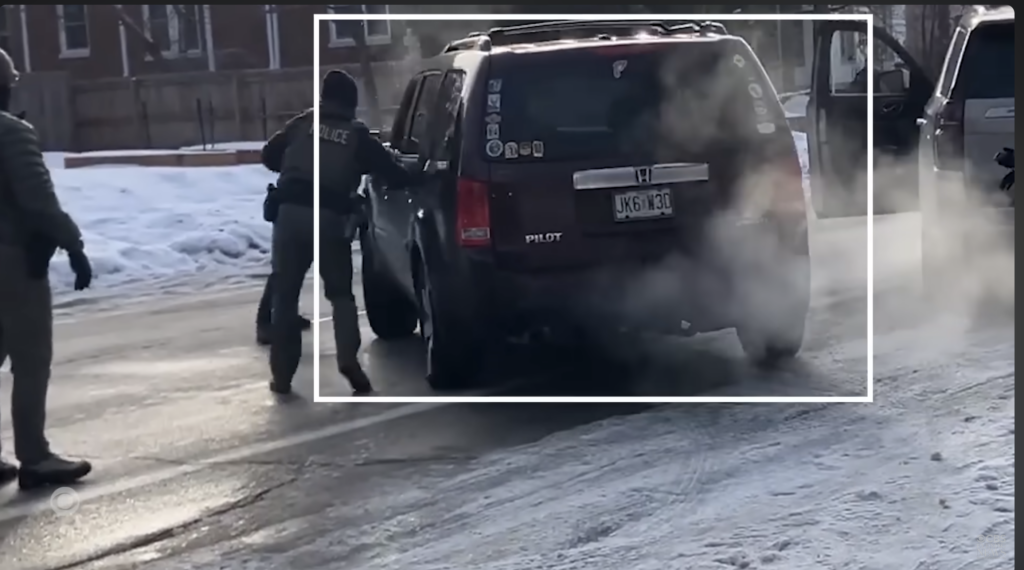
As the vehicle moved forward, the situation escalated further. Video shows the officer firing directly into the vehicle. That detail is critical. Once an officer places himself on a moving car, the encounter is almost automatically reframed as a life-or-death scenario. Any continued movement of the vehicle can then be characterized as an imminent threat, regardless of whether the officer’s own positioning created that danger. The vehicle then continued forward and collided with a parked car.
Under constitutional standards, fleeing alone does not justify the use of deadly force. The legal threshold is imminent danger to life, not the act of leaving the scene. The direction of the vehicle’s wheels further complicates claims that the car was being used as a weapon. The wheels appear turned away from the officers, consistent with an attempt to maneuver around them rather than toward them. That detail suggests evasive intent, not aggression — an effort to exit a chaotic situation rather than escalate it.
Political hostility and mixed messages around ICE operations can undermine public safety, making de-escalation and discipline even more vital for policymakers and law enforcement.
Understanding that accountability is unlikely in such cases should motivate policymakers and law enforcement to prioritize clear policies and oversight to prevent future tragedies.
There is precedent for this outcome. In the 2010 shooting of DJ Henry, no criminal charges were brought against the officers involved. Despite widespread outrage and unresolved questions, the case ended without prosecution because officers stated they believed their lives were in danger when Henry’s vehicle moved. The legal system accepted that assertion, and the case effectively ended there.

The parallel is instructive. When officers position themselves in front of or on top of vehicles, any subsequent movement can be legally framed as an imminent threat. Once that framing is established, the legal analysis overwhelmingly favors the officer. Accountability rarely comes through criminal courts, not because questions do not exist, but because the law evaluates perceived danger, not whether that danger was avoidable or tactically induced.
Another failure in the aftermath of police shootings is the insistence by some local activists and attorneys on labeling every fatal encounter as murder. That framing may satisfy public anger, but it is legally misguided and often counterproductive. Murder requires proof of intent — that the officer knowingly and deliberately intended to unlawfully kill. In police use-of-force cases, that standard is extraordinarily difficult to meet and rarely aligns with the facts prosecutors must work with. Manslaughter, by contrast, is the charge that fits most police shootings when criminal liability is appropriate. It focuses not on intent to kill, but on whether an officer’s reckless actions, violations of training, or departures from policy directly led to a death. That burden is far easier to establish and far more consistent with how these cases actually unfold. By demanding murder charges that are unlikely to survive legal scrutiny, advocates often guarantee no charges at all, undermining accountability rather than advancing it.
This is where the politics matter.
For years, Democratic leaders have built a narrative of non-cooperation with ICE, particularly under Donald Trump, framing enforcement as illegitimate. This political stance influences enforcement practices, often leading to confusion and tension on the ground, which can undermine public safety and accountability in immigration enforcement operations.
At the same time, many local Democratic governments publicly rejected cooperation with ICE and, in some cases, directed police departments not to assist federal immigration operations. As a result, streets were not blocked, perimeters were not clearly established, and police presence was often limited or absent — leaving enforcement activity to unfold without the structure and coordination that normally accompany openly sanctioned operations. The public message from local leadership was that ICE itself was illegitimate, even as elements of local government quietly enabled federal activity behind the scenes
That contradiction mattered. Civilians received one signal — that ICE was something to confront or resist — while officers on the ground operated in environments shaped by political hostility and mixed authority. The result was confusion, heightened tension, and enforcement encounters in spaces never designed to accommodate them safely.
This stands in contrast to the era of Barack Obama, when deportations reached historic highs and local law enforcement cooperation with ICE was widespread. Enforcement was politically legitimized, not demonized. Operations were quieter, more structured, and less prone to street-level confrontation. The difference was not in enforcement power. It was narrative legitimacy.
Under Barack Obama, immigration enforcement operated under a different political framework, one defined by open coordination rather than public resistance. Programs such as 287(g) formalized cooperation between local law enforcement and Immigration and Customs Enforcement, allowing trained local officers to assist with immigration enforcement, primarily through jail-based screening and information sharing. That cooperation created clarity: roles were defined, authority was acknowledged, and enforcement occurred within structured systems rather than contested streets. The result was measurable. With local, state, and federal agencies working in alignment, the Obama administration carried out more deportations than any other president in U.S. history. For these outcomes, Immigration organizations called Obama, THE DEPORTER AND CHIEF!
By contrast, under the Trump administration, many Democratic leaders have been unwilling to maintain that same level of cooperation. Political resistance replaced operational alignment, even though federal enforcement authority remained unchanged. That context matters — and now it matters in life-and-death terms.
Delegitimizing enforcement without dismantling it produces instability. Authority still exists, but public compliance erodes. Civilians feel emboldened to challenge officers. Protestors insert themselves into enforcement spaces. Officers, sensing hostility, become more defensive. Every movement becomes a threat, every command a flashpoint. Under those conditions, tragic outcomes become more likely — and more legally insulated after the fact.
Renee Nicole Good did not have to die. Her death was not inevitable, nor was it the product of a single moment or a single decision. It was the consequence of political warfare — a prolonged conflict between Democrats and Republicans in which immigration enforcement became a symbolic battleground rather than a clearly governed policy area. Competing narratives replaced clarity. Resistance rhetoric collided with unchanged federal authority. Ordinary citizens were left navigating the fallout.
If the goal is fewer deaths and fewer irreversible mistakes, slogans will not suffice. Enforcement authority must either be accepted and clearly structured or lawfully changed. Anything in between invites confusion, escalation, and tragedy — and leaves the public searching for accountability only after the damage is already done.


Murder by cops of Black Americans since 1619. The first cops in America were slave catchers aka “Pattyrollers” were members of slave patrols. Now white Americans can experience what its been like for Black people for 400 years.
“Chicken’s have come home to roost”