






January 6, 2026. Early evening. And surprisingly warm, especially compared to the frigid stretch January had been putting us through. Not warm enough to forget it’s winter, but warm enough that people lingered. Warm enough that coats stayed open. Warm enough that the city felt, for once, like it wasn’t rushing anyone along.
As soon as I walked into the open lobby of the Yonkers Riverfront Library, I heard the band playing.
Not faint. Not background. Present. Alive. The kind of sound that catches you mid-step and tells your body, you’re already late but not in a bad way.
Before I even looked for a seat, before I unfolded the program, the music had already done its work. It filled the open space, bounced lightly off the walls, and traveled up the staircases. It wasn’t asking for attention; it was setting the tone.
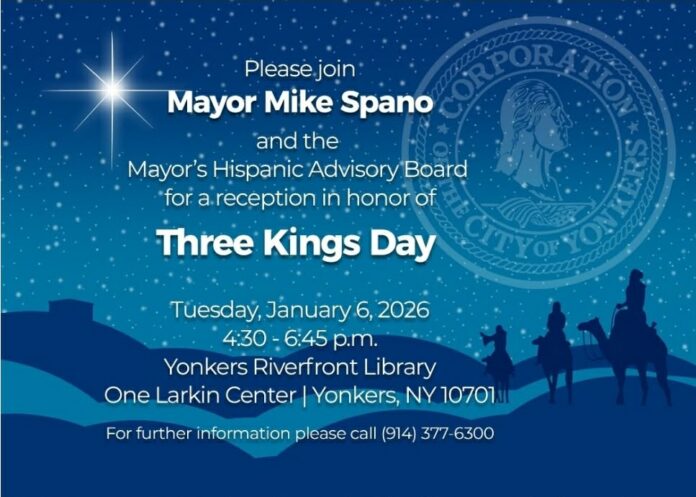
Which mattered because this Three Kings celebration, presented by Mike Spano and the Mayor’s Hispanic Advisory Board, wasn’t hidden behind doors or tucked into a side room.
It was happening right there. In the open. In motion. Where people were already passing through.
I sat down with the program folded in my lap, the blue night sky, the guiding star, the three travelers silhouetted in motion, and felt my shoulders drop. That’s how I knew this wasn’t going to be performative culture.
This was intentional culture.
The kind that doesn’t ask permission to exist.
People entered the lobby from every direction. Some came specifically for Three Kings Day. Others wandered in to return books or warm up and stayed. That’s the power of putting culture in the flow of daily life. It doesn’t have to announce itself. It just invites.
Kids swung their legs from chairs too big for them. Parents whispered reminders in Spanish and English, sometimes both in the same breath. Elders positioned themselves where they could see everything, scanning the room not with concern but with confirmation: yes, we are still here.
When the opening remarks began, the space didn’t tighten. It softened. Names were spoken carefully. Gratitude sounded practiced but not rehearsed. There’s a difference between honoring a tradition and using it as décor and the room felt that difference.
A young voice led the Pledge of Allegiance and the National Anthem, and something subtle happened. The lobby recalibrated. Footsteps slowed. Conversations paused. Phones lowered. Not out of obligation, but out of respect. A child sang like the space was holding them.
And it was.
Libraries are underrated architects of belonging. Their walls don’t just hold books, they hold permission. Permission to gather without purchasing something. Permission to exist without explaining yourself. Permission to be seen without being sold to.
The Yonkers Middle High School Madrigal Choir filled the open lobby with layered voices that echoed just enough to remind you that this wasn’t a performance hall, it was a shared civic space. Then dance, Espíritu de México, grounded, rhythmic, unapologetically alive. Applause traveled up staircases. People who hadn’t planned to stay… stayed.
When the Three Kings were introduced, I caught myself gripping the program again. Not because it was dramatic but because it was familiar. Familiar in that ancestral way. Familiar like a story you didn’t grow up hearing every year, but somehow your body recognizes anyway.
That’s lineage. Quiet. Persistent. Patient.
When gift distribution began, nothing felt frantic. No chaos. No scrambling. Just children receiving, adults smiling without documenting every second. And that’s when it landed: this wasn’t about toys. It was about order. Preparation. The message being delivered, without words, that said, you were expected.
As I stepped back into the evening, still mild, the river close by, I thought about how rare it is to see a city place culture where it can’t be ignored. Not siloed. Not ticketed. Not curated for optics. Just present.
Three Kings Day, at its core, is about following a star when the road is uncertain. That night, the star wasn’t overhead. It was right there, in an open lobby, on a folded program, in children’s faces, and in a city choosing to make room.
And honestly?
That kind of visibility, without conditions, feels radical in 2026.