










When government fails, the instinct is to search for blame. A more useful exercise is to identify where authority actually exists and whether it is being exercised.
A December 19, 2025, letter from the New York State Comptroller’s Office regarding Mount Vernon’s finances removes much of the confusion surrounding the City’s ongoing fiscal instability. The problems are not speculative, political, or newly discovered. They are documented, recurring, and unresolved — not because they are unknown, but because enforcement authority does not currently exist.
The Evidence Is Established
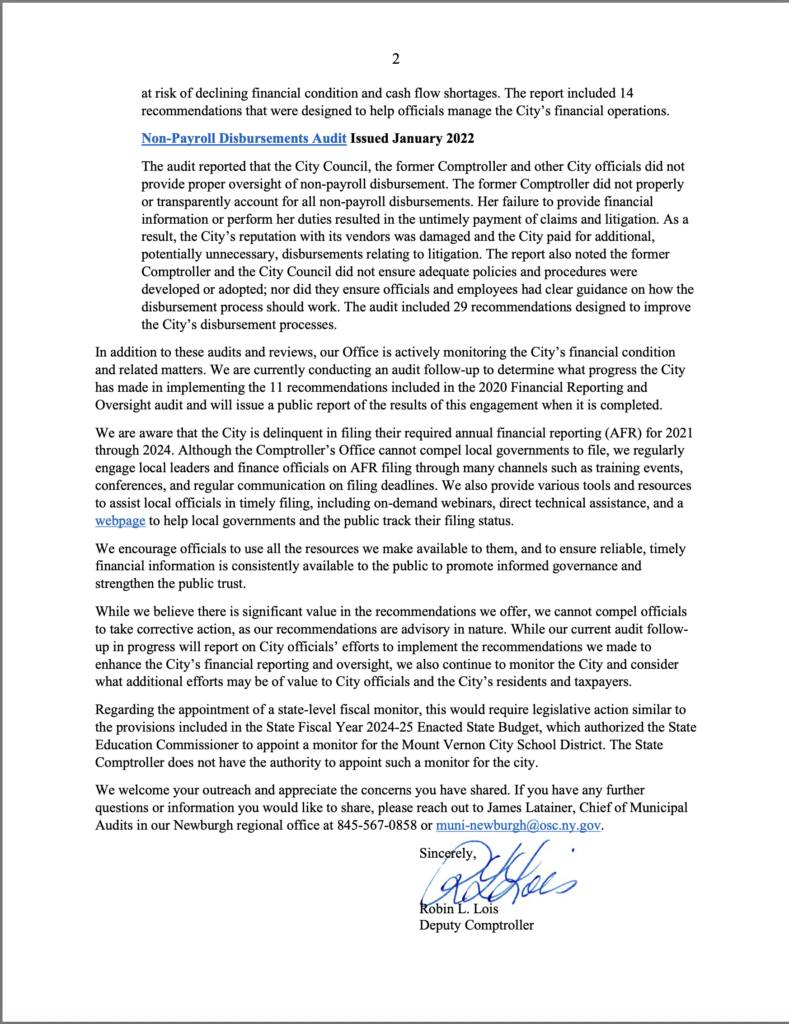
The Comptroller’s Office confirms it has issued multiple audits of Mount Vernon over the past several years. These audits identified fundamental failures in financial reporting and oversight. The City failed to file required annual financial reports for multiple years. Audited financial statements have not been produced since 2015. Officials lacked reliable data to manage cash flow, evaluate budgets, or plan for long-term obligations.
A subsequent budget review found unsupported revenue projections and underbudgeted expenditures, increasing the risk of cash-flow shortfalls. Another audit documented weak oversight of non-payroll spending, leading to late payments, litigation, and higher costs to taxpayers.
These are not matters of opinion. They are operational facts documented by the State.
Why the Audits Did Not Lead to Intervention
The Comptroller’s letter also explains why these findings, despite their severity, did not result in state control of City finances.
Audits identify problems. They do not confer authority to fix them.
The Comptroller states plainly that his office’s recommendations are advisory. The State Comptroller does not have the legal power to compel corrective action or appoint a fiscal monitor for a city government without explicit legislative authorization. In short, the State can document failure, but it cannot intervene unless the law allows it.
This distinction explains why conditions can remain unchanged even as oversight continues.
Why the State Has Not Taken Over City Finances
Some residents have asked why the State imposed a fiscal monitor on the Mount Vernon City School District but not on the City government itself.
The answer is legal, not political.
The answer is legal, not political, because without a law authorizing oversight, the Comptroller has no authority to impose a monitor or control board for the City of Mount Vernon.
In public policy, authority comes from statute — not urgency.

What Mount Vernon Residents Must Do — Based on the Comptroller’s Letter
The Comptroller’s message underscores that only new legislation can enable the State to intervene, giving residents a clear path to meaningful change.
Audits and monitoring do not grant enforcement power. Only a law passed by the New York State Legislature and signed by the Governor can authorize a state fiscal monitor or takeover of City finances.
The responsibility now shifts to residents because legislative action is the only way to enable the State to intervene in Mount Vernon’s finances.
If Mount Vernon taxpayers want the State to act, they must actively encourage their representatives to introduce legislation, making residents key drivers of change.
If passed by the Legislature, the bill would then require the Governor’s signature to become law.
The Comptroller has already done his job. He documented the problem and explained the limits of his authority. What remains is not further investigation, but legislative action. Until the law changes, the outcome will remain the same.
The Bottom Line
Mount Vernon’s financial condition is no longer a matter of debate. The audits are complete. The risks are known. The constraints on state action have been clearly stated.
What happens next depends not on City Hall, auditors, or headlines — but on whether residents are willing to demand legislation from those who actually hold the power to change the outcome.
In government, results follow authority.
Until authority changes, results will not.



I dugg some of your post as I thought they were invaluable invaluable