


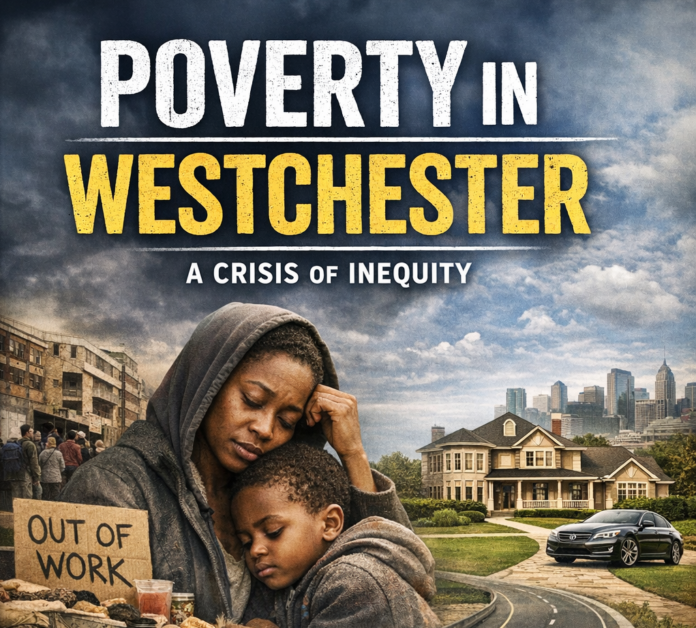





According to reports from the Westchester Children’s Association, poverty and economic insecurity among children and families in Westchester County are more widespread than traditional statistics suggest. The organization’s research shows that a majority of children in the county live in households that are either low-income or struggling to meet basic needs, particularly in high-cost cities and communities of color. Using real-time data collected from frontline service providers, the Association reports rising demand for food assistance, housing support, and emergency services, even as employment levels remain relatively high. The findings highlight a structural gap between wages and the true cost of living in Westchester, indicating that many working families are financially fragile despite being officially classified as above the poverty line
Westchester County is routinely ranked among the wealthiest counties in America. Median income figures, property values, and corporate presence reinforce that narrative. But averages conceal reality. Beneath the statistics is a growing and undeniable truth: poverty in Westchester is rising, persistent, and increasingly institutionalized — particularly in Black and Brown communities.
This crisis is no longer anecdotal. It is measurable, visible, and sustained. And its causes are not mysterious.
When Work Is Not Enough
A growing share of Westchester residents experiencing hardship is not unemployed. They are working — often full-time, sometimes multiple jobs — yet still unable to meet basic needs. Housing, food, utilities, childcare, transportation, and healthcare costs have far outpaced wage growth.
Federal poverty thresholds fail to capture this reality in a high-cost county like Westchester. Families earning “above poverty” are still one emergency away from eviction, food insecurity, or homelessness. This is not a moral failure on the part of individuals. It is a structural failure of policy and priorities.
The Skills Gap No One Wants to Confront
One of the most overlooked contributors to poverty is the failure to train young people for real, available jobs.
Westchester continues to push college as the primary pathway to success while neglecting skills-based workforce development. Trades, infrastructure, logistics, advanced manufacturing, technology, cybersecurity, utilities, and construction offer stable, middle-income careers — yet these pathways are underfunded, undervalued, and inconsistently promoted.
An economy does not reward intentions or credentials alone. It rewards usefulness.
When young people are not equipped with marketable skills aligned with labor demand, poverty becomes predictable. Workforce development in Westchester has too often been treated as branding instead of strategy.
Affordable Housing That Weakens Cities
Affordable housing is frequently presented as the solution to poverty. In theory, it should stabilize families and reduce cost burdens. In practice, the way it has been implemented in Westchester often produces the opposite result.
Developer-driven projects routinely rely on long-term tax abatements, PILOT agreements, and public subsidies that erode municipal tax bases. Cities are left with increased service demands — schools, sanitation, policing, infrastructure — but fewer resources to fund them.
The result is higher taxes on existing residents, declining services, and deeper poverty concentration.
Affordable housing does not work when it destabilizes the municipalities expected to absorb it. Housing policy that ignores fiscal reality does not solve poverty — it institutionalizes it.
The Nonprofit Industry Problem
Westchester has one of the largest nonprofit ecosystems in New York State. Over the decades, billions of dollars have flowed through nonprofit organizations to address poverty, food insecurity, housing instability, and inequity.
Yet the problem remains — and in many areas, worsens.
This is not an indictment of individual nonprofit workers. Many are dedicated and overwhelmed. It is a critique of incentives. When poverty persists indefinitely despite massive funding, outcomes must be questioned.
If poverty were being meaningfully reduced, emergency programs would shrink. Funding would decline. Organizations would sunset.
Instead, poverty has become a permanent operating model.
The uncomfortable truth is this: poverty is now a billion-dollar business.
Entire careers, budgets, grant cycles, conferences, and political narratives depend on managing the problem rather than eliminating it. Success is measured by program growth, not by the number of people exiting poverty.
Children and the Cost of Inaction
Children bear the highest cost. A majority of children in Westchester live in households struggling to meet basic needs. Food insecurity, housing instability, and chronic financial stress undermine educational outcomes, mental health, and long-term economic mobility.
For Black families, these effects are compounded by existing disparities in wealth, homeownership, and access to capital. The consequences of ignoring this crisis will not be abstract. They will surface in classrooms, emergency rooms, and future incarceration rates.
Poverty Is Not Inevitable — It Is a Choice
Westchester does not lack money, data, or expertise. What it lacks is alignment between incentives and outcomes.
Real solutions would require:
- Skills-based workforce training aligned with actual labor demand
- Career pipelines tied to infrastructure, trades, technology, and local industry
- Housing policy that strengthens municipal tax bases instead of eroding them
- Honest audits of nonprofit effectiveness based on outcomes, not activity
- A shift from poverty management to economic mobility
None of this is radical. It is practical.
Poverty in Westchester persists not because the problem is too complex, but because too many institutions benefit from managing it rather than solving it.
Until incentives change, outcomes will not.
And until we are willing to say that plainly, poverty will remain precisely where it is: well funded, well studied, and unresolved.