




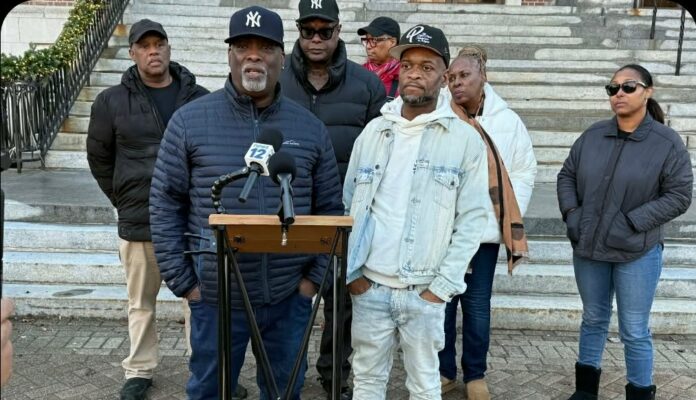




The case of Officer Derek Williams exposes a truth that many prefer to avoid: institutions often fail not because of bad intentions, but because responsibility is diffused until no one is accountable.
Williams is a 19-year veteran of the Mount Vernon Police Department. During the COVID pandemic—when policy decisions were made from home offices and Zoom screens—policing did not stop. He continued working, often overtime, entering homes and responding to emergencies in a period when exposure was not a hypothetical risk, but a certainty.
He contracted COVID. Years later, he is suffering from kidney failure and survives on dialysis.
At that point, the relevant question should have been whether the systems designed to protect workers in precisely this situation functioned as intended, underscoring the need for systemic accountability in protecting frontline workers like Williams.
They did not.
There is now substantial medical evidence that COVID can cause long-term organ damage, including kidney injury and kidney failure. Studies have shown that even patients without prior kidney disease can experience lasting renal impairment following COVID infection, particularly those exposed repeatedly or who suffered more severe illness. In other words, Williams’ condition is not a medical anomaly—it is a documented risk associated with COVID.
This matters because it undermines the convenient fiction that his illness is unrelated to his service during the pandemic.
Federal protections were in place for workers harmed by COVID. New York State enacted presumptive protections for frontline workers, recognizing that exposure was inherent in the job. This should make the audience feel a responsibility to uphold fairness for workers like Williams.
Yet those protections were never effectively applied, exposing a critical gap between policy and enforcement that leaves workers unprotected despite existing laws.
The union did not enforce them. The Police Benevolent Association exists to represent officers when they are least able to represent themselves. That is its comparative advantage. If those protections had been invoked and enforced, Williams would not now be facing termination.
But unions are not the only institutions with obligations.
The City’s Human Resources department failed predictably: by treating responsibility as someone else’s problem. Once a serious medical condition was known, HR had an independent duty to ensure that basic protections—such as FMLA—were put into effect. That duty does not vanish because a collective bargaining agreement covers an employee. Systems that depend on “someone else” acting first usually result in no one acting at all.
The outcome was predictable. Because protections were never activated, the City later classified Williams’ absence as “undocumented.” That classification then justified termination. The system worked exactly as designed—to protect the institution from obligation, not the worker from harm.
Then there is the matter of resources.
Mount Vernon received roughly $40 million in federal ARPA funds—money explicitly intended to address the long-term impacts of COVID, including harm to frontline workers, highlighting the need for proper resource allocation and accountability.
If a police officer who worked through COVID, contracted COVID, and now suffers organ failure does not qualify as a COVID-related impact, then the definition has been rendered meaningless.
The City now points to an “extension” as evidence of compassion. But extending a termination date is not a solution. It changes no incentives, corrects no failures, and secures no long-term protection. Williams remains on track to lose his job and his health insurance. For a man dependent on dialysis, that is not an administrative inconvenience. It is a life-threatening consequence.
This is the predictable result of a system in which laws exist but are not enforced, money exists but is not prioritized, and responsibility exists but is never owned.
In such systems, outcomes matter more than intentions. And the result here is unmistakable.
Officer Derek Williams is not the victim of bad luck. He is the product of institutional design—where accountability is fragmented, incentives reward inaction, and consequences are borne by individuals least able to absorb them.
Delaying the outcome does not change it.
Soft language does not alter hard facts.
If Mount Vernon wants this case to represent more than damage control, it must correct the underlying incentives—by securing Williams’ healthcare, enforcing existing protections, and ensuring that no public servant’s survival depends on public outrage.
Because when systems fail, they do not fail abstractly.
They fail specific people.
And Derek Williams is one of them.
These sources collectively establish that COVID relief laws, funding mechanisms, and medical evidence existed to protect frontline workers harmed by the pandemic—and that the failure in this case was not one of law or resources, but of execution and accountability.
References
- American Rescue Plan Act of 2021 (ARPA)
Public Law 117-2, March 11, 2021.
Established the State and Local Fiscal Recovery Funds to address the public health and economic impacts of COVID-19, including impacts on essential workers and public sector services. - U.S. Department of the Treasury — State and Local Fiscal Recovery Funds Guidance
U.S. Treasury Final Rule and Interim Final Rule (2021–2023).
Clarifies that ARPA funds may be used to address long-term public health impacts of COVID-19, support essential workers, maintain payroll and benefits, and correct COVID-related administrative disruptions. - Families First Coronavirus Response Act (FFCRA)
Public Law 116-127, March 18, 2020.
Expanded job-protected medical leave and COVID-related leave protections for workers affected by COVID-19 during the pandemic period. - Family and Medical Leave Act of 1993 (FMLA)
29 U.S.C. § 2601 et seq.
Provides eligible employees with job-protected leave for serious health conditions and places responsibility on employers to notify employees of FMLA rights. - New York State COVID-19 Presumption for First Responders
New York Workers’ Compensation Law § 21(14) (as amended during COVID).
Establishes a presumption that frontline workers who contracted COVID did so in the course of employment, unless proven otherwise. - Centers for Disease Control and Prevention (CDC)
Post-COVID Conditions guidance.
Documents that COVID-19 can cause long-term organ damage, including kidney injury, even in patients without pre-existing kidney disease. - National Institutes of Health (NIH)
Research on COVID-19 and kidney disease.
Multiple NIH-supported studies show increased risk of acute kidney injury and chronic kidney disease following COVID-19 infection. - Xie, Y., Xu, E., & Al-Aly, Z. (2021)
Long-term kidney outcomes among survivors of COVID-19.
Journal of the American Society of Nephrology.
Peer-reviewed study demonstrating a significant association between COVID-19 infection and long-term kidney dysfunction. - Al-Aly, Z., et al. (2022)
High-dimensional characterization of post-acute sequelae of COVID-19.
Nature Medicine.
Documents long-term systemic and organ-specific effects of COVID-19, including renal outcomes. - U.S. Department of Labor — FMLA Employer Guidance
Clarifies employer obligations to provide notice and designate FMLA leave when a qualifying serious medical condition is known.

Let’s be clear because softness is how systems get away with harm.
Derek Williams didn’t “miss paperwork.” He showed up. During COVID. While people were on Zoom in sweatpants, he was walking into homes, breathing the same air, doing the job anyway. He got sick. Now his life is scheduled around dialysis and somehow the system has the audacity to call his absence “undocumented.”
Miss me with that.
The protections were there. The money was there. The medical evidence was there. What wasn’t there was accountability. Everybody passed the responsibility like a hot potato until it landed back on the man whose body already paid the price.
And let’s not insult our intelligence by calling a delayed firing “compassion.” A countdown to losing healthcare when you need dialysis isn’t grace, it’s cruelty with a calendar.
This isn’t a glitch. This is the system doing what it’s built to do: protect itself and sacrifice the people who kept it running.
And right now, that sacrifice has a name.
Derek Williams.
Plain and simple the city of Mount Vernon, the mayor’s office, and everyone involved in this inhumane decision has failed Officer Williams. How could anyone with a conscious think that termination was in the best interest of a 19 year MVPD veteran who worked non-stop during a global pandemic, contracted COVID, and now has renal failure? It is heartless and shows zero compassion for those who put their lives on the line to serve and protect the city of Mount Vernon. Extending his healthcare benefits for six months while he is on dialysis, and awaiting a kidney donor, is also callous. Do the right thing by Officer Williams and stop his impending termination and grant him every protection under the law.
Black Westchester, Great site, I recommend it to everyone
Thank You Herman, tell a friend to tell a friend
I love this platform