


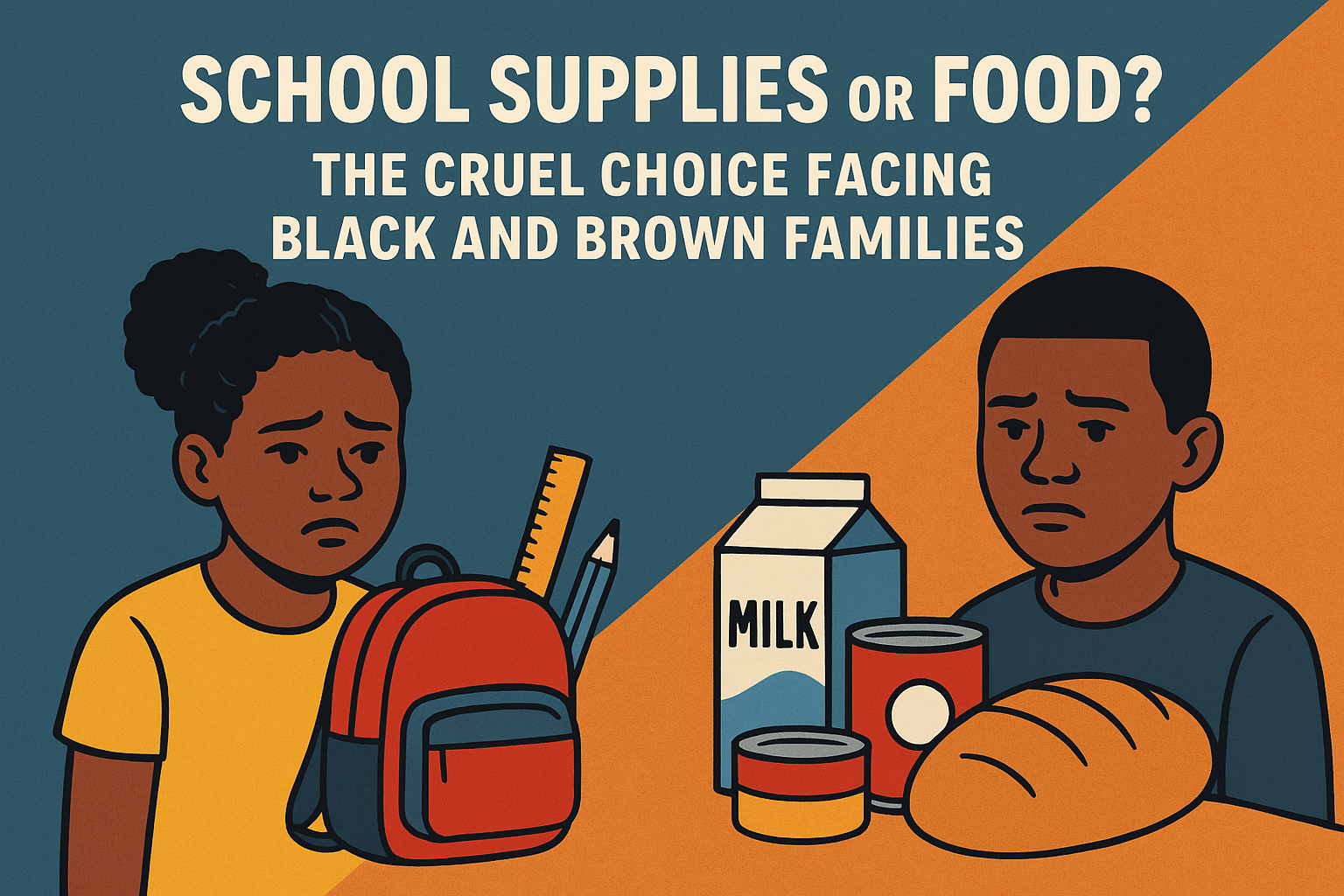





When President Trump signed the One Big Beautiful Bill Act (OBBB) on July 4, 2025, it was framed as fiscal reform. But for millions of families—especially Black and Brown households—it forces a devastating choice: buy school supplies or put food on the table.
The law reshapes the Supplemental Nutrition Assistance Program (SNAP), extending work requirements for able-bodied adults up to age 64, narrowing caregiver exemptions to only those with children under 14, and removing protections for homeless individuals, veterans, and youth aging out of foster care (National Agricultural Law Center, 2025). For communities of color—already experiencing food insecurity at nearly double the rate of white households (USDA, 2024)—these cuts are a direct hit.
The timing could not be worse. More than 300,000 Black women have left or been forced out of the workforce this year, the result of federal layoffs, DEI rollbacks, and persistent inequities (Houston Chronicle, 2025; The Week, 2025). These women are the backbone of many households. Reducing SNAP access while unemployment among Black women rises ensures that hunger will spread across entire families.
Consider the ripple effect: Black veterans facing higher unemployment, Latino youth leaving foster care, and unhoused individuals of color—all denied vital food support. Grandparents raising teenagers, a reality in many Black and Brown families, are now excluded simply because their dependents are older than 13. Instead of strengthening families, the law punishes them for surviving.
To make matters worse, OBBB slashes state flexibility. Previously, states could waive SNAP time limits when jobs were scarce. Now, only areas with unemployment above 10 percent qualify (Investopedia, 2025). That ignores the reality of underemployment, unstable hours, and workplace discrimination that make stable jobs elusive for Black and Latino workers. Meanwhile, Alaska and Hawaii receive special exemptions—a carveout that sends a cruel message to urban Black and Brown communities on the mainland: you’re on your own.
The fallout is predictable. Food banks in Newark, Detroit, Houston, and Los Angeles will strain under rising demand. Parents will face impossible decisions—pencils or pasta, notebooks or nourishment. This isn’t reform. It’s hunger by design.
Congress and the administration must act. Restore exemptions for veterans, foster youth, and the homeless. Expand caregiver protections to reflect family realities. Return waiver flexibility to states. And require federal agencies to publish race-disaggregated data on who loses access to food. Without these steps, the OBBB will be remembered not as fiscal discipline, but as a law that starved America’s most vulnerable communities.
Food is not optional—it is the foundation for learning, labor, and dignity. Until policymakers grasp that, Black and Brown families will continue to face an unconscionable question no parent should have to answer: school supplies or food.
Dr. Charise Breeden-Balaam,LSW