


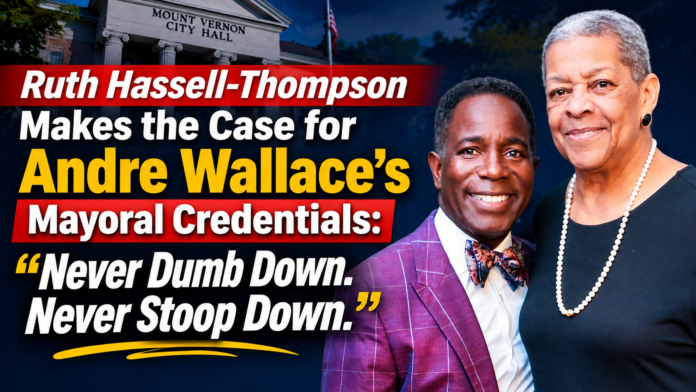






MOUNT VERNON, NY — When former New York State Senator Ruth Hassell-Thompson speaks about Mount Vernon politics, she brings decades of public service and firsthand knowledge of the city's political history. At a recent fundraiser for Mount Vernon City Councilman Andre Wallace at Leewood, Hassell-Thompson delivered more than a routine introduction. She offered a public defense of Wallace's character, his political perseverance, and the qualifications she believes he brings to leadership.
Although she did not explicitly announce or endorse a mayoral campaign in the portion of the speech provided, her remarks raised a larger question about Wallace's political future: Are the qualities she described the same credentials Mount Vernon residents should examine when considering who could lead the city as its next mayor?
For Hassell-Thompson, the conversation was not simply about academic degrees, political titles, or how well a candidate performs in front of a crowd. It was about the work a person has done in the community, the obstacles they have overcome, and whether they have the determination to continue serving when others would have given up.
A Political Elder Speaks About Perseverance
Hassell-Thompson described Wallace as her “bonus son,” explaining that she had watched him develop politically in Mount Vernon and had come to admire his tenacity.
She acknowledged that some people questioned why Wallace continued pursuing elected office after previous defeats. Rather than treating those losses as political weaknesses, she presented his willingness to keep trying as evidence of determination.
“The thing that I appreciate is that many times when people lose, they crawl back under a rock,” she told the audience. “He chose not to do that.”
She also invoked Abraham Lincoln's political history to make the point that losing an election does not necessarily end a person's opportunity to serve.
Her message was that perseverance matters in public life. A candidate's history should not be judged only by the elections they have lost, but also by what they have done between campaigns and how they have continued to contribute to their community.
Community Credentials Matter
One of the most significant moments of the speech came when Hassell-Thompson distinguished academic achievement from what she called community credentials.
“He didn't come here with no credentials,” she said, before clarifying that she was not talking about academic credentials.
“I'm talking about community credentials.”
That distinction is particularly relevant to any discussion about Wallace's qualifications for mayor. A mayor is responsible for more than delivering speeches and attending political functions. The office requires decisions involving public safety, city finances, economic development, municipal services, housing, and the everyday concerns of residents.
Hassell-Thompson's remarks suggested that Wallace's experience in the community deserves consideration alongside the traditional qualifications people expect from public officials.
But her speech also leaves room for a necessary discussion. What specific accomplishments make up those community credentials? How has Wallace's service translated into measurable results? And how would that experience prepare him for the administrative responsibilities of City Hall?
Those are questions residents would reasonably expect any prospective mayoral candidate to answer.
A Businessman, Educator, and Former Mayor
Wallace's background includes experience beyond elected office. According to his published biography, he has lived in Mount Vernon for more than 40 years, operated a construction and development business, and established training opportunities for young people seeking careers in the construction trades.
His biography credits his workforce development efforts with training nearly 1,500 students and placing more than 1,100 participants in construction jobs over a ten-year period. It also describes scholarship assistance, affordable housing initiatives, and employment and housing support for veterans. These are self-reported accomplishments that provide specific areas for further examination.
Wallace also has experience in Mount Vernon's executive branch. He briefly served as mayor in 2019 during a period of political conflict at City Hall and subsequently sought the office through elections in 2019 and 2023. He returned to the City Council in January 2026.
This history gives additional context to Hassell-Thompson's argument about perseverance. Wallace's political career has included both opportunities to hold office and setbacks at the ballot box. His record as a businessman, former mayor, and current councilman provides several areas voters can examine when considering his leadership credentials.
“You May Need to Dress Down, But Never Stoop Down”
Hassell-Thompson also addressed criticism of Wallace's personal presentation and his ability to connect with different segments of the community.
She recalled conversations in which people described him as stiff, too formal, and uncomfortable in certain communities because of his preference for suits and ties.
Rather than dismissing the criticism, she connected it to the expectations historically placed on Black Americans.
“Those of us of African descent learn from birth that we have to look better, act better, learn better 10 times more than anybody else,” she said.
She questioned why someone who had followed those expectations and pursued the American dream would then be criticized for the way he presented himself.
Her advice to Wallace was unmistakable.
“You may need to dress down but never stoop down. And never sit down.”
She followed that message by urging him to hold his head high, remain true to himself, and continue working.
It was one of the most memorable passages of the evening because it went beyond Wallace's personal circumstances. Hassell-Thompson was raising a question about whether political candidates should be expected to change their personalities to satisfy public perceptions, or whether their records and leadership abilities should carry greater weight.
At the same time, connecting with residents remains an important responsibility for anyone seeking public office. The challenge is balancing authenticity with accessibility, particularly in a diverse city where residents have different expectations of their elected representatives.
A Warning About Cliques and Special Interests
Another significant portion of Hassell-Thompson's remarks concerned the political culture of Mount Vernon.
She spoke about residents who want change, inclusion, and an open government where their concerns are heard and addressed.
She specifically criticized the idea of government being controlled by cliques and small special-interest groups.
Her description of the government residents deserve was clear: one where people feel they have a say and where what they say is “heard, respected, and responded to.”
That message has implications beyond one councilman or one political fundraiser. It raises questions about access to local government, transparency in decision-making, and whether elected officials are accountable to the entire city rather than only their political supporters.
For Wallace, the challenge is how those principles translate into his current work on the City Council and any future proposals for the mayor's office.
Why Hassell-Thompson's Words Carry Political Significance
Hassell-Thompson is not simply a former state senator offering encouragement to a younger politician.
Her public service includes serving on the Mount Vernon City Council, becoming council president, and serving as acting mayor before representing the 36th Senate District from 2001 to 2016. She has firsthand experience with both municipal leadership and state government.
That background gives particular significance to her discussion of Wallace's credentials. She has occupied positions that required balancing constituent concerns, government administration, economic development, and political relationships.
When she tells Wallace not to abandon his principles or allow political setbacks to define him, she is speaking from her own experience in public office.
Her comments also deserve to be understood in their proper context. This was a fundraiser, and she was addressing an audience gathered in support of Wallace. Her speech was an expression of confidence in him, not an independent evaluation of his complete political record.
Nevertheless, the themes she chose—experience, perseverance, community service, personal character, and inclusive government—are all relevant to a serious discussion about mayoral leadership.
Was This a Prediction About Wallace's Political Future?
Hassell-Thompson did not explicitly predict that Andre Wallace would become Mount Vernon's next mayor in the available recording. But her remarks can reasonably be interpreted as making the case that his previous defeats should not disqualify him from future consideration.
She encouraged him to remain persistent, defended his professional presentation, emphasized his community credentials, and told those in attendance that people who genuinely want change would listen if he continued working.
The distinction matters. There is a difference between publicly predicting an election victory and expressing confidence that a politician possesses qualities worthy of consideration for higher office.
For Wallace, the speech comes at another stage of a political career that has already included mayoral service, mayoral campaigns, business development, and membership on the City Council.
Whether he pursues the mayor's office again is a decision that will have to be established through his own public statements and actions.
For now, Hassell-Thompson has placed an important argument into the public conversation: Political setbacks do not erase a person's experience, and a candidate's community contributions deserve to be examined alongside their political victories and defeats.
Her message to Wallace was to keep working, remain himself, and not allow criticism to change his sense of purpose.
For Mount Vernon residents, the larger question is how those qualities, together with a documented record of results and a clear governing agenda, should factor into their evaluation of future leadership.
And that is what makes Hassell-Thompson's speech more than an introduction at a fundraiser. It was a statement about the credentials she believes Andre Wallace has already earned and the political possibilities she believes remain open to him.

A multifaceted personality, Damon is an activist, author, and the force behind Black Westchester Magazine, a notable Black-owned newspaper based in Westchester County, New York. With a wide array of expertise, he wears many hats, including that of a Spiritual Life Coach, Couples and Family Therapy Coach, and Holistic Health Practitioner. He is well-versed in Mental Health First Aid, Dietary and Nutritional Counseling, and has significant insights as a Vegan and Vegetarian Nutrition Life Coach. Not just limited to the world of holistic health and activism, Damon brings with him a rich 32-year experience as a Law Enforcement Practitioner and stands as the New York Representative of Blacks in Law Enforcement of America.