







Recognize, remember, release, resurrect — a self-check for faith leaders

I’ve had the joy over the years of working with pastors, ministers, and other faith leaders, and I still marvel at how much their work involves. I’m thinking of the responsibilities that continue after the service, when someone needs to talk, or when a call comes in about a situation nobody quite knows how to handle. Over time I, like many in the congregation, have noticed how easily the pastor’s own need for help can go unrecognized — and, like many, have not stopped to think much about it. I think that is partly because we are accustomed to seeing them respond, and because they do it so consistently, it may never occur to us how heavy the weight is.
Receiving help can also be unfamiliar for the pastor. Some wave it off because they know what other people are dealing with and feel uncomfortable asking anyone to make time for them. There is also something in the role itself. When you have been designated the helper — the one called to shepherd, to lead, to have the answer — being on the receiving end can feel odd, or like a departure from what you were set apart to do. The receiving posture does not come naturally to the spiritual leader, and few people offer it to you anyway, because they assume you are covered.
In my clinical work, I can set appointment hours, arrange breaks, and decide which cases I can accept. There is a fee for what I provide and some structure and timelines around the work. These parameters are not typically in place for pastors. A pastor may be the first (and only) person someone calls when a marriage is in trouble, a relative dies, or a family is frightened about something they have never faced before. That call can come late at night for several nights, long before anyone considers contacting a specialist. Even a pastor who has thought carefully about boundaries may have very little dependable help available. I often wonder how they are able to sustain that level of responsibility year after year, with the expectation that they will always be a call away.
I recall seeing the breadth of their work near the World Trade Center after 9/11. It was a time when people gathered around churches, mosques, and other places of worship, wanting to join hands and pray. They wanted comfort and help making sense of what had happened spiritually. Faith seemed to permeate the atmosphere. I remember people nodding and listening closely as clergy spoke—often in direct contrast to the caution and skepticism they showed when interacting with non-faith-based providers. I could tell that they were hearing something in those words that had a particular meaning for them.
“A bruised reed he will not break” is one of the phrases I remember that seemed to resonate with the survivors receiving care. There was something almost transcendent about those encounters, as I experienced them.
Months later, I spoke at a Heal the Healers retreat for pastors and ministers who were still responding to the aftermath. When I told them how much I appreciated their work, I was shocked by how many began to cry. Some said they felt like robots, just going and going. Others talked about feeling guilty about sleeping while people were hurting. Though physically and mentally depleted, many were still able to push through and work nonstop. They couldn’t quite make sense of that, and some wondered whether God was giving them a special anointing, or extra strength, to keep serving.
“Every healer needs a place and the space to heal.”
When they asked for my thoughts, I told them that every healer needs a place and the space to heal. We discussed what a place and space looked like for them individually. I also asked whether they would be open to sharing a moment of collective stillness, taking a little time to listen and see what thoughts or feelings came up. I had suggested a minute, but it became perhaps two or three as we began noticing sounds inside and outside the room. There was more sniffling and some weeping. It all felt sacred to me. When I asked afterward whether anyone felt comfortable sharing what had happened, some spoke of relief and peace, of feeling connected to themselves again.
I left that experience reflecting on their tenderness and honesty, and how much they needed space to be cared for. I wondered what it would take for them to have that space and feel able to use it. I did some reading with that question in mind. In rereading Luke I noticed Jesus finding a place to have some space, withdrawing to pray even as people sought his help (Luke 5:15–16). I wondered what Jesus was modeling in those moments of solitude and what might have been revealed, or perhaps restored, through silence and prayerful surrender. Over time, I developed these reflections on recognizing, remembering, releasing and resurrecting into a framework that guides my resilience and recovery workshops with healers and ministers.
Recognizing
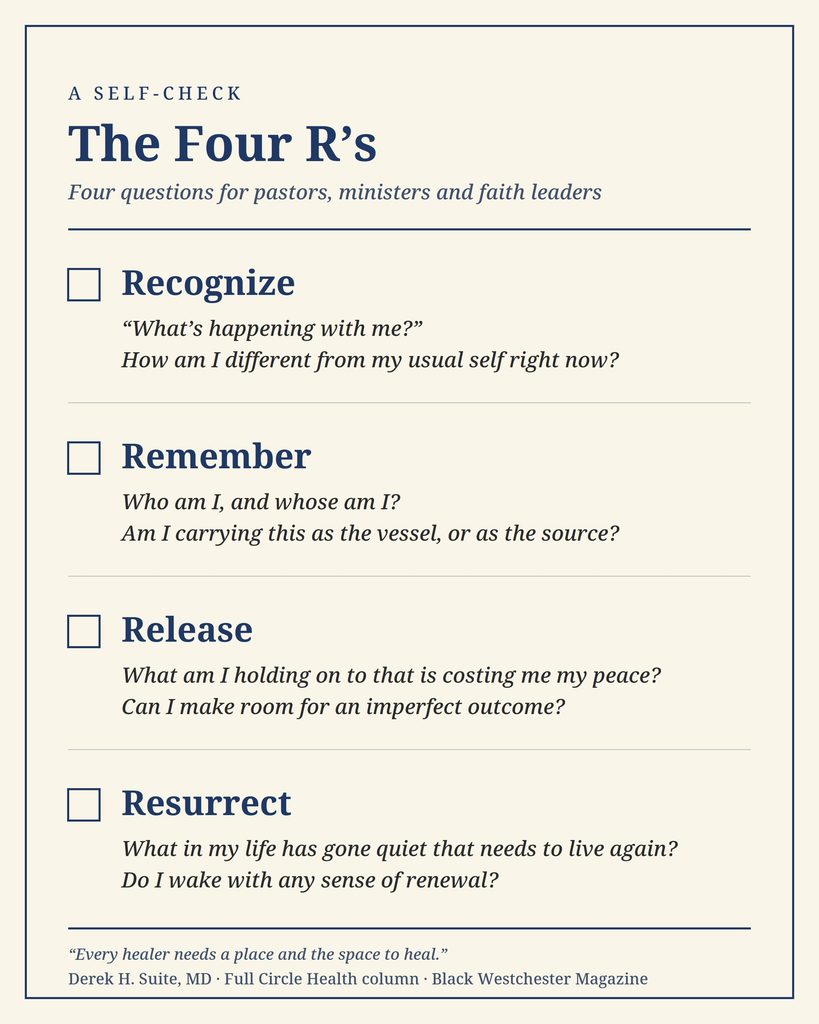
Recognition could begin with taking a few moments to do an honest self-check: “What’s happening with me?” How have I been feeling compared with my usual self, and what has changed in my personal life? How have my sleep, eating, water intake, exercise, personal growth time, and recreational time been affected by my work or ministry? What am I not discerning? Is it time to take a break?
Remembering
Remembering might begin by reflecting on “who you are and whose you are.” This is familiar language to many Christian pastors. Knowing your individual identity and how it aligns with the bigger picture or divine order can bring perspective. It is worth considering how personally responsible you feel for solving every problem that comes your way, and whether remembering yourself as a vessel or messenger through which help can come would allow you some room to rest. It can be easy to deify shepherds and lose sight of them as also being “members of the flock” in God’s eyes, needing guidance and care themselves. Knowing who you are, recognizing your limits in any given situation, and returning to whose you are, with access to the source of all power, can make a real difference.
Releasing
I have come to appreciate that each person will likely need their own inventory of what makes release difficult. Thinking about what is holding you back, binding you, or making it difficult to let go is a solid place to start. What might you be holding on to, or overly attached to, that gets in the way of joy and peace of mind? Even the satisfaction of helping and the appreciation that comes with being needed can make it difficult to step away. Imagining what release would look like for you is also important because it can look different for each of us. An important lesson I learned is that letting go and letting God can involve learning to make peace with imperfect outcomes and finding a way to live with uncertainty. Taking a break can give you time to reflect while you are still working through that.
Resurrecting
When I use resurrecting, I’m thinking about something a person believed had ended or faded, becoming available in their life again. In Christianity, resurrection refers to Jesus rising from the dead. I’m also using the word figuratively here. Pastors and ministers often help us learn how to resurrect our lives even while they themselves are facing setbacks and disappointments. I have found it challenging to determine what constitutes resurrecting in the broader sense for those I work with, so we tend to build a specific, personal resilience plan that targets what needs resurrecting. For one pastor, that might mean returning to a part of life they had stopped enjoying. It may also involve a deeper trust that God can work through them when they are imperfect or have reached their limits. Asking about sleep and its challenges matters here. It can open a conversation about what keeps them awake and whether they wake with any sense of renewal.
I still think about that healing retreat, and the extraordinary pastors and ministers I know, and what it would take for them to have time like that in their everyday lives. Taking a sabbatical often seems impossible given the demands on them, but someone to cover calls or help protect an afternoon away may be possible. Those small arrangements matter if the pastor is going to have a place and space for reflection and recalibration.
References
Luke 5:15–16 (English Standard Version). Verse 16 reads, “But he would withdraw to desolate places and pray.”
Isaiah 42:3 (English Standard Version): “a bruised reed he will not break, and a faintly burning wick he will not quench; he will faithfully bring forth justice.”
If you need support
Faith-based counseling is available at Full Circle Health, PLLC (332) 228-2896 to make an appointment.
The 988 Suicide & Crisis Lifeline is available 24 hours a day by call or text. NAMI Westchester offers free support groups and referrals for individuals and families.
|
FULL CIRCLE HEALTH COLUMN Derek H. Suite, MD Derek H. Suite, MD, is an ordained minister, double board-certified in psychiatry and in sports and performance psychiatry, a graduate of the Columbia University Graduate School of Journalism, and the founder of Full Circle Health, PLLC. He consults to professional sports organizations. He is the host of the weekly SuiteSpot podcast and contributes monthly to Black Westchester Magazine, writing here in his personal capacity. |