







All That Talk About Change, AIPAC Money, and New Leadership — Only to Return to the Same Leadership and the Same Unanswered Questions
By Damon K. Jones | Publisher, Black Westchester Magazine
Well, here we are again. After months of political noise, protests, accusations, and demands for change within the Democratic Party, Hakeem Jeffries has secured his party’s nomination for Speaker of the House by an overwhelming vote of 251 to 11. And here is the part that should make everybody stop and think. Nobody even challenged him for the position.
That’s right. After all the criticism about AIPAC money, corporate donors, and the Democratic establishment, not one person stepped forward to run against Jeffries. Eleven Democrats opposed him, but 251 supported him. That is not a political revolution. That is the same leadership structure receiving another overwhelming vote of confidence.
Now, I am not suggesting that people don’t have the right to criticize Jeffries. They absolutely do. But I question what all that criticism accomplished when the opportunity came to turn political demands into actual power. There is a difference between making noise and making change, and Black America should understand that difference better than anybody.
All That Talk About Change — What Changed?
Let’s remember what we witnessed leading up to this leadership election. Progressive activists were demanding new Democratic leadership. Some criticized Jeffries over his relationship with AIPAC and other political donors, while others argued that Democratic leadership was disconnected from the progressive movement.
We heard demands concerning Medicare for All, immigration enforcement, Gaza, and getting corporate money out of politics. We watched activists organize protests and circulate petitions demanding accountability. But when the votes were counted, Jeffries faced no declared opponent.
So, what happened to the movement for change? Where was the alternative candidate? Where was the coalition prepared to replace the leadership they spent months criticizing?
The election does not mean their concerns were meaningless. It means those concerns did not produce a successful leadership challenge. And that raises a serious question about whether some political movements are more effective at generating headlines than producing political results.
The First Black Speaker — But Where Is the Black Agenda?
Now let me address something even more important to me.
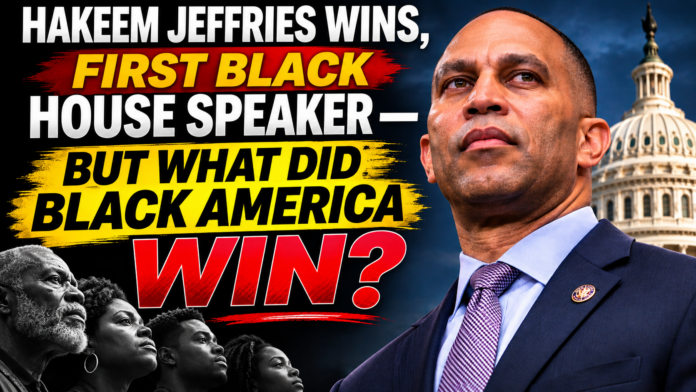
If Jeffries wins the full House vote in January 2027, he will become the first Black Speaker of the House in American history. That would be a historic accomplishment, and I have no problem acknowledging its significance.
But I have said for years that Black representation and Black political empowerment are not automatically the same thing.
We celebrated the first Black president. We have celebrated Black governors, mayors, congressional leaders, and other elected officials. Yet celebrating political history does not automatically close the racial wealth gap, increase Black homeownership, strengthen Black families, or create generational wealth.
So, my question for Hakeem Jeffries is simple. Where is the specific Black American agenda?
I am not talking about another broad statement concerning diversity or helping every underserved community. I am talking about an agenda addressing the historical and economic conditions of Black Americans, particularly descendants of American slavery.
Where is the plan to expand Black homeownership? Where is the commitment to Black-owned businesses and economic independence? Where is the strategy to strengthen Black families and communities? And where is the legislative timetable for reparations?
Jeffries has supported broader policies involving healthcare, housing, and economic opportunity that can benefit Black Americans. But those policies are not a substitute for a clearly defined agenda addressing our unique historical circumstances.
Everybody Has an Agenda Except Black America
What caught my attention about the progressives opposing Jeffries was that they clearly identified their priorities. They demanded action on healthcare, immigration, political contributions, and foreign policy.
Whether you agree with those positions or not, those activists understood something important about politics. Political support should come with political expectations.
So why does Black America continue struggling to get a specific agenda placed on the national political table?
Other constituencies openly advocate for their interests, and I have no problem with that. But descendants of American slavery should not have to apologize for demanding policies that address our history, economic conditions, and future.
We have supported the Democratic Party for generations. We have organized, marched, volunteered, donated, and voted. We have been told repeatedly that Black voters are essential to Democratic victories.
Well, if our votes are that important, our political interests should be important enough to receive specific legislative commitments.
And with Democrats preparing to control Congress in January, those commitments should include hearings, proposed legislation, funding priorities, and recorded votes. Control of Congress does not guarantee every bill becomes law, but it provides opportunities to demonstrate what party leadership is willing to advance.
Black America Needs Results, Not Another Historic First
I want to be clear. This is not about attacking Hakeem Jeffries because he is Black. Nor am I suggesting that he should represent only Black Americans. As Speaker, he would have responsibilities to the entire country.
But those responsibilities do not prevent Black Americans from demanding accountability on issues directly affecting our communities.
We cannot continue measuring political progress by the number of Black faces occupying powerful positions. We must measure progress by whether Black families are building wealth, owning homes, strengthening communities, and creating opportunities for future generations.
The progressive movement made its demands known. Other political constituencies have made their demands known. Black America has every right to do the same.
My Final Thoughts
Hakeem Jeffries won the Democratic leadership nomination overwhelmingly. Despite months of criticism, nobody challenged him directly. The same leadership remains in place, and the questions about the Democratic Party’s priorities remain unanswered.
Jeffries is now positioned to make American history. But making history and delivering measurable progress are two different things.
I want to know whether reparations will receive serious consideration. I want to know what legislation will address Black homeownership, generational wealth, and economic independence. Most importantly, I want to know what Black Americans can expect from the political power they helped Democrats obtain.
Hakeem Jeffries won. The Democratic establishment won. But what did Black America win?
Because representation without accountability is not enough, and political history without measurable progress cannot be our final destination.
Only Black America can save Black America.

A multifaceted personality, Damon is an activist, author, and the force behind Black Westchester Magazine, a notable Black-owned newspaper based in Westchester County, New York. With a wide array of expertise, he wears many hats, including that of a Spiritual Life Coach, Couples and Family Therapy Coach, and Holistic Health Practitioner. He is well-versed in Mental Health First Aid, Dietary and Nutritional Counseling, and has significant insights as a Vegan and Vegetarian Nutrition Life Coach. Not just limited to the world of holistic health and activism, Damon brings with him a rich 32-year experience as a Law Enforcement Practitioner and stands as the New York Representative of Blacks in Law Enforcement of America.