

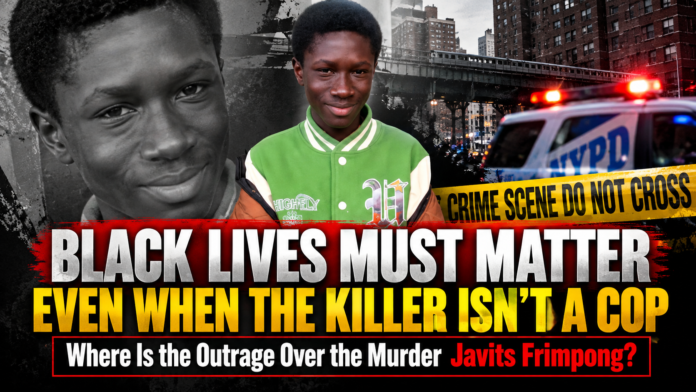




Where Is the Outrage Over the Murder of 15-Year-Old Javits Frimpong?
A 15-year-old Black boy left home to go to school in the Bronx and never came back. Javits Frimpong. His family came from Ghana to the US in search of opportunity and a better life. What they now face is the unimaginable agony of burying a child who was supposed to have a whole life ahead of him. The paper reports that Javits was shot as he was going to school. His dad has claimed that his son was being bullied and that the school authorities were aware of the problem. The police have not established whether the bullying in any way led to his murder.
Before we get into politics, activism, or accountability, we must remember this was somebody’s child. Somebody who had dreams, somebody who had friends, somebody who had fears and a future. His parents sent him to school expecting him to come home. What they got instead was the news that no mother or father should ever have to hear. As I watch this tragedy unfold, I find myself asking a question that should make every Black organization, every civil rights leader, every elected official, and every community activist feel uncomfortable.
Where is the outrage?
Accountability must work both ways
I spent 33 years in the force, and I’ve always fought for accountability on both sides of the badge. I’ve challenged misconduct, challenged institutional failure, and always demanded that the force be held to the standards it is expected to operate under. I’ve also challenged the behaviors in our own communities that lead to violence, lead to instability, and lead to the destruction of Black families.
I’ve never believed accountability should depend on someone’s race, occupation, political affiliation, or uniform. If a cop violates someone’s constitutional rights, that cop must be held accountable. If an ICE agent uses force in an unlawful manner, that behavior must be investigated, and that agent must be held accountable. Yet when a Black child is murdered in our own community, where is that same organized demand for justice? Where are the community meetings? Where are the rallies? Where are the emergency calls? Where are the leaders demanding a solution?
We can’t carry on pretending that Black lives only become a national priority when the person accused of taking one is in a badge.
The selective outrage that is destroying our credibility
Over the years, I’ve seen how fast certain organizations and individuals will move to get involved when an incident involving the police becomes a racial one. The moment the full facts are known, the social media channels are full of comments. The cameras come, the microphones come, and the activists who were nowhere to be seen the week before suddenly are the loudest voices in the room demanding justice.
Sometimes that outrage is entirely justified. We’ve seen real cases of police brutality, real cases of unlawful killing, real cases of discriminatory enforcement and real cases of government misconduct. I’ve challenged those issues head-on, and I will continue to do so. Genuine outrage at police misconduct in no way justifies our refusal to face the violence that exists in our own communities.
What worries me is the rise of the internet influencer culture and the protest profiteers. People have learned that racial controversy will generate followers, donations, media coverage and political clout. Every incident is an opportunity to build a personal brand. Every confrontation is content. Every incident involving police is another opportunity to be the voice of Black America.
I’m not saying every activist works that way. There are absolutely people out there who are doing the hard, thankless work of protecting our communities. But we must be prepared to question those who will jump in whenever racism can be attached to a headline and who simply don’t seem to be present when it comes to the actual, day-to-day work of tackling violence within our own communities.
If your activism only comes to light when there’s a white officer, an ICE agent or an allegation of racism then people are right to question the consistency of your commitment to Black lives.
Where are our civil rights organizations?
As of right now I can’t find any public statements from any of the major civil rights groups (Black Lives Matter Global Network Foundation, Black Lives Matter Greater New York, the national NAACP, the NAACP New York State Conference, the NAACP Bronx Branch, the National Action Network, the National Urban League, the New York Urban League, the Black Alliance for Just Immigration, the Movement for Black Lives, Color of Change and the Black Youth Project 100) making any reference to the killing of 15 year old Javits Frimpong.
That doesn’t mean those organizations have done nothing, and I’m certainly open to any statements or actions that haven’t yet come to light. It does, though, raise a very pertinent question which needs to be answered: Where is the same level of highly visible, sustained pressure against the violence which is taking the lives of Black children in our own communities?
We have organizations in place to mount national demonstrations, mobilize thousands of people, and demand that police forces and government agencies be held to account. Why shouldn’t we have the same capacity to use that organization to protect our children from the senseless violence that is occurring in our communities daily?
We’re not saying these organizations have never done anything about community violence. Over the years, several chapters, members, and local leaders have been involved in anti-violence work. The question is whether preventing the murder of Black children gets the same level of sustained attention from the organization as cases of alleged police violence.
Where are the coordinated campaigns on youth shootings? Where are the ongoing efforts to deal with bullying, gang recruitment, illegal guns and reprisals? Where are the partnerships with parents, schools, community groups, and other legitimate violence-prevention people?
A press conference following a police shooting may be the right thing to do, but protecting Black children requires so much more than simply reacting to tragedy. It requires us to be there before the next child is shot.
What about the violence we do to each other?
We need to have an uncomfortable conversation about violence in Black communities. It’s not that Black people are in any way more violent than any other group. It’s not that we should just brush it under the carpet and pretend it doesn’t happen. We need to have this conversation because children are dying, families are suffering and too many people have simply come to accept violence as part and parcel of everyday life.
We talk about racism, discrimination, poverty, unemployment and the lack of opportunity in education. All of those are very real issues and all of them are issues that we need to be talking about. We also must talk about personal responsibility, the role of the parent, conflict resolution, community relationships and the normalization of violence.
We’ve got young people who can’t resolve a disagreement without resorting to threats. We’ve got kids being bullied, intimidated and humiliated, and adults who are just completely unable to do anything about it. We’ve got communities where people won’t cooperate with an investigation for fear of retaliation. We’ve got families who have children murdered, and then the public just moves on to the next thing that’s in the news.
I won’t accept the argument that talking about violence in our communities in any way justifies racism or gives fuel to those who are already predisposed to have a negative view of Black people. That’s politics over human life. You can’t build safer communities by refusing to acknowledge the problems in our communities.
Black accountability is not anti-Black. It is a necessary part of Black progress.
Our elected officials must answer too
Every election cycle, you’ve got politicians turning up in Black churches, community centers, housing developments, and local businesses in the neighborhoods asking for our votes. They’re all talking about the importance of protecting our communities, public safety, education, and creating opportunities for our young people. But when another child is murdered, we need more than a statement of sympathy and a few well-worded platitudes.
What are the actual outcomes of the programs being funded in our communities? Are the schools tackling bullying and threats? Are violence-prevention organizations being assessed on outcomes rather than political connections? Are the parents being consulted on matters of school safety?
In Javits Frimpong’s case, his father’s allegations of bullying absolutely require investigation. If school staff knew his son was being threatened or bullied, the public has a right to know what steps were taken, whether those steps were adequate, and whether anyone had information that could have suggested the situation might escalate into something more serious.
That’s not an accusation that the school caused his death. It’s a call for answers as to whether the opportunities to protect a child were in fact missed.
We cannot police our way out of every problem
After 33 years in Law Enforcement, I know what professional standards are, I know what constitutional protections are and I know that you can’t just have a police department solving the problem of community violence on its own.
Public safety is about responsible policing, strong families, working schools, credible community leadership, and citizens who simply won’t accept bad behavior as the norm. It’s about parents who correct their kids, adults who step in before a situation blows up, and organizations that do the boring, unglamorous work nobody ever talks about on social media.
I’m sick of seeing Black suffering turned into political capital while the real work of building our communities gets barely a mention. I’m sick of the notion that every problem in Black America must be framed as being caused by some external villain before we can even begin to organize around it.
We have every right to demand justice from the institutions of government. We also have an obligation to demand accountability from ourselves.
Accountability cannot stop at the badge.
Black lives must matter every day
Javits Frimpong should be alive today. He should be out there doing the normal things that kids do, doing their homework, making friends, thinking about graduation, thinking about what they’re going to be when they grow up. His parents should be doing what parents do to prepare a child for adulthood. They should not be doing the things that parents do to prepare to bury a child.
His death absolutely must not be another headline that just vanishes after a few days. It must make us all stop and think about what we value, what we are prepared to tolerate, and whether the organizations that claim to be the voice of Black America are addressing the full spectrum of threats to our children.
I’m not interested in the game of who’s the most tragic. What I’m interested in is setting one standard: every Black life matters, every victim deserves justice, and every person who’s committed unlawful violence deserves to be held accountable.
Whether the individual pulling the trigger is in a police uniform, wearing a federal badge, or just a hoodie, the value of the life taken is the same.
To the Frimpong family, my heartfelt condolences. Your son’s life was real, and his death is a very real thing, and there are questions that need to be answered.
To the activists, the influencers, the civil organizations, and the elected officials who claim to be the voice of Black America, I have this challenge for you: Show our children that their lives matter before they become victims, not just when their deaths are politically useful.
Only Black America Can Save Black America.