

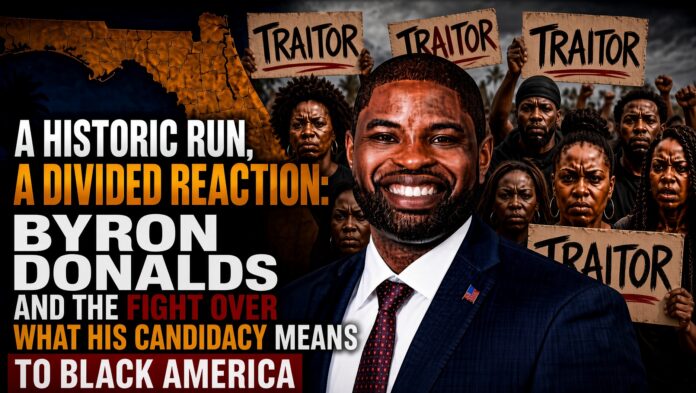




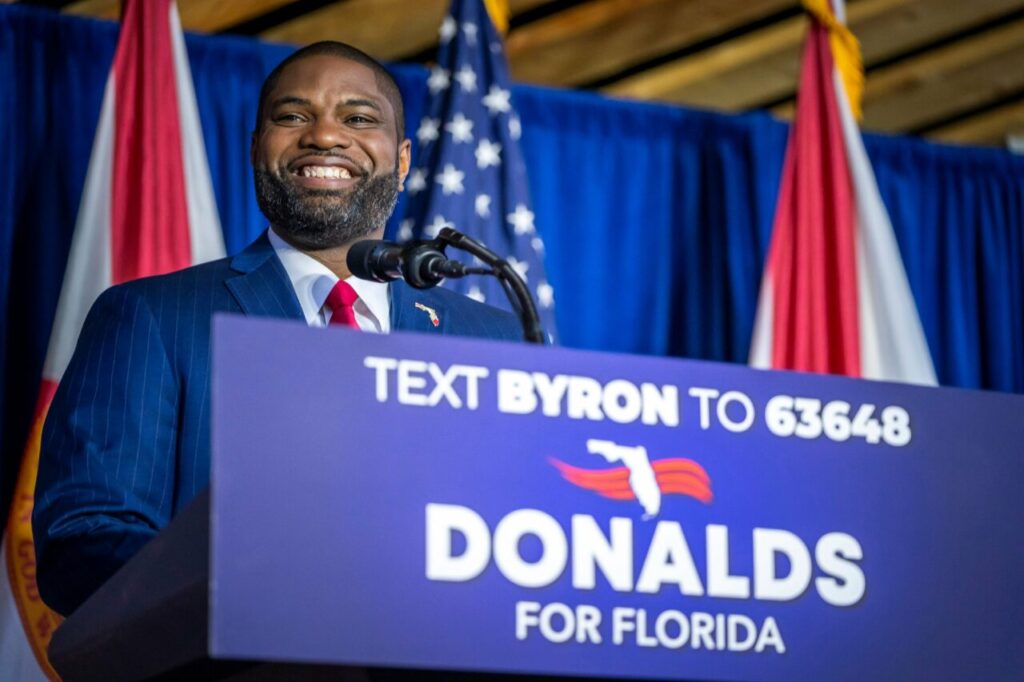
Byron Donalds needs just one election to become Florida’s first Black governor. Donalds, a Republican congressman, easily won his primary on Aug. 18, 20 and, at that point, had already amassed a significant financial lead over his Democratic opponent, David Jolly, who had formerly been a Republican before crossing over to the Democratic Party. He’s running on a campaign war chest of $100 million dollars, thanks to mega Republican donors like Ken Griffin. He also has the endorsement of former President Donald Trump. Donald’s impending accomplishment should be something that we can all celebrate. He was born in Brooklyn and spent several years working in the banking, finance, and insurance industry before pursuing a career in politics. He is poised to become Florida’s first Black governor. But this moment is not being celebrated in quite the same way among Black Floridians and Black political analysts nationwide. The rift illuminates how America talks about race and representation more than it highlights anything about Donalds himself.
The case for pride
Others say that representation is representation. That for Black people to know that someone who looked like them made it to the highest office in the state, regardless of the state’s often fraught and frequently violent racial history, should be celebrated regardless of party affiliation. They argue that milestone ‘firsts’ have been heralded on both sides of the aisle: cite the first Black secretary of state, or the first Black Supreme Court justice, or the first Black president. Arguing that a Black Republican’s accomplishment is any less deserved or legitimate than a Black Democrat’s sets a dangerous precedent, they say, one that implies that Black accomplishments are only acceptable if they help progress a particular partisan goal. Donalds has, at times, leaned into this framing, recounting his own story — arriving in Florida at 17 years old with nothing but a Greyhound ticket and a suitcase full of clothes, putting down roots to start a family and build a career, and working his way up to the state legislature and now Congress — as one example of what Florida has offered him regardless of political beliefs.
Read: The Rise of Black Republicans: Traitors or Trailblazers?
The case for skepticism, even anger.
For others, the criticism stems not from Donald’s race, but instead his political beliefs and what they see as his race being exploited by a party which they feel willfully works against Black political and economic interests when it comes to issues like voting rights, criminal justice, and civil rights enforcement. People who believe this see celebrating a “first” as a hollow gesture while ignoring the policy positions that person espouses, and they argue that having a representative without unity on key issues is not the type of progress praised in these situations. Some of the criticism goes a step further by accusing the GOP—whether intentionally or not—of attempting to downvote fraud claims, weakening criticism of the GOP’s positions on race-centric policies by electing Donalds, a Black person, who can help defend their policies. During his career, particularly for being a prominent Trump surrogate and vocal critic of the legitimacy of the 2020 election, Donalds has faced this criticism from within Black Democratic political circles.
Why both reactions are coherent
Both answers are fair. Just as any collective of individuals is diverse, so too has the question of whether ‘representation’ should be measured by identity or alignment with one’s political interests been a long-running debate within American politics – we’ve seen it with Clarence Thomas, with other Black Republican politicians prior to him, and we will see it again. What’s notable about the Donalds is the degree to which this is the case: a real opportunity to take the reins of the nation’s third-largest state, seeing as Florida’s Republican voter rolls now outnumber Democrats by 1.5 million – indicating this is no mere gesture or unlikely bid, but a tangible route to the governor’s mansion.
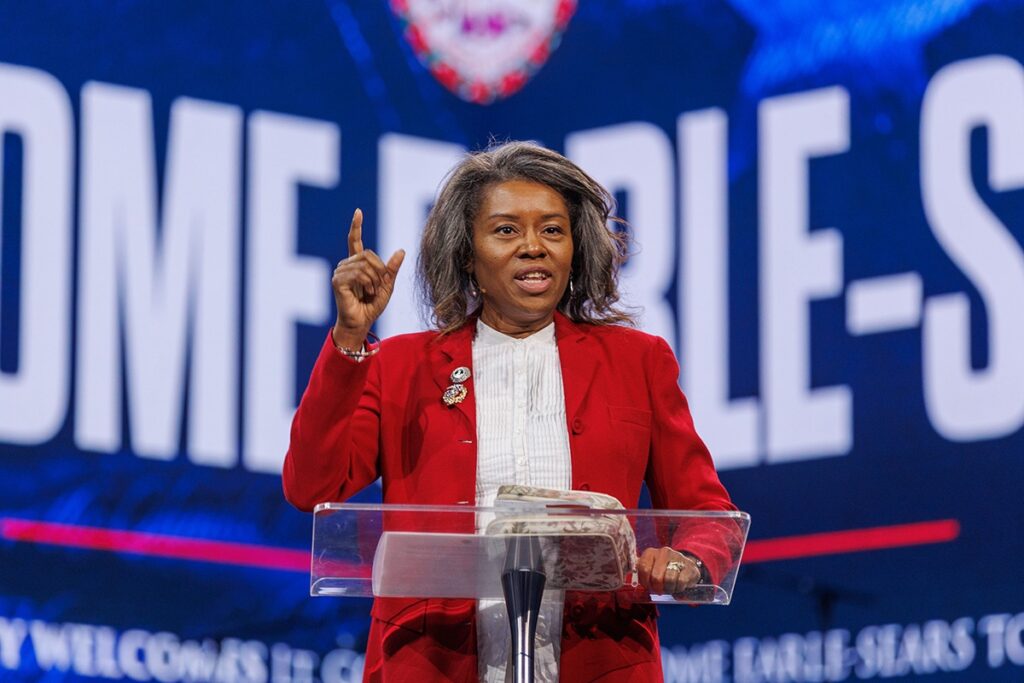
A preview in Virginia
Virginia was an early example of this dynamic playing out. Winsome Earle-Sears, a Black woman, a veteran of the Marines, a mother of three who supported herself and several others working multiple jobs, and Virginia’s first-ever Black statewide officeholder — ran as a Republican in 20×5 and found that her biography alone did not automatically grant her the institutional support many assumed it would. The Virginia NAACP technically does not endorse any candidate, Democrat or Republican. The group clarified that during her campaign.
However, actions spoke louder than words: the NAACP had noted the “historic significance” surrounding Earle-Sears’ 20×1 nomination in 2021, but offered no accommodation for her to run again in 2025, despite her opponent, Democrat Abigail Spanberger, headlining the group’s state convention. Earle-Sears ultimately lost in the general election. To her critics, nothing had happened. Her supporters saw it as undeniable proof that support from Black institutions had subtly shifted to favor a particular party, meaning a Black candidate’s pioneering status was only lauded when it benefited Democrats.
Regardless of which side one takes, what happened to Earle-Sears in Virginia last year was the same phenomenon as surrounds Byron Donalds in Florida: Black candidates’ race is becoming politicized by both parties and voters alike less by their identity and more by the party they chose to attach themselves to.
What’s next
Donalds will be running against David Jolly in November. Recent polls show the race to be tighter than Republicans would like against independents, but Donalds remains the heavy favorite come fall. Regardless of who wins however, the controversy over his candidacy won’t likely disappear. If anything, a win for Donalds would likely amplify the conversation surrounding what a “first” means and for whom.