



Let’s ground this in reality before we talk about vibes.
- Nearly half of New York renters are rent-burdened, meaning more than 30% of their income goes straight to housing.
- In Westchester County, housing costs have grown faster than wages for years, squeezing not just low-income renters, but teachers, nurses, municipal workers, artists, the people who make the county function.
- The private market has not produced permanently affordable housing at scale, because permanence and affordability are not profitable goals.
That’s not ideology. That’s math.
Now let me tell you what happened Thursday evening at the White Plains Public Library, because if you weren’t there, you need to understand why people who were won’t forget it.
I walked in halfway through, and that made it clearer
I didn’t arrive for the opening remarks. I walked in midstream.
And instead of feeling like I missed context, it felt like I walked into momentum.
No rows of chairs facing a stage.
No microphones waiting to be passed.
No polite silence.
There were tables. Markers. Large sheets of paper already filled with ideas in different handwriting, evidence that people weren’t being talked at, they were already working.
Phones were face down. Jackets half-off. That specific Westchester posture: tired, alert, and unwilling to waste time.
That’s when it clicked:
You didn’t miss a meeting.
You missed a moment.
Let’s be clear about whose room this was
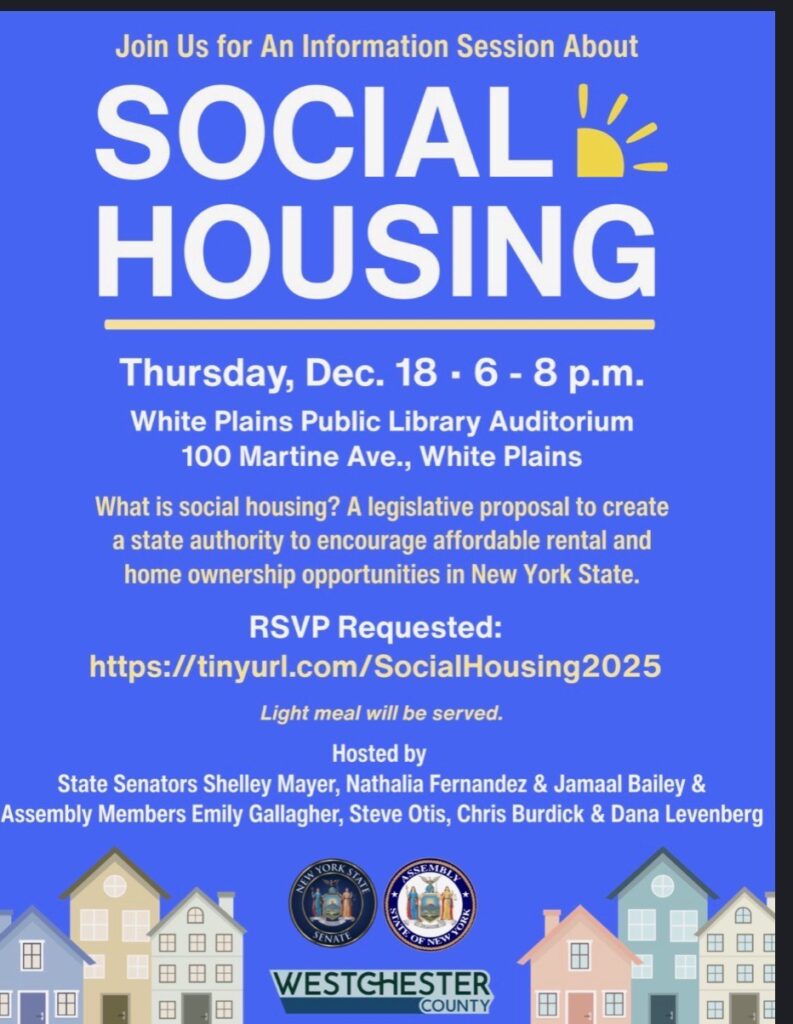
This wasn’t an informal gathering or a one-off conversation. This was a state-led convening, and the host list reveals how seriously it was taken.
The Social Housing information and visioning session was hosted by:
- Shelley Mayer
- Nathalia Fernandez
- Jamaal Bailey
Alongside Assembly Members:
- Emily Gallagher
- Steve Otis
- Chris Burdick
- Dana Levenberg
These weren’t just names on a flyer. These were elected officials showing up to listen, learn, and participate, not just speak.
The presentation that aligned the room
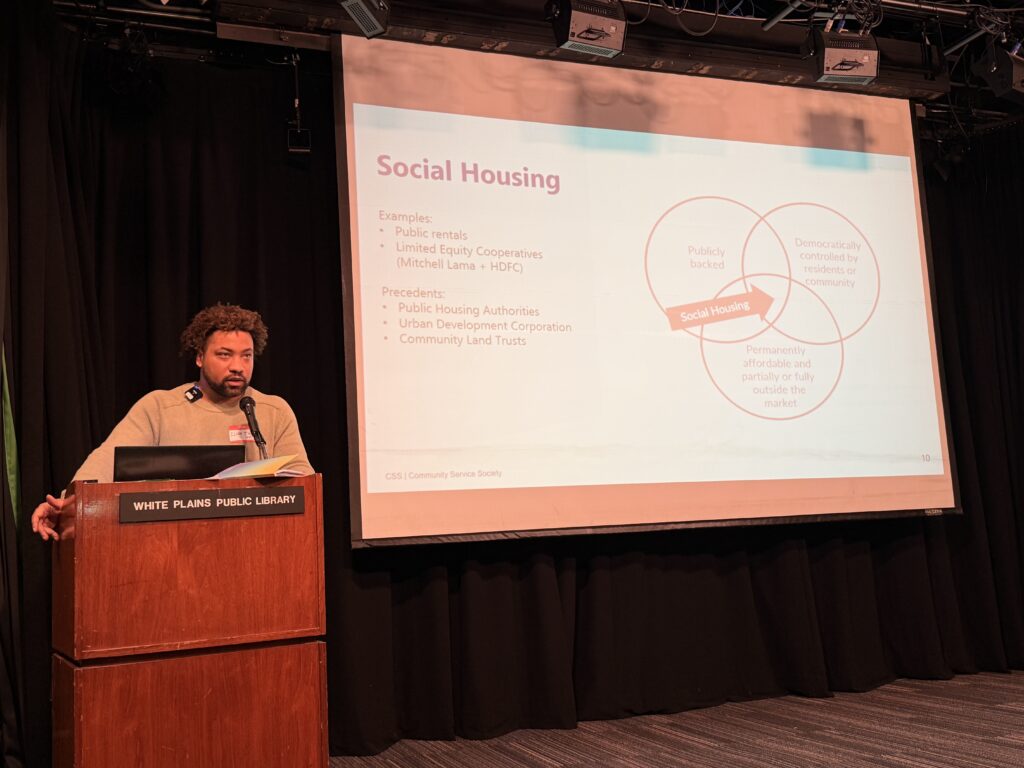
Before the breakout work began, there was a grounding presentation by Iziah Thompson.
No scare tactics.
No abstract theory.
Just a clear explanation of:
- What social housing actually is
- Why New York’s current system reproduces scarcity
- How removing housing from speculative market pressure changes outcomes, not just rent, but stability, health, and long-term community cohesion
That presentation mattered. It gave everyone a shared language before anyone picked up a marker.
When power pulls up a chair, the energy shifts
Here’s the part people don’t forget.
Shelley Mayer wasn’t observing from the edge of the room.
She was in the huddles.
Marker in hand.
Walking through the housing solutions exercise.
Listening. Asking questions. Adjusting in real time.
Right alongside her was Evelyn Santiago, also seated at the tables, not facilitating from above, not collecting sound bites, but engaging residents as collaborators.
That matters in Westchester, where too often the distance between lived experience and policy feels intentional.
This wasn’t proximity for optics.
This was shared labor.
Emily Gallagher’s lens didn’t sugarcoat the truth
The session centered on New York’s Social Housing bill A6265 / S5674, championed by Emily Gallagher.
Her framing was direct:
Housing should be treated like infrastructure, not a speculative asset.
The bill would establish a Social Housing Development Authority tasked with building:
- High-quality, union-built, sustainable housing
- Permanently affordable units (not time-limited deals)
- Rent is capped at approximately 25% of income, regardless of how much you earn
- Mixed-income communities by design, not by loophole
Vienna and Singapore weren’t offered as dreams; they were offered as proof.
For anyone who wants to go deeper into the bill and the movement behind it, the living resource is here:
Spend time with it.
What people asked for says everything about the system
When residents were asked what kind of housing they would design for real life, not for investor decks, nobody said “luxury.”
They said:
- Stability
- Dignity
- Predictability
Housing that doesn’t disappear after a compliance period.
Housing that doesn’t punish you for earning more.
Housing that doesn’t require you to re-prove your humanity every lease cycle.
If that sounds radical, that’s not on the people in the room.
That’s on what we’ve been conditioned to accept.
Yonkers was in the room, and that was intentional
Also present were George Kevgas, Housing Chair of the Yonkers NAACP, and Kisha Skipper, President of the Yonkers NAACP.
That presence wasn’t symbolic.
Yonkers understands how displacement unfolds quietly, first as rising rents, then as longer commutes, then as families being told it’s “just the market.”
Housing isn’t just an affordability issue.
It’s a civil rights issue.
And the ending is why this will stay with people
Before anyone packed up.
Before coats went back on.
Before the room dissolved.
Every table reflected out loud.
Not summaries.
Realizations.
People said things like:
- “This feels doable.”
- “I’ve never been asked to think this way before.”
- “This is the first time housing didn’t feel like a fight.”
That’s not policy language.
That’s a shift in consciousness.
That’s the village remembering itself.
Why you really don’t want to miss the next one
Once you sit in a room where your ideas are treated like data, not complaints, you don’t go back.
Once elected officials stop performing and start building with you, the old meetings stop working.
I walked in halfway through on a Thursday evening and still felt it.
So read Emily Gallagher’s work.
Visit https://housethefuture.com/.
And when the next session is announced, clear your schedule.
Because next time, you shouldn’t have to hear about it secondhand.
You didn’t miss a meeting.
You missed a moment.