

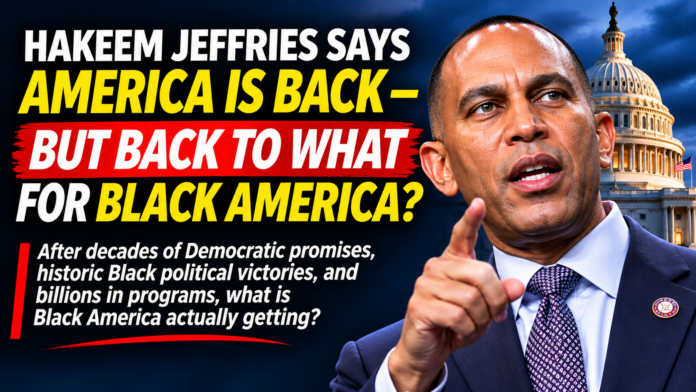






After decades of Democratic promises, historic Black political victories, and billions spent on government programs, the question remains: What is Black America getting?
On election night, House Democratic Leader Hakeem Jeffries stood before a cheering crowd celebrating his party’s victory in the 2026 midterm elections. Democrats had regained control of the House of Representatives, and Jeffries was positioned to become the first Black Speaker of the House in American history. It was a historic political moment, especially for a Black man from Brooklyn who had risen to the highest levels of congressional leadership.
But as I listened to his speech, I found myself asking a question that I believe every Black American should be asking of our political leadership: When Hakeem Jeffries says America is back, exactly what America is he talking about, and what does that mean for Black America?
I heard the familiar promises about affordable housing, good-paying jobs, healthcare, education, and retirement. I heard him promise to fight for working-class Americans, middle-class Americans, and Black and brown communities. These are important issues, but they are also the same issues Democrats have been campaigning on for decades.
At some point, we must stop measuring political success by the number of Black faces standing at the podium and start measuring it by the economic conditions of Black families sitting at their kitchen tables.
A Historic First Is Not an Economic Plan
Let me make something clear. Hakeem Jeffries becoming the first Black Speaker of the House would be an extraordinary historical achievement. Nobody should dismiss the significance of a Black man reaching a position that was unavailable to Black Americans for much of this country’s history.
But history has already taught us that representation and economic transformation are two different things. Having someone who looks like us occupying a powerful office does not automatically mean that the economic conditions of our communities will improve.
We celebrated Barack Obama becoming the first Black president in 2008. Millions of Black Americans viewed his election as proof that America was finally moving beyond some of its racial barriers. His victory inspired an entire generation, and his presidency will always occupy an important place in American history.
But inspiration does not pay a mortgage. Representation does not automatically create a business, and political symbolism does not guarantee that a Black child receives a quality education.
If Jeffries becomes Speaker, I want to know what he intends to accomplish beyond making history. What legislation will he prioritize to expand Black homeownership? What economic development strategy will help Black-owned businesses compete? What policies will create opportunities for Black families to build wealth rather than simply survive from paycheck to paycheck?
Those questions are not disrespectful. They are what political accountability is supposed to look like.
We Already Had Eight Years of Barack Obama
One of the reasons I question these promises is that we have already experienced eight years of a Black Democratic president. Barack Obama entered the White House with enormous political support from Black Americans, and his administration inherited an economy devastated by the Great Recession.
To be fair, the Obama administration helped guide the country through an economic recovery. The Affordable Care Act expanded access to health insurance, including for millions of Black Americans. Those achievements deserve recognition, whether someone supported Obama politically or not.
But we also must examine what happened to Black wealth during those eight years.
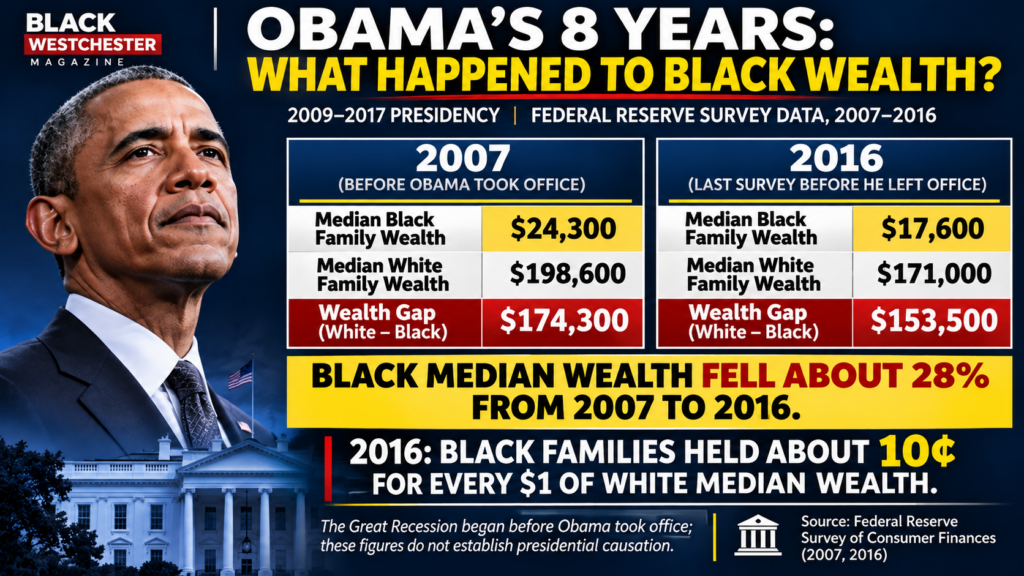
Barack Obama made history as America’s first Black president, but what happened to Black America’s economic wealth during his eight years? According to the Federal Reserve, median Black family wealth declined from approximately $24,300 in 2007 to $17,600 in 2016, a decrease of nearly 28%. Although the Great Recession began before Obama took office and devastated Black household wealth, the recovery did not restore Black families to their pre-recession position. By the end of his presidency, Black families held approximately 10 cents in median wealth for every dollar held by white families. The question is not whether Obama made history. He did. The question is whether making history translated into lasting economic progress for Black America.
Think about that. After eight years of the first Black president, the typical Black family still possessed only a fraction of the wealth held by the typical white family.
That does not mean Obama personally created the racial wealth gap. It existed long before his presidency, and the housing crash had devastated Black household wealth. But it does demonstrate that economic recovery and historic political representation were not enough to overcome generations of accumulated economic inequality.
And that is where my criticism begins. Why was there not a stronger, sustained national strategy centered on Black ownership, entrepreneurship, skilled trades, and generational wealth? Why did economic independence never become the defining measure of progress for Black America?
The Democratic Party Has Been Making These Promises for Generations
For decades, Democrats have positioned themselves as the political party most responsive to Black Americans. They have championed civil rights legislation, voting protections, social programs, public education funding, and access to healthcare. Those policies have produced real benefits, and pretending otherwise would not be an honest examination of history.
However, acknowledging those accomplishments does not mean we should ignore the economic problems that remain unresolved.
Black Americans continue to face substantial disparities in homeownership, business capital, household wealth, and educational opportunity. These problems have persisted through Democratic and Republican administrations, Democratic-controlled cities, and Republican-controlled states.
In many predominantly Black communities, Democrats have held local political power for generations. Yet residents still struggle with failing infrastructure, limited employment opportunities, expensive housing, and schools that do not consistently prepare children for economic independence.
It is reasonable to ask how much responsibility belongs to federal policy, state government, local leadership, and broader economic forces. But it is equally reasonable to ask elected officials to explain what they have accomplished with the authority voters entrusted to them.
We cannot keep accepting the explanation that Republicans are responsible for everything wrong in Black America while refusing to examine the record of Democratic leadership. Republicans deserve scrutiny for their policies and decisions, but that does not excuse Democrats from answering questions about their own results.
Fighting Trump Is Not a Black Economic Agenda
One thing I noticed about Jeffries’ speech was his emphasis on accountability, corruption, and reversing Trump-era policies. Those may be legitimate congressional priorities, and oversight is an important responsibility of Congress.
But opposing Donald Trump is not the same thing as presenting a comprehensive economic agenda for Black Americans.
I am not asking Hakeem Jeffries what he intends to do to Donald Trump. I am asking what he intends to do about Black homeownership, Black business development, educational achievement, employment, and generational wealth.
Those are two entirely different conversations.
Political opposition can mobilize voters, generate campaign donations, and produce enormous television audiences. But after the election is over, families still have bills to pay, children still need quality schools, and communities still need businesses capable of employing their residents.
Black Americans should be able to demand answers about these conditions without having every conversation redirected toward the Republican Party. We can examine Republican policies and hold Republicans accountable while simultaneously demanding that Democrats explain what their own leadership will deliver.
The existence of one political party does not eliminate the responsibility of the other.
What Happened to the Black Middle Class?
Another concern is the economic pressure facing Black middle-class families. These are households where people work, pay taxes, purchase homes, raise children, and attempt to build something they can leave behind.
In communities across Westchester County and throughout New York, the cost of housing has become a serious obstacle to building generational wealth. Young working families increasingly find themselves unable to afford homes in the communities where they grew up.
Meanwhile, many longtime homeowners face rising property taxes, insurance premiums, utility bills, and maintenance costs. A family may earn what once would have been considered a respectable middle-class income and still struggle to maintain financial stability.
This is why I believe the conversation must move beyond simply expanding government assistance. Assistance can be necessary, especially for vulnerable families, but it should not become the entire economic vision for a community.
Where is the national strategy to increase Black ownership of businesses, commercial property, manufacturing operations, and income-producing assets? Where is the serious investment in entrepreneurship, financial literacy, skilled trades, and pathways from employment into ownership?
A government program may help someone survive an economic crisis. Ownership can help a family build asset that remains long after the program ends.
We need both immediate economic protections and long-term opportunities for financial independence.
Black Political Power Must Produce Measurable Results
One of the most important lessons I have learned through decades of political involvement is that politicians respond to organized interests. Businesses have economic agendas, labor unions negotiate for their members, and industries employ lobbyists to protect their financial priorities.
Black Americans have every right to organize around their own economic interests and ask elected officials for measurable commitments.
If Jeffries wants to demonstrate that this new Democratic majority represents transformational change, he should explain what that transformation will look like for communities that have supported his party for generations.
How many additional Black families should be able to purchase homes? How will federal contracting opportunities become more accessible to historically disadvantaged businesses? What measurable improvements should we expect in educational achievement and workforce development?
These questions should come with legislative proposals, realistic timelines, funding explanations, and public reporting. Promises without measurable objectives make it difficult for voters to determine whether elected officials have delivered.
And those standards should apply to every political party.
Black America Cannot Outsource Its Future to Politicians
There is another part of this conversation that we cannot ignore. Government has responsibilities, but Black Americans also have responsibilities to us, our families, and our communities.
We cannot expect politicians to create economic independence while neglecting entrepreneurship, financial education, family stability, and community investment. Political advocacy should be accompanied by practical efforts to build institutions and create opportunities within our own communities.
That means supporting businesses that provide real value, teaching children financial responsibility, encouraging ownership, strengthening families, and preparing young people for an economy increasingly shaped by technology and artificial intelligence.
We should also be willing to examine the decisions made by our own local institutions and elected leaders. Community progress requires accountability at every level, not just in Washington.
My belief remains that only Black America can save Black America. That does not mean government has no responsibility to address discrimination or unequal opportunity. It means we cannot surrender our entire economic future to any political party and simply hope that the next election changes our circumstances.
Political independence begins when we are willing to question everyone, including politicians we personally admire.
Mr. Jeffries, What Is Black America Getting?
Hakeem Jeffries told America that Democrats would deliver dramatic change. He acknowledged that trust between Congress and the American people has been broken and promised that his party would work to restore it.
Those are significant commitments. But trust cannot be restored through speeches alone, and change cannot be measured by applause on election night.
If Jeffries becomes the first Black Speaker, he will have an opportunity to help shape the legislative priorities of the House. He will also face the realities of divided government, congressional negotiations, and the limits of a speaker’s authority.
I am not suggesting that one man can eliminate generations of economic inequality. I am saying that political leaders should be willing to identify the problems they intend to address, explain their proposed solutions, and accept responsibility for the results.
We have already experienced the excitement of electing the first Black president. We have celebrated Black political appointments, congressional victories, and historic achievements across the country. Those milestones matter, but they cannot become substitutes for economic progress.
The question is not whether Black America should celebrate Hakeem Jeffries making history. The question is what that history will mean for Black families five, ten, or twenty years from now.
Will more Black families own homes? Will more Black entrepreneurs control successful businesses? Will our children receive better educational opportunities? Will more families possess assets they can pass to the next generation?
Those outcomes deserve our attention.
So, when Hakeem Jeffries declares that America is back, I have one final question.
Back to what, Congressman Jeffries? Because for Black America, returning to the same economic conditions, the same political promises, and the same unanswered questions is not the transformational change you promised.
Black America does not need another historic first without a measurable economic agenda. We need political leadership that can demonstrate what its policies are accomplishing, and we need communities organized enough to demand those results.
Making history is one thing. Changing the economic future of Black America is another.
And after decades of promises, it is time to have that conversation.

A multifaceted personality, Damon is an activist, author, and the force behind Black Westchester Magazine, a notable Black-owned newspaper based in Westchester County, New York. With a wide array of expertise, he wears many hats, including that of a Spiritual Life Coach, Couples and Family Therapy Coach, and Holistic Health Practitioner. He is well-versed in Mental Health First Aid, Dietary and Nutritional Counseling, and has significant insights as a Vegan and Vegetarian Nutrition Life Coach. Not just limited to the world of holistic health and activism, Damon brings with him a rich 32-year experience as a Law Enforcement Practitioner and stands as the New York Representative of Blacks in Law Enforcement of America.