








A public disagreement inside New York’s Democratic Party escalated this week after Queens Borough President Donovan Richards issued a sharp rebuke of the Democratic Socialists of America (DSA), using social media to compare the organization to one of Malcolm X’s most famous political warnings.
Richards’ comments came after reporting highlighted growing tensions between the DSA and Black and Latino Democrats over whether the socialist organization adequately represents the interests of communities of color.
Instead of remaining silent, Richards responded with two posts that quickly drew attention.
His first message was brief but direct:
“White supremacy comes in all forms.”
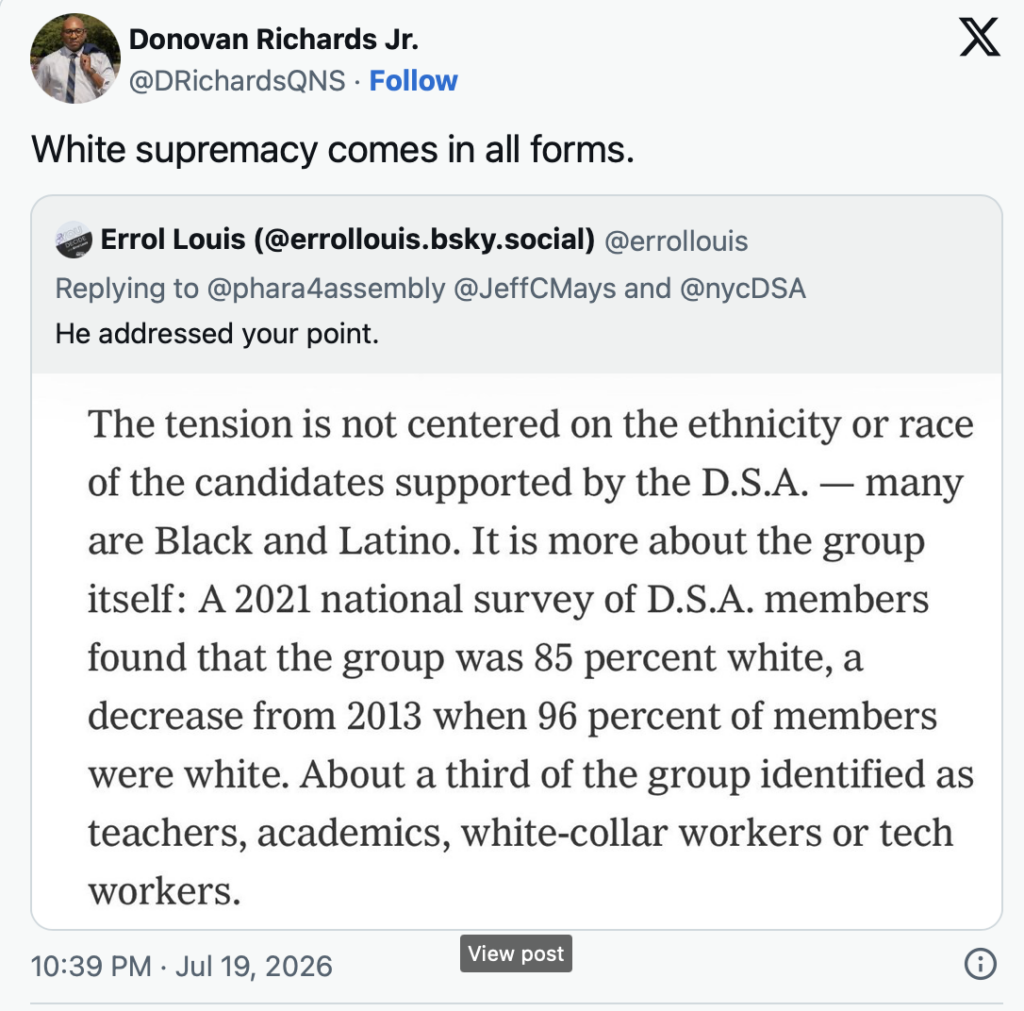
The statement appeared to be a response to criticism surrounding the DSA and reflected Richards’ frustration with what he sees as a political movement that claims to champion marginalized communities while failing to fully address Black concerns.
Hours later, Richards doubled down.
He posted Malcolm X’s famous observation about white liberals:
“The white liberals are more dangerous than the conservatives… as the Negro runs from the growling wolf, he flees into the open jaws of the smiling fox.”
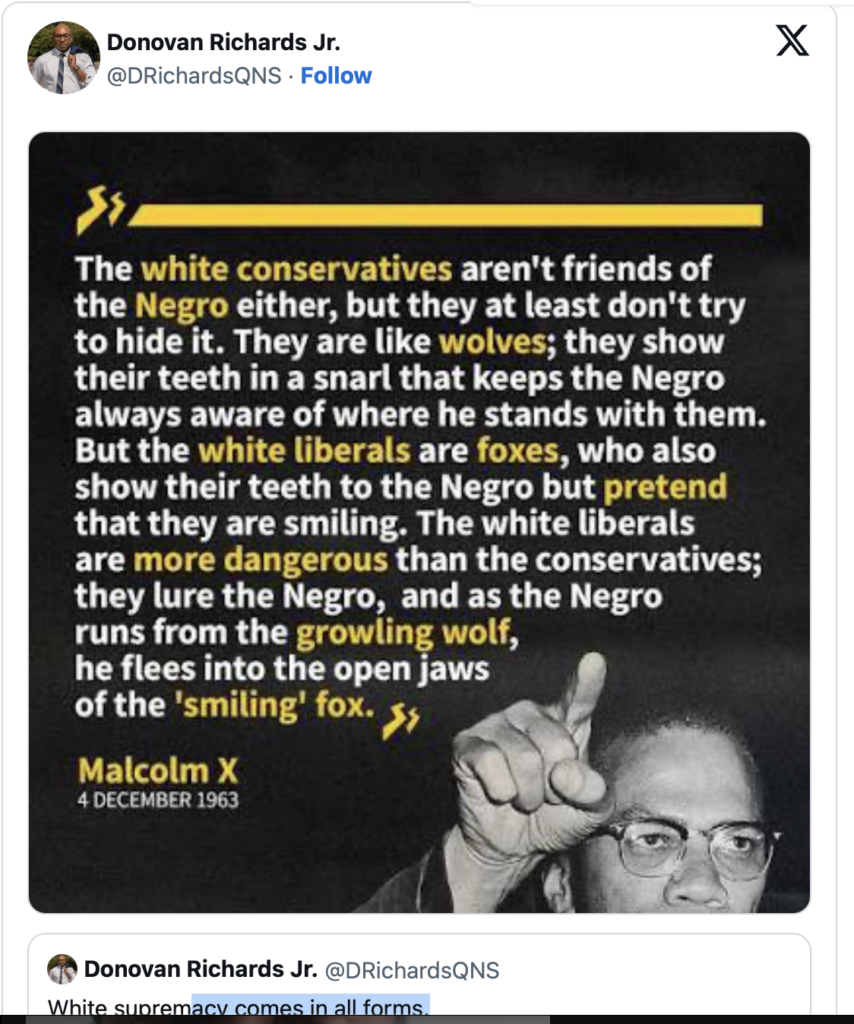
The quote, originally delivered by Malcolm X in 1963, warned Black Americans not to judge political movements solely by their rhetoric but by whether they genuinely advance Black interests.
A Rare Public Break
Richards’ comments are significant because they represent one of the strongest public criticisms of the DSA from a prominent Black Democratic elected official.
Although disagreements between establishment Democrats and Democratic Socialists have existed for years, those disputes have typically centered on housing, taxation, policing, or government spending.
Richards instead framed the disagreement around race, political representation, and trust.
His decision to invoke Malcolm X suggests he believes the debate extends beyond policy differences to a broader question of whether the DSA understands—or prioritizes—the concerns of Black communities.
The Membership Question
One criticism frequently raised by opponents of the DSA involves the organization’s membership.
According to a 2021 Democratic Socialists of America membership survey, approximately 85% of members identified as white, while only about 4% identified as Black.
Although the organization has helped elect several candidates of color, including Mayor Zohran Mamdani, critics argue those numbers raise legitimate questions about who shapes the organization’s priorities and whose voices are most influential within the movement.
Supporters counter that the DSA’s policies are intended to benefit all working-class people regardless of race.
Critics respond that universal policies are not necessarily the same as a focused agenda addressing the specific historical and economic challenges facing Black Americans.
Why Richards’ Comments Matter
Richards is not a political outsider.
He serves as Borough President of Queens, represents one of the city’s largest Black constituencies, and has spent years advocating for Black homeownership and economic opportunity.
His criticism therefore carries weight inside Democratic politics.
It also comes at a time when Mayor Zohran Mamdani and the DSA continue to expand their influence over the direction of New York City’s Democratic Party.
A Growing Divide
Richards’ posts underscore a broader debate unfolding within Democratic politics.
Increasingly, the disagreement is not simply between Democrats and Republicans.
It is between Democrats who believe broad progressive policies are sufficient to improve the lives of Black communities and those who argue Black communities require more intentional political and economic priorities.
By invoking Malcolm X, Richards challenged Black voters to ask a fundamental question:
Should political movements be judged by their language of equity—or by measurable outcomes for Black communities?
That question is likely to remain part of New York’s political conversation long after the latest social media exchange fades

A multifaceted personality, Damon is an activist, author, and the force behind Black Westchester Magazine, a notable Black-owned newspaper based in Westchester County, New York. With a wide array of expertise, he wears many hats, including that of a Spiritual Life Coach, Couples and Family Therapy Coach, and Holistic Health Practitioner. He is well-versed in Mental Health First Aid, Dietary and Nutritional Counseling, and has significant insights as a Vegan and Vegetarian Nutrition Life Coach. Not just limited to the world of holistic health and activism, Damon brings with him a rich 32-year experience as a Law Enforcement Practitioner and stands as the New York Representative of Blacks in Law Enforcement of America.