







The 2026 midterm elections are over, and Democrats across America have plenty to celebrate. They won key races, gained political ground, and showed voters were willing to challenge Republican leadership. From New York to Texas, Georgia to Michigan, the election revealed a country deeply concerned about its political and economic future.
But while Democrats celebrate their victories, another story deserves attention. Black Americans, who have historically been among the Democratic Party’s most dependable supporters, were not simply sitting quietly and accepting everything candidates told them. In places like Texas and Detroit, Black voters questioned candidates, challenged campaign strategies, and demanded greater attention to the issues affecting their communities.
Chicago also belongs in the broader discussion about Black political dissatisfaction, although specific examples of pushback during this election require separate verification.
As publisher of Black Westchester Magazine, I believe the most important conversation isn’t simply about how many Democrats won or how many Republicans lost. It’s about what happens after the election, when politicians return to Washington, state capitals, and city halls with the authority voters have given them.
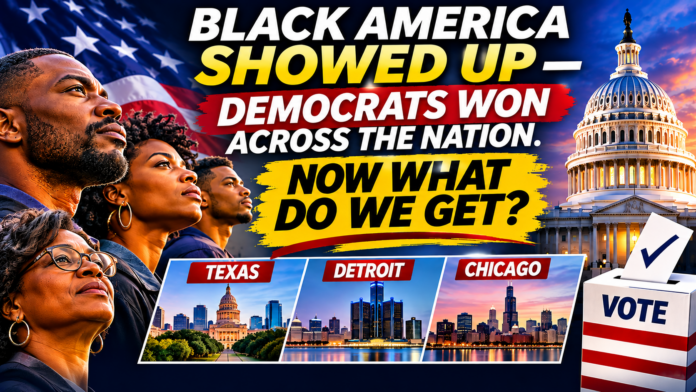
Democrats won. But what did Black America win?
Black voters are more than a dependable voting bloc
For generations, Black Americans have maintained a strong political relationship with the Democratic Party. That relationship has deep historical roots involving civil rights, voting rights, economic policies, and concerns about discrimination. Many Black voters have legitimate reasons to continue supporting Democratic candidates.
But history should never prevent voters from examining whether their political support is producing meaningful results. When a community consistently supports one party, that party should be prepared to explain what it has accomplished and what it intends to accomplish next.
During every election season, candidates visit Black churches, attend community events, appear on Black radio programs, and seek endorsements from Black elected officials. They understand the importance of Black voters and the influence those voters can have in competitive elections.
There’s nothing wrong with political outreach. Candidates should visit communities, listen to residents, and explain their policies. The problem arises when those visits become more about photographs, celebrity endorsements, and campaign appearances than serious conversations about the economic conditions facing Black Americans.
Black voters are not simply an audience for political speeches. They are taxpayers, workers, homeowners, business owners, parents, and grandparents who have every right to ask candidates what they intend to accomplish.
Texas: Black voters challenged the Democratic playbook
Texas provided one of the clearest examples of Black voters demanding greater accountability during the 2026 election season.
Democratic Senate candidate James Talarico faced pointed questions from Black residents following his primary victory over Congresswoman Jasmine Crockett. During a Houston town hall, voters questioned his campaign’s engagement with Black communities and expressed frustration with what they viewed as the Democratic Party’s longstanding tendency to take Black support for granted.
Talarico responded by committing $25 million toward Black voter outreach, including advertising, community organizing, and direct engagement. The exchange showed that Black voters were willing to challenge a Democratic candidate rather than accept the party’s nominee without question.
That confrontation mattered because it went beyond personality or party loyalty. Residents wanted to understand whether their communities would receive meaningful attention after the election, not simply during the campaign.
The lesson from Texas is that political candidates cannot assume historical loyalty eliminates the need to earn trust. A candidate’s party affiliation may influence voters, but it does not answer questions about economic opportunity, education, housing, or community investment.
Detroit: Black voters questioned political endorsements
Detroit offered another example of Black voters refusing to treat political endorsements as substitutes for their own judgment.
During Michigan’s closely watched Senate race, Democrat Abdul El-Sayed faced Republican Mike Rogers in a contest that attracted national attention. El-Sayed’s campaign brought prominent political figures and celebrities into Michigan, while Republicans made an aggressive effort to appeal to Black voters in Detroit.
Some Black voters questioned whether endorsements from national figures should determine their political choices. Interviews conducted during the campaign found residents who remained skeptical despite those endorsements, even though many still intended to support El-Sayed.
The controversy intensified when Democratic Congresswoman Haley Stevens withdrew her endorsement of El-Sayed and backed Rogers shortly before Election Day. One Detroit-area voter criticized Stevens for treating Black Detroiters as political props, illustrating that residents could object to politicians’ conduct without necessarily rejecting the Democratic candidate.
El-Sayed ultimately won the Senate race, but the campaign’s disputes showed that Black voters were not speaking with one voice. Their concerns included affordability, healthcare, housing, political representation, and the credibility of candidates seeking their support.
Chicago: The Black vote is not guaranteed
Chicago provides another example of political competition for Black support, although its most visible local contest is the upcoming 2027 mayoral election rather than Tuesday’s midterm election.
Mayor Brandon Johnson faces a crowded field of challengers, including Willie Wilson and other prominent political figures. Candidates are already competing for attention at major Black community events, including the Bud Billiken Parade. Reporting by the Chicago Crusader identified Black voters as a central constituency in the developing mayoral race.
The political competition comes amid concerns about city finances, public services, affordability, and the direction of local government. These issues provide a backdrop for the broader national discussion about whether elected officials are addressing the needs of the communities they represent.
Chicago’s circumstances differ from those in Texas and Detroit. The available reporting does not establish a comparable confrontation between Black voters and a specific candidate during the November 2026 midterms. Nevertheless, the city’s political debate shows why Black voters cannot be treated as a uniform constituency whose support automatically belongs to one candidate.
The difference between outreach and pandering
Every election season, candidates visit Black churches, attend community festivals, appear on Black radio programs, and take photos with local leaders. These appearances are legitimate forms of political outreach, but they lose meaning when candidates cannot explain how their policies will address community concerns.
The question is not whether candidates should visit Black neighborhoods. They absolutely should. The question is whether those visits produce genuine conversations, specific commitments, and continuing relationships after Election Day.
In Texas, voters asked Talarico to explain his investment in Black outreach. In Detroit, voters questioned political endorsements and examined competing candidates. In Chicago, political competition has renewed attention to the priorities of Black communities.
These examples are different, but they raise a common issue: Political engagement should involve more than appearances and promises.
What happens after Black voters deliver?
Now that Democrats have won significant victories across the country, the discussion should turn toward governing.
What commitments were made concerning Black unemployment, homeownership, business development, and education? What policies will help working families purchase property, expand businesses, and prepare their children for an economy increasingly shaped by technology and automation?
Those questions deserve answers supported by measurable results. Government officials should explain not only how much money they intend to spend, but also what their policies are expected to accomplish and how the public will evaluate their effectiveness.
Historic political representation matters, and the election produced important milestones. But representation alone doesn’t show whether Black families are becoming economically stronger or whether educational disparities are narrowing.
As publisher of Black Westchester Magazine, I believe these questions belong at the center of independent journalism. I’m not a Democrat or Republican. I’m an independent, and my responsibility is to examine political decisions without protecting any party from accountability.
My philosophy remains simple: No permanent friends. No permanent enemies. Only permanent interests.
That standard should apply equally to Democrats and Republicans because public accountability should never depend on party affiliation.
I’ve said many times that only Black America can save Black America. That belief emphasizes community responsibility, economic independence, and the importance of building institutions that serve future generations. It does not excuse elected officials from explaining how their policies affect the people they represent.
Voting expresses preference. Funding creates obligation. Political accountability requires measurable results.
The election celebrations will end, and the work of governing will begin. The coming months will offer an opportunity to examine whether campaign promises become policies that produce meaningful change.
Democrats won across America. Black voters helped make those victories possible, even as some challenged candidates to earn their trust. Now comes the question that matters beyond Election Day: What will Black America receive in return?

A multifaceted personality, Damon is an activist, author, and the force behind Black Westchester Magazine, a notable Black-owned newspaper based in Westchester County, New York. With a wide array of expertise, he wears many hats, including that of a Spiritual Life Coach, Couples and Family Therapy Coach, and Holistic Health Practitioner. He is well-versed in Mental Health First Aid, Dietary and Nutritional Counseling, and has significant insights as a Vegan and Vegetarian Nutrition Life Coach. Not just limited to the world of holistic health and activism, Damon brings with him a rich 32-year experience as a Law Enforcement Practitioner and stands as the New York Representative of Blacks in Law Enforcement of America.