


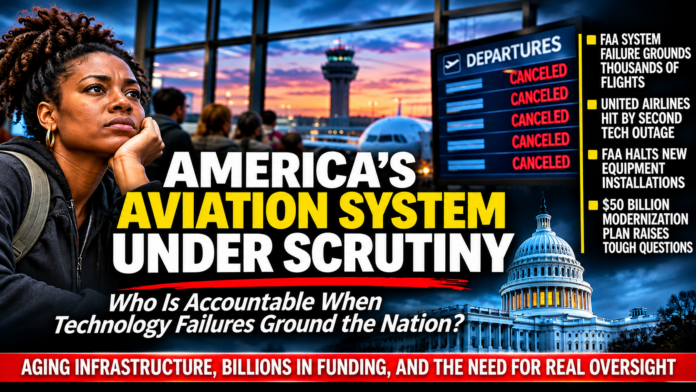






America is supposed to have one of the world’s safest and most advanced aviation systems. Millions of Americans rely on that system to travel for business, visit family, attend important events, and keep the nation’s economy moving. Yet recent technology disruptions have raised a troubling question: How vulnerable is America’s aviation infrastructure, and who is responsible when the systems we depend on begin to fail?
On November 13, the Federal Aviation Administration reportedly experienced a major technology disruption that led to a nationwide ground stop lasting several hours. Thousands of flights were affected as airlines struggled to restore normal operations. Passengers found themselves stranded, schedules were disrupted, and airports became scenes of frustration and uncertainty.
Just days later, United Airlines experienced a separate technology problem that affected the information pilots need before departure. Although the incidents have not been established as connected, their timing raises legitimate concerns about the reliability of the technology supporting commercial aviation.
An Aging System Facing Modern Demands
The United States has been discussing the modernization of its air traffic control system for years. Federal officials have repeatedly acknowledged the need to replace aging equipment, improve communications, and strengthen the infrastructure responsible for managing thousands of aircraft every day.
But modernization is not simply about buying new computers and installing new equipment. It is about ensuring that technology works, that proper testing takes place, and that backup systems are available when something goes wrong.
According to preliminary reports, the FAA disruption may have involved newly installed telecommunications equipment interacting with older systems. If confirmed, that would raise serious questions about the testing and oversight procedures used before critical equipment was put into operation.
Americans deserve to know whether the government is modernizing aviation infrastructure responsibly or creating new vulnerabilities while attempting to correct old ones.
Billions of Dollars and Questions of Accountability
Transportation Secretary Sean Duffy has advocated approximately $50 billion in funding to modernize America’s air traffic control infrastructure. That is a significant investment of taxpayer money, and the American public has every right to demand accountability.
Who approved the equipment installations? What testing was conducted before the systems went online? Were potential failures identified in advance? Most importantly, were adequate backup systems in place to prevent a localized technology problem from becoming a national disruption?
These are not partisan questions. They are questions of public safety, government responsibility, and fiscal accountability.
Whether a Republican or Democrat occupies the White House, the responsibility to maintain safe and dependable aviation infrastructure remains the same.
The Public Deserves Answers, Not Excuses
Federal officials have not established that these incidents were the result of a coordinated cyberattack. That distinction matters because technological failures and deliberate attacks require different responses. Investigators must follow the evidence rather than speculation.
However, the absence of evidence of a cyberattack does not eliminate concerns about infrastructure vulnerabilities. A system that can be significantly disrupted by equipment failures deserves serious examination.
The aviation industry is not just about airlines and airports. It supports jobs, tourism, commerce, emergency transportation, and countless families whose lives depend on reliable travel.
America cannot afford to treat these disruptions as routine inconveniences.
Congress should demand a transparent accounting of what happened, what safeguards failed, and what corrective measures will be implemented. The FAA and the Department of Transportation must demonstrate that modernization efforts will improve reliability rather than introduce additional risks.
The American people are being asked to invest billions in the future of aviation. They should not have to wonder whether the technology responsible for keeping aircraft moving safely across the country can do its job.
The question is no longer simply what went wrong. The question is who will be held accountable for making sure it does not happen again.

A multifaceted personality, Damon is an activist, author, and the force behind Black Westchester Magazine, a notable Black-owned newspaper based in Westchester County, New York. With a wide array of expertise, he wears many hats, including that of a Spiritual Life Coach, Couples and Family Therapy Coach, and Holistic Health Practitioner. He is well-versed in Mental Health First Aid, Dietary and Nutritional Counseling, and has significant insights as a Vegan and Vegetarian Nutrition Life Coach. Not just limited to the world of holistic health and activism, Damon brings with him a rich 32-year experience as a Law Enforcement Practitioner and stands as the New York Representative of Blacks in Law Enforcement of America.