







By Damon K. Jones | Publisher, Black Westchester Magazine
Well, New York, the election is over. The campaign signs are coming down, the victory celebrations are ending, and Governor Kathy Hochul has secured another four years in Albany. But before the ink could even dry on the election results, here comes the conversation about raising your taxes.
Imagine that. You went to the polls on November 3, and by November 6, the governor was already opening the door to tax increases. The same governor who resisted raising taxes during her campaign is now telling New Yorkers that she may have to do what is necessary to fund government programs. And standing alongside this conversation is New York City Mayor Zohran Mamdani, who has been pushing to raise taxes on millionaires and corporations.
Now, I know what some of you are going to say. They’re only talking about taxing the rich. They’re going after millionaires and big corporations, not ordinary working people. That’s the political language that makes these proposals easier to sell. But I have a question for everyone who believes the working class will somehow escape the financial consequences.
When was the last time a corporation received a higher bill and never considered passing some of that cost along to its customers?
THE ELECTION IS OVER. NOW COMES THE BILL.
Let’s deal with some facts because this conversation did not begin three days after the election.
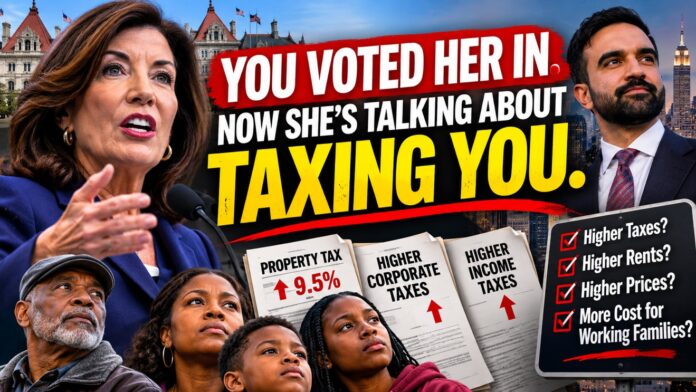
Back in February 2026, Mayor Mamdani’s preliminary budget included a possible 9.5 percent property tax increase that was projected to generate approximately $3.7 billion. He presented it as a last resort if Albany refused to authorize his preferred tax increases on wealthy individuals and corporations.
Think about that for a moment. While politicians were talking about affordability and helping working families, a proposal was already on the table that could increase property taxes on homeowners and commercial properties throughout New York City.
And please don’t tell me this only affects wealthy property owners. I spent 33 years working in law enforcement, and I know what it means to work overtime, pay bills, raise a family and try to build something for the next generation. Working people don’t have unlimited money sitting in a bank account waiting for government to come collect it.
A homeowner who worked thirty years to pay off a mortgage is not suddenly wealthy because the government says the property is worth more. A retired public employee living on a fixed income cannot simply go back to work every time property taxes, insurance or utility bills increase. And a small business owner already struggling to survive cannot continue absorbing higher expenses without eventually making some difficult decisions.
Those decisions may mean higher prices, fewer employees, reduced hours or, in some cases, closing the doors altogether. Not every tax increase gets passed along, but anyone pretending that businesses never shift costs onto consumers or workers is ignoring how businesses operate.
STOP TELLING WORKING PEOPLE THEY WON’T PAY
Here is what bothers me about this entire conversation. Politicians have become very comfortable telling working people that someone else is going to pay for their programs.
Tax the rich. Tax the corporations. Make the wealthy pay their fair share. Those slogans sound wonderful at a political rally, but slogans don’t pay your electric bill, mortgage, rent or grocery bill.
If the government increases property taxes on a rental building, the owner may try to recover those expenses through rent increases where legally and economically possible. If a corporation faces higher taxes, it may absorb some of the cost, but it may also adjust prices, wages, hiring or investment. The actual burden depends on the tax and the market, but working people are not automatically protected simply because politicians say they are targeting the wealthy.
And let’s not forget that New Yorkers are already dealing with some of the highest costs of living in America. People are leaving communities where their families have lived for generations because they can no longer afford to stay. Young adults are struggling to purchase their first homes, while seniors who spent their lives working are wondering whether they can afford to remain in the homes they already own.
So explain to me how making New York more expensive is supposed to solve New York’s affordability problem.
GOVERNMENT ALWAYS NEEDS MORE MONEY. WHEN IS ENOUGH ENOUGH?
New York City presented a preliminary budget of approximately $127 billion for fiscal year 2027. That’s billion with a B. And yet, somehow, the conversation keeps coming back to the government needing more revenue.
I am not suggesting that government doesn’t have responsibilities. We need functioning schools, safe communities, infrastructure, healthcare and programs that support families. But before you ask taxpayers for another dollar, shouldn’t you explain what you have done with the billions already collected?
Where are the independent spending reviews? Where are the measurable results? Which programs are working, which ones are failing, and what administrative costs can be reduced without harming essential services?
These are questions that should be answered before anyone starts reaching deeper into the pockets of working families.
I find it interesting that politicians can always identify another group of taxpayers to fund their latest initiative, but rarely begin the conversation by explaining where existing spending can be reduced or redirected. Every new program comes with a price tag, and every price tag eventually has to be paid by somebody.
And if the program costs more than projected, what happens then? Do we raise taxes again, borrow more money or return to the same taxpayers with another explanation about why government needs additional revenue?
WHAT HAPPENED TO HOCHUL’S CAMPAIGN POSITION?
During the campaign, Governor Hochul resisted proposals to raise income taxes. She understood that affordability was a major concern among New Yorkers and that higher taxes were not exactly a popular campaign message.
But on November 6, at the Somos conference in Puerto Rico, Hochul indicated that she was willing to consider additional taxes if necessary to sustain universal childcare. She has not announced a specific new tax, and we are expected to hear more about her plans in the 2027 State of the State address.
Now, I want to be fair about what actually happened. Hochul has not signed a new tax increase into law because of those remarks. But I also refuse to ignore the timing of this conversation.
Three days after winning reelection, the governor is publicly discussing something she resisted during the campaign. That deserves scrutiny, especially when voters were repeatedly told that affordability was a priority.
And where was this detailed conversation before Election Day? Where were the discussions about the long-term costs of these programs and the possibility that additional revenue would be needed?
Voters should have been presented with those numbers before they entered the voting booth, not left waiting until the next State of the State address to find out what the administration might propose.
BLACK HOMEOWNERS AND THE WORKING CLASS CANNOT KEEP CARRYING THE BURDEN
Let me bring this conversation home to Black America because there is another side to this issue that too many politicians overlook.
For generations, Black families have struggled to build wealth through homeownership, entrepreneurship and economic independence. Our parents and grandparents worked long hours, sometimes holding two jobs, to purchase homes in communities where they hoped their children would have greater opportunities.
Many of those homes represent the largest financial asset those families will ever own. They are not luxury investments or vacation properties. They are the foundation of whatever generational wealth those families have managed to build.
Now imagine spending thirty years paying for a home only to discover that rising property taxes, insurance premiums, utilities and maintenance expenses are making it increasingly difficult to remain there.
That is not economic empowerment. That is a serious affordability problem, and it deserves just as much attention as the government’s desire to expand programs.
The same concern applies to Black-owned businesses. We constantly hear politicians talking about supporting minority entrepreneurship and strengthening small businesses. But how do you build a sustainable business when the cost of operating continues to increase?
You cannot talk about building generational wealth while ignoring policies that may make it more expensive to own property, operate businesses and maintain financial independence.
YOU WON THE ELECTION. NOW GOVERN RESPONSIBLY.
Governor Hochul won the election. Congratulations. But winning an election does not give any politician a blank check to spend without accountability or increase taxes without explaining the consequences.
Mayor Mamdani also has a responsibility to the people of New York City. If he believes his programs require additional revenue, then he should present a complete financial plan showing what those programs will cost, how they will be funded and what protections will exist for working-class and middle-class residents.
And let’s stop pretending that every person questioning a tax increase is against childcare, education or helping struggling families. You can support those services and still demand responsible budgeting. You can believe in helping people without believing government should continuously expand its financial demands on taxpayers.
Those positions are not contradictory. They are what responsible public accountability should look like.
What I want to know is why the first conversation always seems to be about collecting more money rather than making the money already collected work better for the people.
New Yorkers deserve a government that understands the difference between spending money and producing results.
THE PEOPLE WHO VOTED FOR YOU DESERVE ANSWERS
Here is the part that should concern every New Yorker, regardless of political affiliation.
The election was November 3. By November 6, the possibility of higher taxes was back in the political conversation. Whether Hochul ultimately proposes an increase remains to be seen, but the public deserves to know exactly what she is considering and who would be affected.
And I don’t want to hear another carefully rehearsed speech about making the rich pay their fair share without a serious explanation of the potential impact on homeowners, renters, small businesses and working families.
If the governor wants additional revenue, let her administration show us the numbers. Show us the projected costs, the alternatives considered, the safeguards for ordinary taxpayers and the measurable benefits New Yorkers should expect in return.
I have said repeatedly that elections are not supposed to be popularity contests. We are electing people to govern, manage public resources and protect the interests of the people they represent. That responsibility does not end with the people who supported them politically. It extends to every resident who must live with the consequences of their decisions.
And for those who voted believing that affordability was going to improve, this is the moment to pay attention. Not because a new tax has already been enacted, but because the conversation about who will pay for government’s priorities is now taking shape.
You voted her in. Now she’s talking about taxing you.
The campaign is over, Governor. The celebration is over. New Yorkers have bills to pay, families to support, homes to maintain and businesses to keep alive.
Before you ask them to pay another dollar, show them why the billions government already collects are not enough.
Because the working class cannot continue being treated as an unlimited source of revenue every time government needs more money.
And remember, New Yorkers: The politician may promise to tax somebody else, but that doesn’t guarantee somebody else will be the only one paying the bill.

A multifaceted personality, Damon is an activist, author, and the force behind Black Westchester Magazine, a notable Black-owned newspaper based in Westchester County, New York. With a wide array of expertise, he wears many hats, including that of a Spiritual Life Coach, Couples and Family Therapy Coach, and Holistic Health Practitioner. He is well-versed in Mental Health First Aid, Dietary and Nutritional Counseling, and has significant insights as a Vegan and Vegetarian Nutrition Life Coach. Not just limited to the world of holistic health and activism, Damon brings with him a rich 32-year experience as a Law Enforcement Practitioner and stands as the New York Representative of Blacks in Law Enforcement of America.