


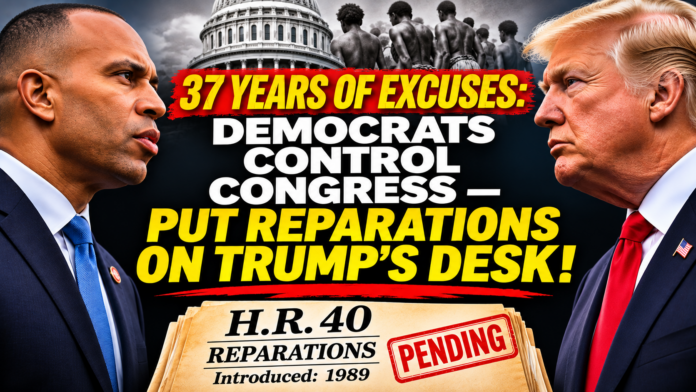






37 YEARS OF EXCUSES: DEMOCRATS CONTROL CONGRESS — PUT REPARATIONS ON TRUMP’S DESK!
Black voters helped Democrats win. After decades of introducing H.R. 40 and repeatedly demanding reparations under Republican control, Democrats must now explain what they intend to do with their congressional majority in 2027.
By Damon K. Jones | Publisher, Black Westchester Magazine
The 2026 midterm elections are over, and Democrats have won control of both the United States House of Representatives and the Senate. Black voters were an important part of the coalition that helped deliver those victories. Once again, Black America showed up, and Democratic leaders are celebrating what their supporters accomplished at the ballot box.
But I have a question. What are Black Americans getting out of this victory? I am not talking about another thank-you speech, another celebration, or another politician telling us how important our votes are. I am talking about legislation that addresses the historical and economic interests of descendants of American slavery.
For 37 years, Congress has had the opportunity to act on H.R. 40, the federal reparations study proposal Congressman John Conyers first introduced in 1989. Thirty-seven years of introducing legislation, holding discussions, and explaining why America needs to confront the economic consequences of slavery.
Now Democrats are preparing to control both chambers of Congress in 2027. My position is that reparations should be on their legislative agenda, and they should make a serious effort to pass legislation through both chambers and put it on President Donald Trump’s desk.
If Trump wants to veto it, let him. But I do not want to hear that he might veto it used as an excuse for never bringing the legislation forward.
Thirty-Seven Years of Waiting
Think about what 37 years means. Children born when Congressman John Conyers introduced his original reparations proposal in 1989 are now approaching 40. Some have children of their own. During those decades, America has elected presidents, fought wars, passed enormous spending packages, and found ways to address countless national priorities.
Yet Congress has never enacted H.R. 40, which would establish a commission to study slavery, its continuing consequences, and possible reparations proposals. The legislation does not authorize direct payments. It creates a process to study the issue and recommend potential remedies.
That is what makes this conversation so frustrating. After nearly four decades, Congress still hasn’t agreed to establish the commission proposed in H.R. 40.
Democrats didn’t suddenly discover this issue during the 2026 election. Their own congressional record demonstrates that reparations remained part of their political agenda throughout Trump’s second presidency.
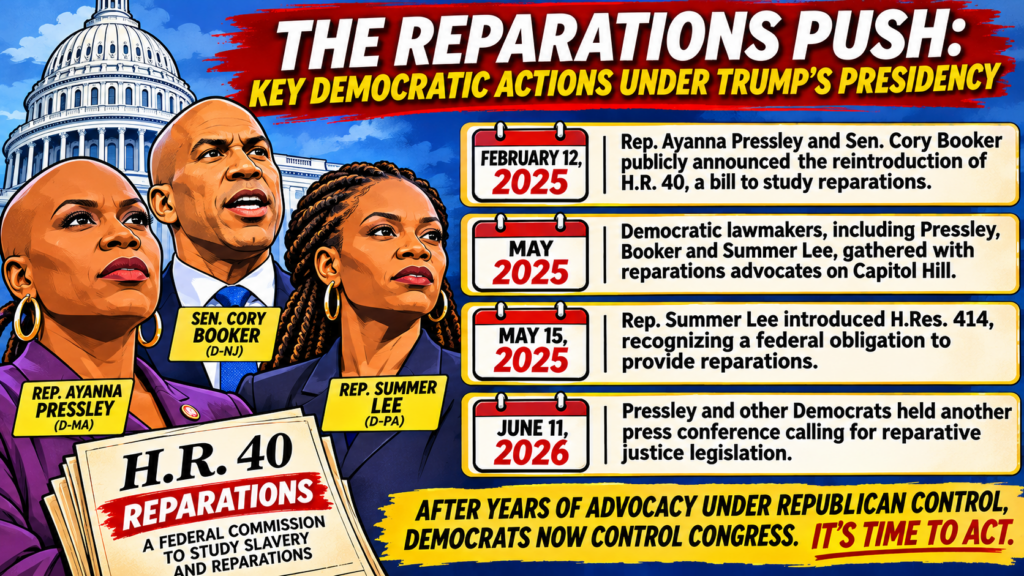
Let’s Look at What Democrats Said and Did Under Republican Control
On February 12, 2025, Congresswoman Ayanna Pressley and Senator Cory Booker publicly announced the reintroduction of H.R. 40. At a Capitol Hill press conference, Democratic lawmakers called attention to the lasting consequences of slavery and the need for federal reparations proposals.
This happened while Republicans controlled the White House, House, and Senate. Democrats understood that the legislation faced significant political obstacles, but they still believed it was important enough to introduce and publicly defend.
Then came May 2025, when Democratic lawmakers and reparations advocates organized additional activities on Capitol Hill. The events included congressional briefings, public advocacy, and renewed demands for federal action. Senator Cory Booker was among the lawmakers involved in the broader advocacy efforts.
On May 15, 2025, Congresswoman Summer Lee introduced House Resolution 414, known as the Reparations Now Resolution. The resolution recognized the federal government’s moral and legal obligation to provide reparations for slavery and its lasting consequences. Lee appeared with Congresswomen Ayanna Pressley and Rashida Tlaib, along with advocates, to announce the effort.
Unlike legislation authorizing a program, H.Res. 414 was a statement of congressional position. Nevertheless, it demonstrated that Democrats were willing to put their support for reparations into the congressional record while Republicans held power.
And the conversation did not stop there.
On June 11, 2026, Congresswoman Pressley joined other Democratic lawmakers and reparations advocates for another Capitol Hill press conference. As America prepared to commemorate its 250th anniversary, they called on Congress to advance a broader reparative justice legislative agenda.
These are not rumors or statements somebody made on social media. These were documented congressional actions, official press conferences, and legislative proposals.
So I have a reasonable question. If reparations were important enough for Democrats to introduce legislation and hold press conferences about while Republicans controlled Congress, why shouldn’t reparations receive serious legislative consideration when Democrats control Congress in 2027?
Democrats Had Control Before
We also need to remember what happened during the Biden administration.
In 2021 and 2022, Democrats controlled the White House, House, and Senate. In April 2021, H.R. 40 advanced through the House Judiciary Committee by a 25–17 vote. That was amajort milestone for legislationintroducedd repeatedly since 1989.
But the legislation never received a full House vote.
I understand that Democrats faced Senate procedural obstacles and that passing legislation through both chambers is not always easy. But the House never completed its part of the process, even though Democrats controlled that chamber.
That history matters because Black Americans should not be expected to forget what happened the last time Democrats held congressional power.
Now they have another opportunity. And this time, I believe Black voters should expect a clear legislative timetable rather than another explanation of why nothing could be done.
Black People Came Out. Put It on Trump’s Desk.
Here is where I want to be absolutely clear.
I do not want to spend another two years listening to Democrats explain why Donald Trump would veto reparations legislation. I want Congress to do its job and make the effort to get the legislation to his desk.
Introduce the bill, hold the hearings, debate the details, and bring it to a vote. Let members of Congress explain where they stand, and work to secure the votes necessary to pass it through both chambers.
If the bill reaches President Trump’s desk and he believes reparations are wrong, let him veto it. Let him explain his decision publicly and allow the American people to judge his position.
There is a difference between a president actually vetoing legislation and politicians assuming he will veto it before Congress has even acted.
Of course, Senate rules matter. Democrats may need support beyond their own caucus to overcome a filibuster, and controlling both chambers does not automatically guarantee passage. But that should not prevent leadership from making the legislative effort and establishing a public record.
Black people came out and helped Democrats win. I believe they deserve more than another press conference about what Republicans will not do.
Reparations Must Be About Economic RepairThere
There is another part of this conversationthat cannott be ignored. H.R. 40 is a study commission, not a direct reparations program.
After 37 years, I believe the conversation should be moving toward what actual economic repair would look like for descendants of American slavery.
Would reparations include direct compensation, homeownership opportunities, business capitalization, land acquisition, or policies specifically designed to build generational wealth? Who would qualify, how would eligibility be established, and how would the federal government fund and administer the program?
These are serious policy questions that deserve serious congressional debate.
For me, reparations must be connected to economic independence. We cannot keep talking about political empowerment while ignoring the importance of ownership, capital, entrepreneurship, and generational wealth.
The Congressional Black Caucus Must Answer
I want to hear from Hakeem Jeffries, Senate Democratic leadership, and the Congressional Black Caucus about their plans for 2027.
Will H.R. 40 receive a floor vote? Will congressional leaders advance legislation that goes beyond establishing a commission? Will they provide a timetable explaining what they intend to accomplish?
These are legitimate accountability questions, especially considering the public statements and legislative actions Democratic lawmakers took in 2025 and 2026.
If lawmakers support reparations, voters should be able to see what they are prepared to do. If they oppose reparations, they should explain why. And if legislation fails, the public should know where the votes fell short.
The Election Is Over. Now Govern.
I have always believed that political parties should be accountable to the people, not the other way around. That applies to Democrats, Republicans, and independents alike.
Black Americans should not measure political success simply by which party wins an election. We should be examining whether those victories produce legislation that addresses our economic interests and improves opportunities for future generations.
H.R. 40 has been part of the congressional conversation for 37 years. Democrats publicly advocated reparations in February 2025, May 2025, and June 2026, while Republicans controlled Congress.
Now Democrats will control the House and Senate. They will have the authority to set the congressional agenda, and their decisions about reparations will become part of their governing record.
My position is simple. Black people came out. Democrats won. Reparations should be on the 2027 congressional agenda, and leadership should make every serious effort to move legislation through both chambers.
Put reparations legislation on Donald Trump’s desk. If he vetoes it, let that be his decision and his record. But do not use the possibility of a veto as another excuse for congressional inaction.
Thirty-seven years is long enough to wait for Congress to act on a reparations study commission. It is time to move beyond speeches, press conferences, and political promises.
The election is over. Now it is time to govern.

A multifaceted personality, Damon is an activist, author, and the force behind Black Westchester Magazine, a notable Black-owned newspaper based in Westchester County, New York. With a wide array of expertise, he wears many hats, including that of a Spiritual Life Coach, Couples and Family Therapy Coach, and Holistic Health Practitioner. He is well-versed in Mental Health First Aid, Dietary and Nutritional Counseling, and has significant insights as a Vegan and Vegetarian Nutrition Life Coach. Not just limited to the world of holistic health and activism, Damon brings with him a rich 32-year experience as a Law Enforcement Practitioner and stands as the New York Representative of Blacks in Law Enforcement of America.