

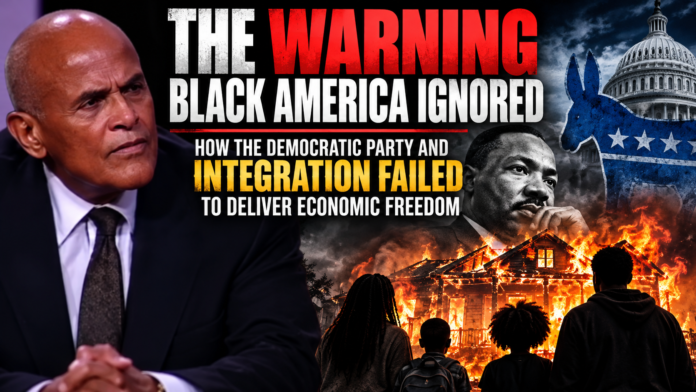




In 2005, legendary entertainer and civil rights activist Harry Belafonte delivered a warning that Black America should have taken seriously. Speaking before the Congressional Black Caucus, Belafonte challenged the Democratic Party, questioned the direction of the civil rights movement, and recalled a troubling conversation with Dr. Martin Luther King Jr. shortly before King’s 1968 assassination.
Belafonte recalled King expressing concern that the integration movement was leading Black Americans into a burning house. Think about that for a moment. Here was the man who helped lead the fight against segregation, questioning whether the movement was bringing Black Americans into a society whose economic and moral foundations were already in trouble.
Twenty-one years later, we need to ask ourselves whether King was right. Did we spend generations fighting to gain access to American institutions while failing to establish the economic independence necessary to control our own future? And did our overwhelming loyalty to the Democratic Party become part of the problem?
Dr. King’s Warning Was About More Than Integration
Dr. King wasn’t suggesting that segregation should continue. He understood that denying people access to education, employment, housing, and public accommodations was morally wrong. But toward the end of his life, King increasingly recognized that civil rights without economic opportunity would leave millions of Black Americans struggling despite their newly recognized freedoms.
Integration opened doors, but opening doors doesn’t automatically create wealth. We gained the right to shop wherever we wanted, but how many businesses did we build and protect? We fought to work in corporate America, but how much effort went into developing companies capable of employing our own communities? We demanded access to neighborhoods, but did we develop an economic strategy to increase Black homeownership?
Before integration, segregation forced Black Americans to develop businesses, financial institutions, and commercial districts because opportunities elsewhere were restricted. Those institutions existed despite discrimination, limited access to capital, and constant economic pressure. Integration created opportunities that Black Americans deserved, but it also exposed smaller Black businesses to competition from larger corporations.
The problem wasn’t integration itself. The problem was treating integration as the destination rather than one step toward economic independence. We gained greater freedom to participate in the American economy without gaining a comparable share of ownership in that economy.
The Democratic Party’s Political Monopoly on Black America
One of the most revealing parts of Belafonte’s 2005 speech was his criticism of the Democratic Party. He openly acknowledged being a lifelong Democrat, but reminded his audience that Democrats had not always been friends of Black Americans.
Historically, Southern Democrats defended segregation and Jim Crow. Following the civil rights movement, many white Southern conservatives gradually shifted toward the Republican Party. Meanwhile, Black voters increasingly aligned with Democrats, particularly after the civil rights legislation of the 1960s.
That political relationship became one of the strongest voting alliances in American politics. For decades, Black Americans have delivered overwhelming support to Democratic candidates, helping elect presidents, governors, mayors, members of Congress, and countless local officials.
But here’s the question we should have been asking all along. What has that political loyalty produced for the economic condition of Black America?
We have elected Black mayors in major cities, Black members of Congress, Black governors, and the first Black president. Yet many communities continue to struggle with poverty, failing schools, limited business ownership, and housing costs that make building generational wealth increasingly difficult.
I’m not suggesting that Democrats have accomplished nothing. Civil rights protections, healthcare programs, and other public policies have provided meaningful benefits. But political accountability requires examining what hasn’t worked, especially in cities where one party has controlled government for generations.
When politicians know they can count on your vote regardless of their performance, what incentive do they have to compete for your support? When your community believes voting for the other party is never an option, how much negotiating power do you really have?
And Republicans shouldn’t mistake this criticism for an endorsement. If Republicans want Black Americans to reconsider their political allegiance, they must demonstrate how their policies will improve economic opportunity, education, public safety, homeownership, and business development.
Neither party deserves unconditional loyalty.
Twenty-One Years Later, Where Is the Economic Progress?
In 2005, Belafonte spoke about poverty, incarceration, struggling schools, and the moral failures of American political leadership. Those concerns weren’t new then, and they certainly haven’t disappeared today.
According to the Federal Reserve’s 2022 Survey of Consumer Finances, median white family wealth was approximately $285,000, compared with approximately $45,000 for Black families. That difference demonstrates how far America remains from achieving economic equality.
Homeownership tells another troubling story. In late 2005, the Black homeownership rate was approximately 48 percent. By the second quarter of 2026, it was approximately 45 percent. Despite decades of political promises, Black homeownership has not improved sustainably beyond the level it was at when Belafonte delivered his warning.
We have witnessed tremendous individual accomplishments. Black Americans have become successful entrepreneurs, corporate executives, doctors, attorneys, entertainers, and elected officials. But individual success cannot substitute for broad economic advancement.
A Black mayor doesn’t automatically make Black residents homeowners. A Black corporate executive doesn’t guarantee Black-owned businesses access to capital. And electing a Black president doesn’t eliminate the economic challenges confronting millions of Black families.
We must stop confusing representation with results.
The Black Church and the Politics of Loyalty
We also need to examine the Black church’s role in maintaining political relationships. Historically, the church was one of the most important institutions in the civil rights struggle. It organized communities, challenged injustice, and provided leadership when other institutions refused to stand with Black Americans.
Today, however, too many churches have become comfortable providing politicians with an audience during election season without demanding serious accountability. Candidates are introduced from pulpits, applauded by congregations, and welcomed because of their political connections rather than their accomplishments.
The church should never become a haven for politicians who cannot explain what they’ve done for the people they represent. Whether Democrat or Republican, anyone seeking support from Black congregations should be prepared to answer questions about education, housing, employment, public safety, and economic opportunity.
Our ancestors didn’t sacrifice their lives so that future generations could become a permanent voting bloc for one political organization.
Black America Needs Economic and Political Independence
Belafonte’s warning wasn’t simply about switching political parties. It was about recognizing that political leadership had failed to confront the country’s deeper economic problems.
Black America needs to develop a political philosophy based on permanent interests rather than permanent party loyalty. We should support policies that strengthen families, expand homeownership, encourage entrepreneurship, improve education, reduce unnecessary economic burdens, and prepare our children for skilled trades, technology, and artificial intelligence.
We must also accept responsibility for our own economic decisions. Government cannot replace strong families, financial discipline, entrepreneurship, or community institutions. At the same time, personal responsibility doesn’t excuse government policies that restrict opportunity or make economic advancement unnecessarily difficult.
Political independence means Democrats must earn our votes. Republicans must earn our votes. Judge every candidate by what they can deliver, not simply by the party they represent.
No permanent friends. No permanent enemies. Only permanent interests.
The House Is Still Burning
Harry Belafonte warned Black America in 2005. Dr. Martin Luther King Jr. had expressed his concerns decades earlier. Yet in 2026, we are still discussing many of the same economic and political problems.
The Democratic Party has benefited enormously from Black political loyalty, but that loyalty should come with expectations and accountability. Integration provided access to opportunities that previous generations were denied, but access alone was never enough to establish economic freedom.
We cannot spend another twenty-one years celebrating political appointments, election victories, and symbolic representation while failing to build the ownership and economic independence our communities need.
The question is no longer whether Dr. King recognized the danger of integrating into a burning house. The question is whether Black America has become so comfortable being allowed inside that we have forgotten the responsibility to change the conditions within it.
We fought for the right to enter the house. Now it’s time to stop depending on the people who control it and start building economic institutions, businesses, and generational wealth that we own.
Because political freedom without economic independence will always leave our future in somebody else’s hands.