





Project RISE showed me something I haven’t seen enough of in seven years of living in Yonkers: organizations actually moving together. Now we have to make sure the village reaches the whole family, not just the child. By Larnez Kinsey
Yonkers is home to an estimated 212,603 people packed into just 18 square miles. Nearly one in five residents is under 18, meaning more than 40,000 children are growing up here. And while the median household income is $83,549, 13.8% of Yonkers residents live below the poverty line.
Those numbers tell us something about Yonkers. But they don’t tell us everything. They don’t tell us what it feels like to be 14 years old and already know the sound of gunfire. They don’t tell us what happens inside a family when somebody’s child doesn’t make it home. And they don’t tell us what it means when the children we’re trying to protect are sometimes also the children we’re trying to prevent from pulling the trigger.
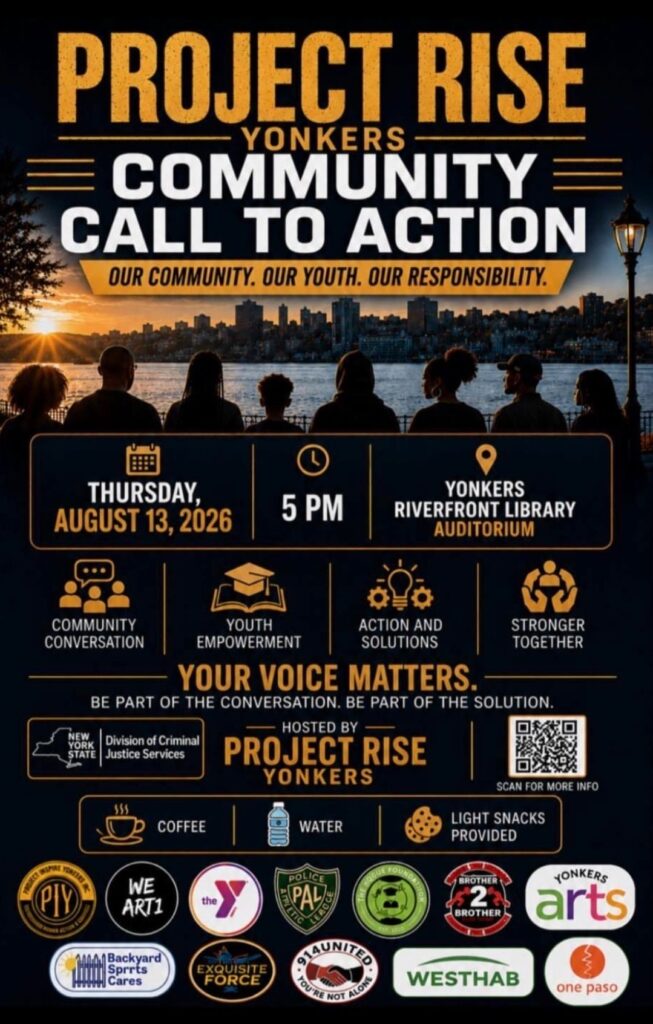
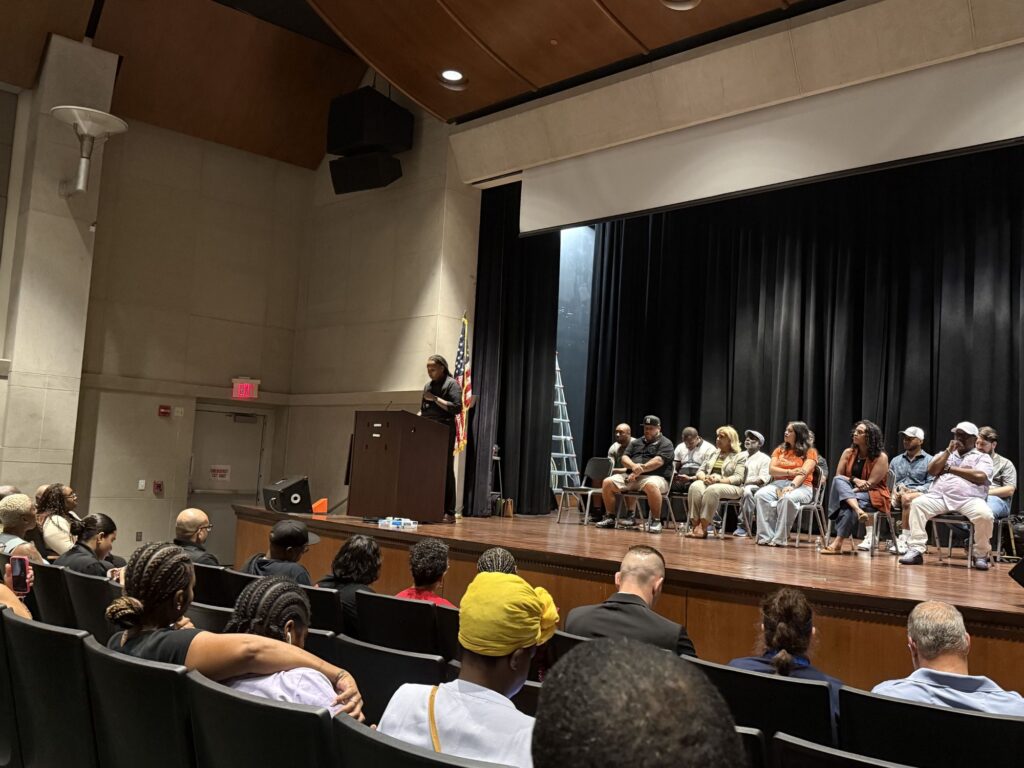
That reality was sitting heavy on me when, on Thursday, August 13, 2026, at 5 p.m., I walked into the Yonkers Riverfront Library for the Project RISE Yonkers Community Call to Action. The message was: Our community. Our youth. Our responsibility.
Beautiful words, but everybody loves community until community requires inconvenience. Everybody loves our youth until the youth is angry, grieving, suspended, arrested, traumatized, loud, misunderstood, or already halfway convinced the streets are the only place where they belong. And everybody loves responsibility until it’s time for somebody to actually take some, but that evening, I saw something in Yonkers that gave me hope.
For the first time in the seven years I have lived here, I saw this many community organizations visibly moving around the same mission. Not just logos lined up on a flyer. People working together.
Everybody on That Stage Had a Why
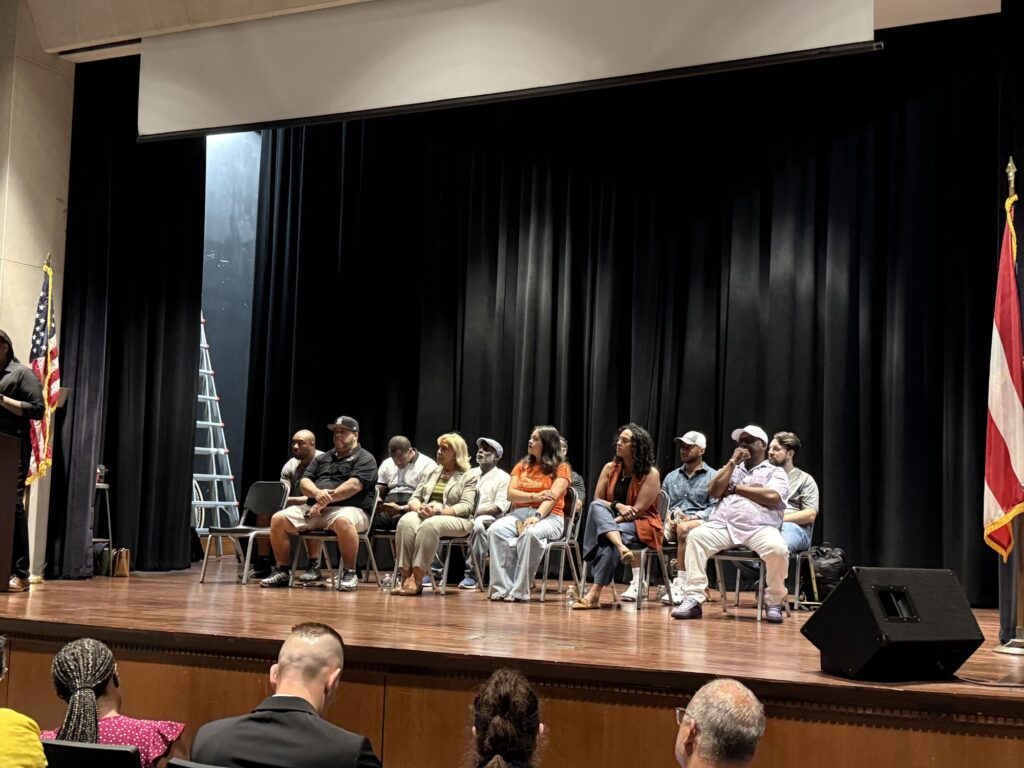
Each organization had a representative on stage speaking about its programs, but they weren’t just giving us the nonprofit elevator pitch. They talked about why. Why they mentor? Why they coach? Why they create? Why they intervene? Why they continue showing up when community work can exhaust you?
We heard from parents, people raised in these communities, people who have watched young people they knew become victims of violence, people who have watched friends make choices that changed their lives forever, and people who understand that behind every statistic is somebody’s baby.
There’s a kind of knowledge you learn in training. Then there’s the kind you carry because you know the block. You know the family. You know that mother’s face. You know what it feels like when somebody’s name suddenly ends up on a candle, a hoodie, or a memorial T-shirt. That’s different, and sitting there, I thought: Yonkers already has the village. Now we have to connect it.
The Village Was in the Room
Project RISE, Respond, Invest, Sustain and Empower, invests in community organizations addressing gun violence and the conditions surrounding it. New York State’s current Year 3 funding structure identifies three Yonkers lead organizations: the Police Athletic League of Yonkers Foundation, Yonkers Family YMCA and Westhab Inc. PAL distributes funding to Brother 2 Brother and The Hogue Foundation; the YMCA works with 914United, We Art One and Exquisite Academy of Arts; and Westhab works with One Paso, Project Inspire and Yonkers Arts.
Different organizations.
Different strengths.
Same children.
And I want to give particular flowers to We Art One, Yonkers Arts, 914United, Project Inspire, Brother 2 Brother, One Paso and the YMCA. Not because they’re the only organizations doing meaningful work. They’re not. I’m highlighting them because I personally keep seeing them. At each other’s events. Sharing resources. Connecting people. Supporting young people. Building relationships across organizational lines.
For seven years, I’ve watched good organizations do good work throughout Yonkers. What felt different on August 13 was seeing pieces of that work actually connecting. Because collaboration isn’t ten logos sitting together at the bottom of a flyer. Collaboration is when the mission becomes more important than whose logo gets the credit. That is what Yonkers needs more of.
Now Widen the Circle
Collaboration cannot become another exclusive club. There are grassroots organizations throughout Yonkers doing meaningful work without large budgets, government contracts, or polished communications departments. Some are working from churches, community rooms, gyms, art spaces, neighborhood spaces and sometimes somebody’s living room. But they may possess something institutions spend years trying to manufacture: Trust.
They know the families. They know which child stopped coming around. They know who’s grieving. They know who just came home. They know who’s angry. They know which mother is overwhelmed. They may know who is one bad night away from making a permanent decision. I believe deeply the people closest to the problems in our communities are often closest to the solutions. Find them. Invite them. Listen to them. And when they’re doing effective work, resource them.
Stop Plucking Children Out of Their Circumstances
This is where our approach to youth violence has to mature. We cannot keep plucking children out of their circumstances, putting them into a six-week or twelve-week program, teaching them coping skills, leadership, and conflict resolution and then dropping them right back into the same conditions without offering meaningful assistance to the parents and caretakers raising them.
You cannot heal a child in isolation. What happens when the workshop ends? What does home look like? Is the rent behind? Is there enough food? Is the caregiver overwhelmed? Does somebody need mental-health support? Does the family need employment assistance? Childcare? Transportation? Housing support? Financial literacy? Therapy?
Sometimes the strongest youth intervention isn’t another youth program. Sometimes it’s helping the person raising that young person breathe. We love saying, Save the children. Okay. Help the people raising them. Children don’t live in programs. They live in ecosystems. Helping the parent helps the child. Supporting the caretaker supports the child. Stabilizing the household supports the child. That is violence prevention too. We cannot keep trying to save children while ignoring what they’re being asked to survive.
Violence Is Moving Through Our Communities
Violence is a disease moving through our communities, and our children are being asked to develop immunity in real time. They’re watching friends die. They’re watching fights become content. They’re watching social-media arguments become street conflicts. They’re carrying grief before they even have language for grief. Some are carrying fear. Some are carrying anger. And some are carrying weapons because somewhere along the way they learned that having a gun meant having protection.
We cannot keep waiting until they’re bleeding, physically or emotionally, to decide prevention matters. They need tools before the crisis. They need language to identify what they’re feeling before those feelings start making decisions for them. They need tools to regulate anger before anger becomes action. They need mental-health resources. They need safe adults. They need opportunity. They need somewhere to belong. They need to know who to call. And they need all of that before somebody puts their face on a candle, hoodie or memorial T-shirt.
We Heal Communities Through Connection
That’s why I kept coming back to one word: Connection.
Connect the child to the mentor. Connect the parent to resources. Connect the school to the grassroots organization. Connect the credible messenger to the family. Connect mental-health providers to the people who need them. Connect the artist to opportunity. Connect the organization with community trust to the institution with resources. Because a village isn’t simply a bunch of people standing near each other. A village is a network of relationships that knows how to move when somebody needs help.
Jordan Mendez Said the Part We Needed to Hear
One of the strongest moments of the evening came from Jordan Mendez. Jordan told the room he was indignant. Not simply angry. Indignant. Angry because what he was witnessing felt like an injustice. And then this young man challenged a room full of adults. If all these organizations exist… If all these programs exist… If all these adults care… why don’t enough young people know about them? There it is. Adults love saying: There are programs out here. Okay! Does the 14-year-old know? Does the mother working two jobs know? Does the grandmother raising grandchildren know? Does the teenager who just came home know?
A resource our families don’t know exists cannot help them. Jordan challenged Yonkers to bring violence-prevention organizations directly into our schools. And that deserves serious consideration. School is one of the few places where we already have access to large numbers of young people, so why are we treating violence prevention like an extracurricular activity when violence isn’t extracurricular in their lives?
Jordan wasn’t simply giving adults his opinion.
He was giving us policy.
Listen to him.
Everybody Doesn’t Need a Basketball
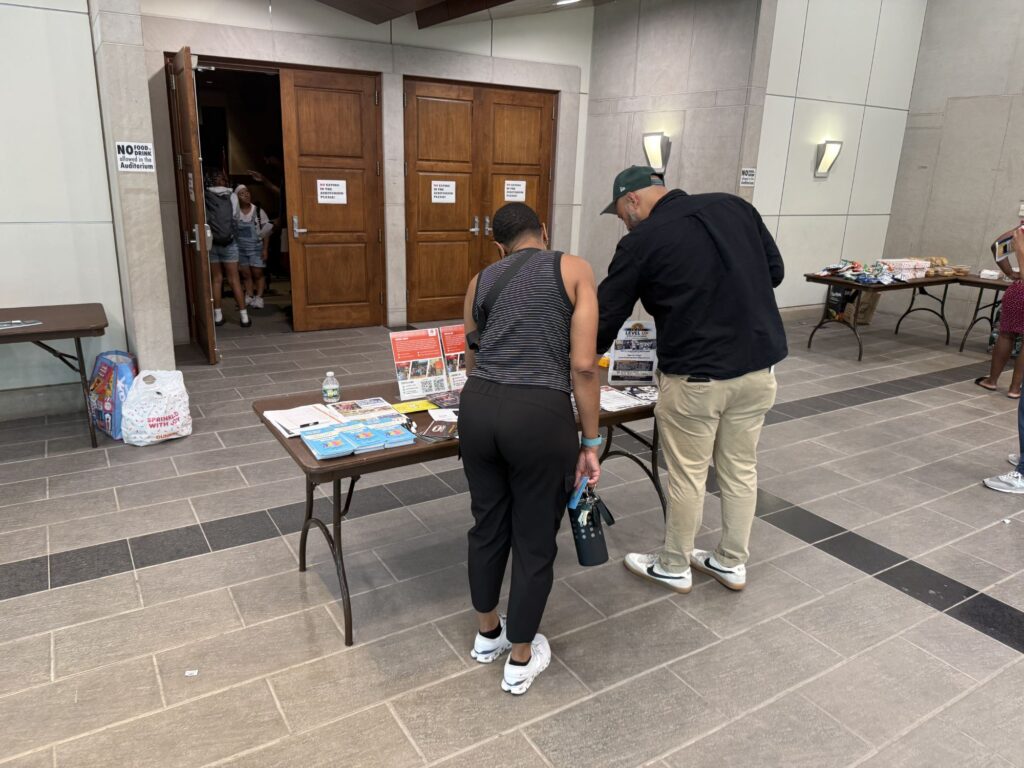
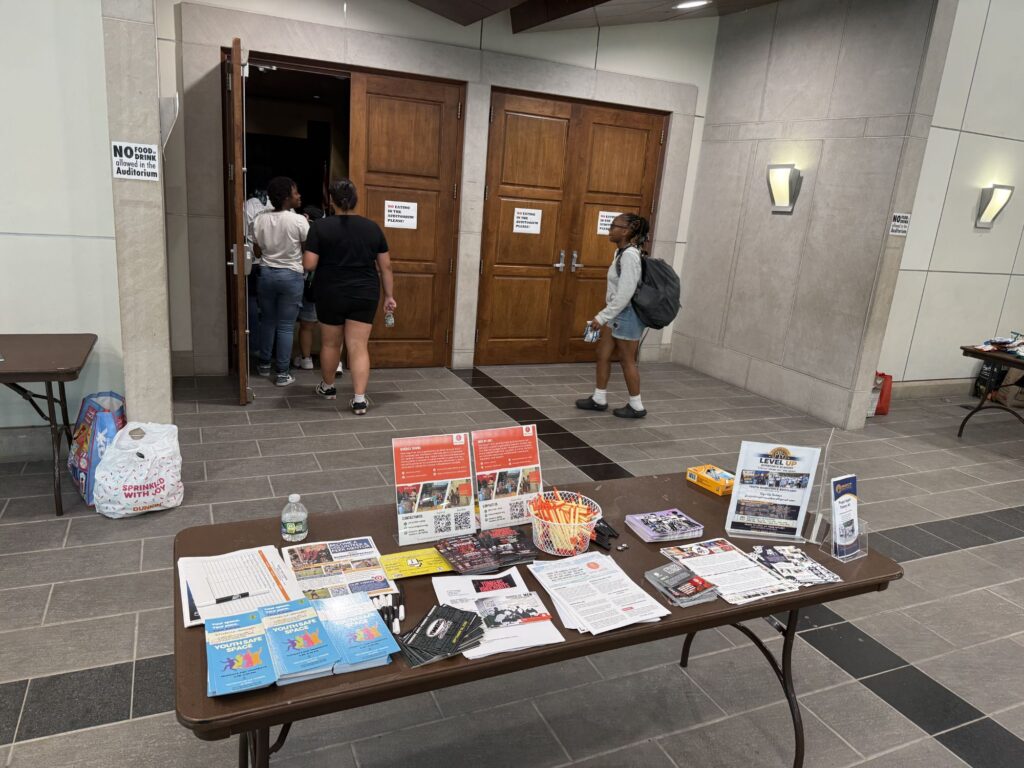
We also heard about free youth programming that includes sports, family engagement, and robotics. The robotics caught my attention because someone acknowledged an obvious truth our youth-development strategies sometimes miss: Every child doesn’t want to play sports. Somebody wants a camera. Somebody wants a computer. Somebody wants to paint. Somebody wants to dance. Somebody wants to build something. Somebody wants to make music. Somebody wants to start a business. And somebody hasn’t discovered what makes them light up yet. Violence prevention cannot become code for: Give Black and brown kids a basketball.
Give them choices. Give them exposure. Give them possibilities. Let them discover who they are before the streets decide who they’re supposed to be.
Presence Is the Beginning. Partnership Is the Assignment.
Government leadership was represented in the room as well.
Among those I observed were Symra Brandon, representing the office of New York State Senate Majority Leader Andrea Stewart-Cousins; Westchester County Legislator James Nolan, District 15; Yonkers City Council President Lakisha Collins-Bellamy, Esq.; and Yonkers City Councilwoman and Majority Whip Deana R. Norman, representing District 1. I also saw Leslye Oquendo-Thomas, candidate for Westchester County Legislature District 17. Their presence mattered. But presence is the beginning. Partnership is the assignment.
Grassroots organizations have relationships government cannot manufacture. Government has access and resources grassroots organizations often cannot reach. We need both. If elected leaders heard an idea in that room that makes sense, help move it. If organizations need access to schools, help open the door. If a grassroots organization is producing results, help connect it to sustainable resources. Don’t just applaud the work. Build infrastructure around the people already doing it.
Some of the Most Important People Weren’t on the Stage
I also noticed credible messengers from SNUG in the audience. That mattered to me. Sometimes the person who can reach a young person isn’t the person with the biggest title or longest résumé. Sometimes it’s somebody who can look at them and say: “I’ve been where you are.” And the young person knows they’re not performing empathy. They lived it.
I also saw organizers from ELOC (Environmental Leaders of Color) alongside some impressive young advocates. We need those young people in these conversations. Not as decoration. Not for the group photo. Not because somebody’s grant requires “youth voice.” Give them influence. Ask why their friends carry guns. Ask what scares them. Ask why they don’t come to our programs. Ask which adults they trust. Ask what we’re getting wrong. And then do something adults sometimes struggle with: Be quiet and hear them.
No Wrong Door
Here’s what I want this ecosystem and eventually the broader Yonkers community to become: No wrong door. A young person enters through art and needs mental-health support? Connect them. A credible messenger meets somebody who needs employment? Connect them. A family enters through the YMCA and needs another service? Connect them.
Brother 2 Brother or Project Inspire realizes a child is struggling because the parent is drowning? Help the parent too. A teacher notices something changing in a student? They should know who to call before that child reaches crisis. Wherever a child or family enters the village, somebody should know where the next door is. That’s an ecosystem. That’s community. That’s prevention.
Don’t Let August 13th Become Another Meeting
This is my challenge to everybody who was in that room, including me. Don’t let August 13 become another meeting where everybody felt good about the conversation and then went back to their separate corners. Don’t let the photographs become the outcome. Don’t let attendance become the accomplishment. And please don’t let another shooting be the thing that brings everybody back together.
For the first time in seven years of living in Yonkers, I saw enough organizations genuinely moving together to make me believe something bigger is possible. So build on it. Widen the circle. Bring in the grassroots organizations still outside of it. Bring in the schools. Bring in businesses. Bring in mental-health providers. Bring in parents and caretakers. Bring in credible messengers. And put young people at the center, not at the edge.
Because Yonkers doesn’t have to start from scratch. We have programs. We have artists. We have mentors. We have mental-health advocates. We have credible messengers. We have grassroots leaders with community trust. We have elected officials with the ability to open doors. And we have young people intelligent enough to tell us exactly what we’re missing. Yonkers has the village. Now connect it. Because the people closest to our community’s problems are often closest to the solutions.
And because violence is a disease our children are combating in real time, our responsibility is to make sure they and the people raising them have the tools, language, resources and relationships to protect themselves, heal and choose something different.
On August 13, the message was: OUR COMMUNITY. OUR YOUTH. OUR RESPONSIBILITY.
Cool.
Now comes the part that counts: