







This week, the United States House of Representatives quietly held a vote that most Americans will likely never hear about.
The question before Congress was simple: Should the public have access to records of sexual misconduct investigations involving members of Congress?
The answer from the House was equally clear.
No.
By a vote of 357–65, the House voted to send a resolution back to the Ethics Committee rather than force the public release of sexual misconduct reports involving members of Congress. In Washington procedure, sending a measure back to the committee is often the polite way of killing it.
In other words, Congress voted to keep the information inside the institution rather than in the hands of the public.
The resolution, introduced by Nancy Mace, would have required the House Ethics Committee to preserve and publicly release records related to investigations involving sexual harassment, unwelcome sexual advances, and sexual assault by members of Congress.
Instead, the House chose institutional protection.
The $17 Million Question
The vote is particularly striking given what is already known about the cost of misconduct inside Congress.
According to House records cited by Thomas Massie, members of Congress have spent roughly $17 million in taxpayer money to settle sexual harassment claims over the years.
The exact number of cases remains unclear because many of the settlements were handled through congressional administrative processes that shielded the identities of both the complainants and the lawmakers involved.
For critics, the issue is simple: if taxpayer money was used to settle these cases, taxpayers should know who the accusations involved and how Congress handled them.
That is precisely what the Mace resolution attempted to address.
The Number That Is Getting Attention
Among the members voting to block the release were 78 female members of Congress, a number that has drawn attention online because many lawmakers have built their political messaging around workplace accountability and protecting employees from harassment.
The vote itself was not strictly partisan or gender-based. The majority coalition that kept the records sealed included Democrats and Republicans, men and women alike.
Still, the optics are striking.
At a time when political messaging frequently centers around accountability and protecting employees from harassment, Congress voted overwhelmingly to keep its own disciplinary records confidential.
Washington’s Favorite Move: The Procedural Kill
To understand what happened, it helps to understand how Congress often avoids politically damaging votes.
Members rarely vote directly against transparency. Instead, they rely on procedural maneuvers.
That is exactly what happened here.
By voting to send the resolution back to committee rather than voting directly on releasing the records, lawmakers avoided a simple yes-or-no vote that could later be used in campaign ads.
Technically, members can now say they did not vote against transparency.
But in practical terms, the outcome is identical.
The reports remain sealed.
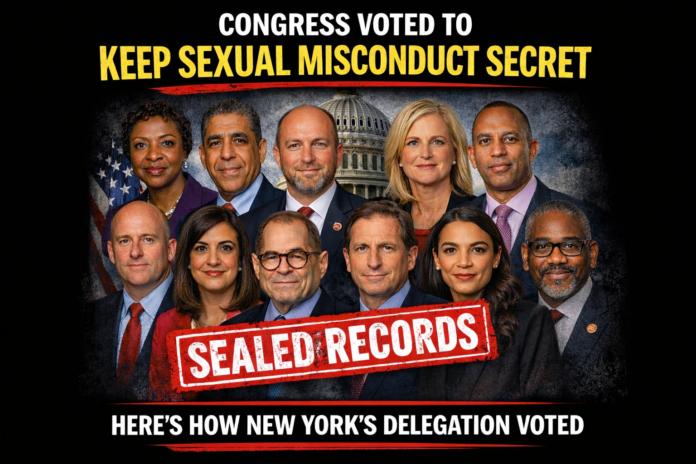
How New York’s Congressional Delegation Voted
According to the official House roll call vote, members of New York’s congressional delegation were largely aligned with the majority that voted to keep the records from being publicly released.
The motion passed 357–65, sending the transparency resolution back to committee and effectively blocking the release of misconduct investigation records.
New York members who voted “Yea” on the motion to refer — meaning they supported sending the resolution back to committee rather than releasing the records — included:
- Yvette Clarke
- Adriano Espaillat
- Andrew Garbarino
- Laura Gillen
- Dan Goldman
- Hakeem Jeffries
- Tim Kennedy
- Nick LaLota
- George Latimer
- Mike Lawler
- Nicole Malliotakis
- John Mannion
- Gregory Meeks
- Grace Meng
- Joe Morelle
- Jerrold Nadler
- Alexandria Ocasio-Cortez
- Tom Suozzi
- Claudia Tenney
- Paul Tonko
- Ritchie Torres
- Nydia Velázquez
Only four members of New York’s delegation voted against sending the resolution to committee, meaning they supported allowing the measure to move forward toward releasing the records:
- Nick Langworthy
- Josh Riley
- Pat Ryan
- Elise Stefanik
Accountability for Everyone — Except Congress?
In nearly every other sector of American life, transparency has become the expectation.
Corporate executives lose their jobs over misconduct.
University leaders face public investigations.
Media organizations report aggressively on allegations involving powerful figures.
But when it comes to the legislative branch, the rules appear to change.
Congress writes the laws that govern the country, yet it often maintains its own internal system for handling ethical violations behind closed doors.
And when an effort is made to open those records to the public, the institution closes ranks.
The Real Question
The debate now is not simply about one vote.
The larger question is whether the public should have access to records involving allegations of misconduct by the very officials responsible for writing the laws that govern everyone else.
Because transparency in government is not just a slogan.
It is a test.
And this week, Congress decided that test would remain sealed.