


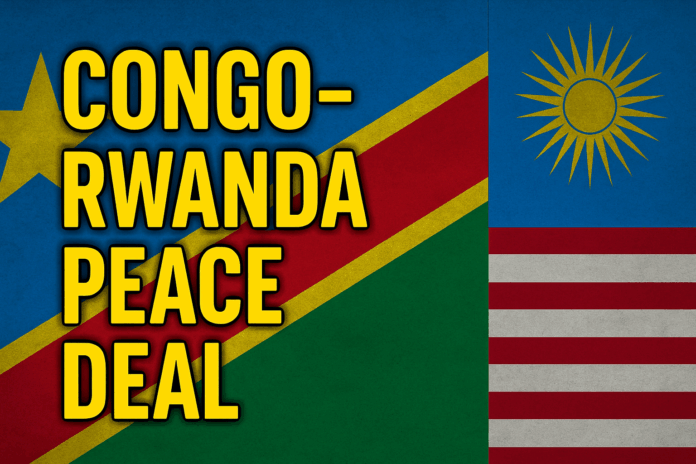





On June 27, 2025, a rare event occurred in global diplomacy: Rwanda and the Democratic Republic of the Congo, two nations long embroiled in a cycle of war, betrayal, and foreign exploitation, signed a peace agreement. Brokered in Washington, D.C., and attended by U.S. Secretary of State Marco Rubio and former President Donald Trump, the deal should have flooded headlines. Instead, it landed with a whisper.
Why is that?
After all, we’re talking about a conflict that has cost over six million lives. A region destabilized for decades. One of the most mineral-rich zones in the world—home to cobalt, coltan, copper, and lithium—finally witnessing a structured attempt at troop withdrawal, disarmament, and reintegration. This is not a footnote. It’s front-page news. Or at least, it should be.
But mainstream media coverage has chosen caution over curiosity. Skepticism over strategy. Rightfully so, in part—because the deal excludes the M23 rebel group, avoids discussions on justice and reparations, and hinges on fragile political trust. These are not minor flaws. Yet, when the only stories told are those of what could go wrong, we deprive the world—and especially the Congolese people—of the full story.
The story of hope. The story of possibility. The story of what this moment could become.
Let’s not pretend the peace deal is perfect. It isn’t. The exclusion of M23 is a glaring omission. The silence on reparations is deafening. And the long shadow of past broken agreements looms large. But this agreement is different for one key reason: it introduces economic and political incentives tied directly to stability.
For the first time, access to Congo’s critical minerals is not just a trigger for warlords and smugglers—it’s a bargaining chip in a rules-based framework. The joint security mechanism, troop withdrawal deadlines, and disarmament plans offer structure where chaos once reigned. That matters.
Yet, legacy media institutions are not prepared to embrace this as progress. They’ve grown more comfortable covering Congo as a humanitarian crisis, not as a site of African agency or African diplomacy. The framing remains extractive: what can the West get out of this? How might China respond? Will it help U.S. battery production?
What about the Congolese child who may no longer be recruited by armed militias?
What about the families in Goma and Bukavu who might finally return home?
What about African-led peace?
The truth is, narratives of African success—especially when negotiated without UN troops, Western sanctions, or regime change—don’t fit the script. The Congo-Rwanda deal wasn’t orchestrated from Geneva or Brussels. It was birthed through regional pressure, national exhaustion, and yes, Western strategic interest—but not Western control.
Maybe that’s why it’s being downplayed.
Here’s what the media won’t say: peace, even imperfect peace, is power. And this deal, flawed as it may be, is a chance for the DRC and Rwanda to reset decades of animosity and foreign manipulation. If successful, it could shift how conflicts are resolved in Africa—by Africans, with accountability, economics, and sovereignty at the center.
But only if we stop treating African peace as unnewsworthy. Only if we dare to report hope, not just horror.
If we wait for the perfect peace deal before we acknowledge progress, we may never acknowledge progress at all.