

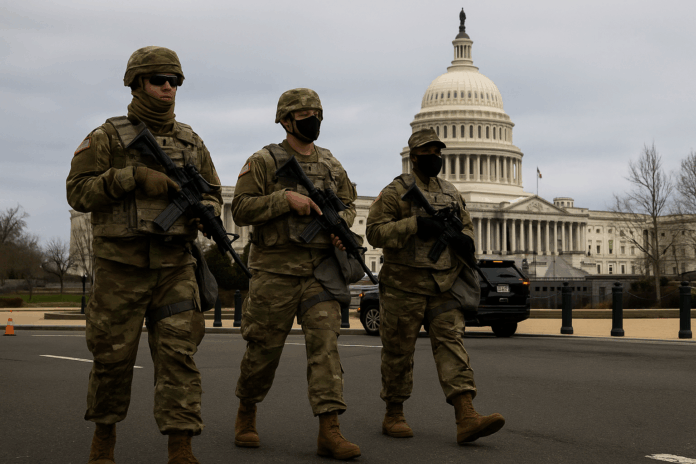






The Trump administration has intensified its federal crackdown in Washington, D.C., with West Virginia, South Carolina, and Ohio now joining other states in deploying National Guard troops to the nation’s capital. The move comes amid growing unrest, violent outbreaks, and an increasingly visible homelessness crisis in the city. While the administration frames the deployment as a measure to restore order, critics argue that militarization does little to address the systemic issues at the root of the problem.
A City Under Siege
Washington, D.C. has seen a surge in violent crime, high-profile protests, and sprawling homeless encampments that have made national headlines. President Trump has doubled down on his law-and-order stance, insisting that deploying additional troops will protect residents, businesses, and federal property. For his supporters, the move signals strength and decisive leadership. For many others, it raises the specter of an over-policed city that has historically struggled with civil rights tensions.
The Limits of Militarization
Experts warn that this type of response risks repeating a familiar cycle: deploy force, disperse crowds, and move encampments without changing the conditions that led to instability in the first place. Violence in D.C. is tied to poverty, unemployment, untreated mental illness, and the skyrocketing cost of living that pushes thousands into homelessness each year. Troops on street corners may temporarily reduce visible disorder, but they cannot provide affordable housing, mental health services, or job opportunities.
Criminal justice advocates further point out that militarization erodes public trust. Communities already skeptical of police see the presence of armed soldiers as intimidation rather than protection. This dynamic often heightens tensions rather than calming them, deepening the divide between residents and government.
A Divided Community Response
Despite the protests and loud criticism from activists, many Black residents in Washington, D.C. have openly welcomed the crackdown. For those who live in neighborhoods plagued by shootings, robberies, and drug activity, the presence of National Guard troops offers a sense of relief and safety that city leaders have failed to deliver. Their support reflects a reality often overlooked in national coverage: not every resident sees law-and-order measures as oppression. For some, they are a long-overdue answer to daily fears of crime and insecurity.
The move also has symbolic weight. Washington, D.C. is not just another American city—it is the seat of the federal government. The sight of military units patrolling its streets sends a message to the nation and the world about how America responds to its own domestic crises. Critics note that an administration willing to deploy troops to handle social breakdown risks normalizing force as the first option, rather than the last resort.
What Have Elected Officials Been Doing?
The second question many residents are asking is just as pressing: what have elected officials been doing all this time? For years, D.C. has struggled with rising rents, failing schools, untreated mental illness, and a revolving door of criminal justice policies. Yet little has been done to break the cycle. Leadership has relied on short-term fixes and campaign talking points while communities continue to deteriorate.
What D.C. needs, experts argue, is not more soldiers but more solutions: investments in housing, education, mental health, and job training. Cities across America are grappling with the same underlying issues, from Los Angeles to Philadelphia. Until policymakers address these conditions, the deployment of the National Guard will remain a band-aid—covering up the wound without healing it.
The Trump administration’s crackdown may project toughness, but the deeper failure rests with decades of political leadership that allowed crime and poverty to grow unchecked. Without real accountability and long-term solutions, residents will continue to ask the same question: if the troops can show up, why haven’t our elected officials?

A multifaceted personality, Damon is an activist, author, and the force behind Black Westchester Magazine, a notable Black-owned newspaper based in Westchester County, New York. With a wide array of expertise, he wears many hats, including that of a Spiritual Life Coach, Couples and Family Therapy Coach, and Holistic Health Practitioner. He is well-versed in Mental Health First Aid, Dietary and Nutritional Counseling, and has significant insights as a Vegan and Vegetarian Nutrition Life Coach. Not just limited to the world of holistic health and activism, Damon brings with him a rich 32-year experience as a Law Enforcement Practitioner and stands as the New York Representative of Blacks in Law Enforcement of America.