




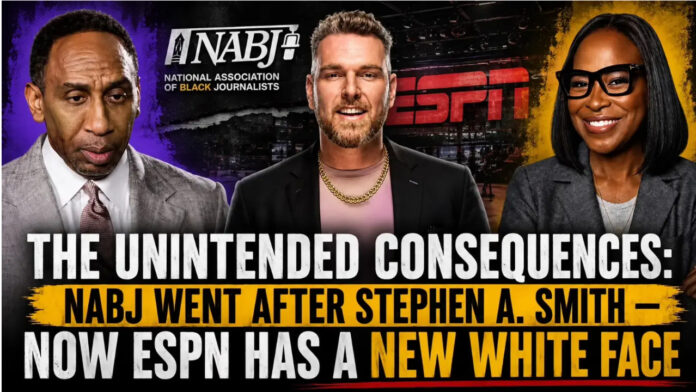




Intentions are not consequences. You can think you’re doing the right thing. You can win praise from those who agree with your action. And still produce an outcome far different than what you originally intended. For that reason, good leadership must always look past the cheers of the moment and take a hard look at the result. Good leadership must ask questions like “What did we actually accomplish?” “What did this cost?” “Who gained power?” and “Who lost power?” As far as leadership goes, those are the questions that Black journalists should be asking about NABJ’s decision to honor Stephen A. Smith with its 2026 Thumbs Down Award. According to NABJ, Smith exhibited “a recurring pattern of disparaging commentary toward prominent Black women.”
Stephen A. is rich and popular, but that doesn’t make him above criticism. And if NABJ feels Stephen A. has crossed a line, the organization has every right to call him out. But just because you have a right to do something doesn’t mean you shouldn’t consider the consequences. Those consequences are difficult to ignore when you consider what is happening at ESPN at the exact same time NABJ is attacking Stephen A. Smith. Today, ESPN is giving Pat McAfee more visibility and opportunity. McAfee is white. He’s also quickly becoming one of ESPN’s biggest stars. NABJ is not responsible for McAfee’s success. And McAfee is not literally taking Stephen A. ‘s spot on First Take. But if Stephen A.’s relationship with Black journalists continues to weaken while McAfee’s relationship with ESPN continues to grow, who ultimately gains power? Who loses it?
Stephen A. Wasn’t Just a Black Face at ESPN
Black representation is not the same thing as Black power. Representation involves seeing a Black person at the desk. Power is that person earning enough influence to dictate where an enormous media corporation travels, what resources it devotes to certain projects and which institutions it allows access to that coveted platform. Stephen A. Smith earned that kind of power at ESPN. That is why what is reportedly happening now matters. Don’t like his politics? Sorry you didn’t like my personality? Think he talks too much nonsense? Fine. Those are valid discussions to be sure. But none of that changes the reality that Stephen A. became one of the most famous figures representing ESPN. For generations of Black journalists, the goal was simply to gain entry into established newsrooms and sports departments. Stephen A. Smith earned himself a place where he was not just another ESPN employee. His larger-than-life personality became part of the fabric of the ESPN brand itself. When you have that kind of visibility, you wield something more valuable than celebrity: leverage with the institution that employs you. Some of that was directly used to benefit NABJ.
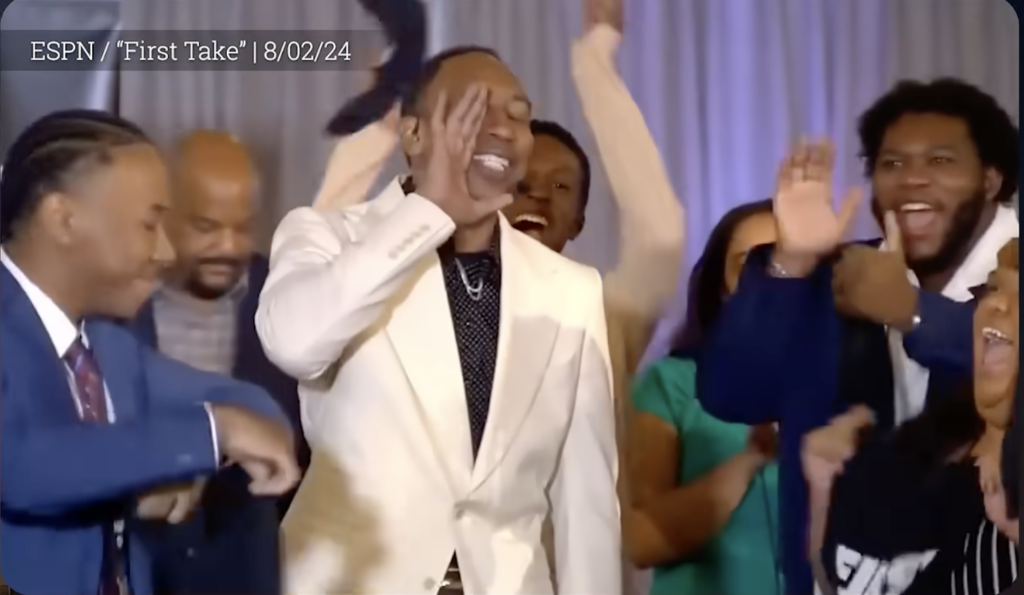
Last year, ESPN broadcast First Take outside its regular studio and onto the floor of the NABJ Convention in Chicago, with Stephen A. Smith and Molly Qerim hosting from inside the convention. ESPN placed its cameras, production team, on-air personalities, and national audience directly into the heart of an event devoted to Black journalists. Reportedly, NABJ also hosted Smith and live broadcasts of First Take at its 2024 and 2025 conventions. That context matters because Stephen A. was never just another celebrity appearing at NABJ. His partnership with the organization created a valuable link between NABJ and one of the most powerful media brands in all of American sports. At the same time, NABJ developed a relationship with Stephen A., linking him to an important professional organization serving Black journalists. Both sides had something to gain from that relationship, which is why any attempt to damage it should be taken seriously by everyone involved. When Stephen A. brings First Take to NABJ, he is not simply flying into the conference on the cache of his own celebrity. He also brings ESPN with him.
Black Power Is More Than Seeing a Black Face
Sometimes Black America conflates representation with power because for so much of our existence we have been fighting simply to gain representation. Having a Black anchor, executive, coach, journalist, or politician in a space that was previously closed off to us is important, but representation reaches new heights of value when that person is able to cultivate enough influence within that institution to help open doors for more Black people and Black institutions. Stephen A. had reached that level. ESPN wasn’t just paying a Black commentator to be on television; they had a Black man who had become one of the network’s flagship personalities. When that personality can help to bring First Take and ESPN’s media might to an NABJ convention, symbolic Black representation is morphed into something more powerful: Black institutional power.
Institutional power can not be easily replicated because black people with Stephen A.’s influence are not ubiquitous. ESPN can hire another Black commentator tomorrow, but that hire won’t automatically endow that person with Stephen A.’s viewership, negotiating ability, contacts, longevity, or clout. Organizations can fire employees, but whole communities can’t fire away decades of established leverage. That’s why I feel the controversy surrounding Stephen A. warrants more discussion than simply whether you feel he was right or wrong in his statements. There aren’t dozens of journalists with Stephen A.’s reach at major media companies across America. And when something is scarce, it should be treated as such when it’s diminished or lost.
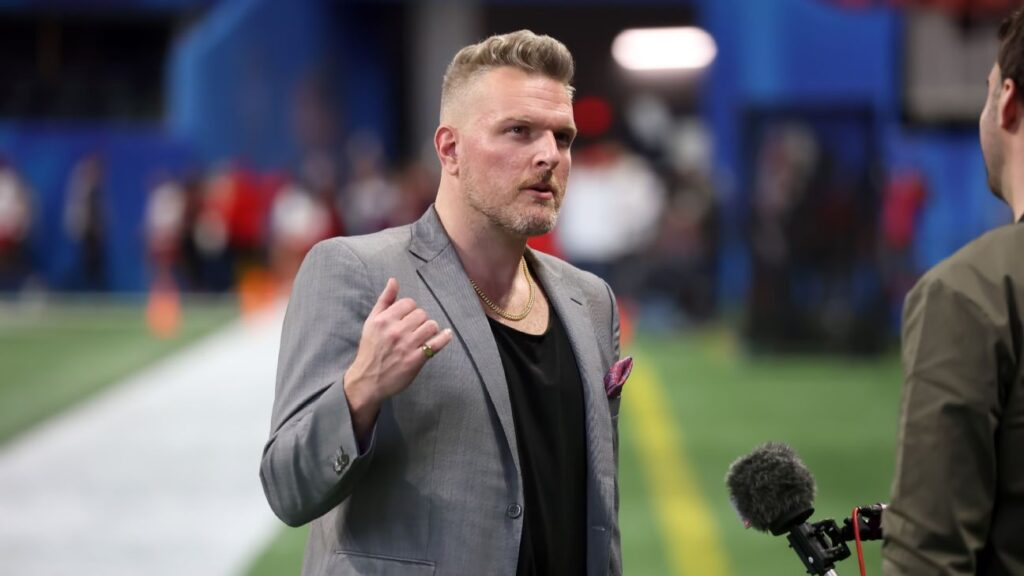
Now Look at Pat McAfee
Stephen A.’s relationship with NABJ is reaching an all-time low. During this exact moment, ESPN is launching Pat McAfee into the universe. Pat McAfee has his own talk show. He has a consistent role on College GameDay, and now ESPN is allowing him to stretch his platform even further with Monday Night Countdown. Before we know it, sports media wonks will be debating if Pat McAfee is now ESPN’s marquee personality. There is nothing wrong with Pat McAfee receiving these opportunities. McAfee has carved out a massive platform for himself, and ESPN sees dollar signs when his face is on television. To frame this as a black man vs. white man scenario would be doing yourself a disservice. The real issue at hand is what McAfee’s ascension tells us about how power is redistributed within these corporations. ESPN is under no obligation to uphold Black institutional power.
Disney doesn’t owe Black people anything by ensuring that if Stephen A. loses power or becomes estranged from Black organizations, another Black man will receive the same pull. Companies typically give these opportunities only to people they believe will generate viewers, advertisers, subscribers, eyes on whatever product they are peddling, and cultural cachet. If ESPN believes Pat McAfee can do those things, they will continue to give Pat McAfee all the opportunities, whether Black people feel another Black man should’ve been given Stephen A’s seat. This is where the unintentional consequences of our arguments come into play. Black journalists could fight over whether Stephen A deserved to win an award for two weeks, and ESPN will continue to build Pat McAfee into the network’s next golden child. The corporation doesn’t care who’s right, and the new influential person doesn’t have to uphold the same ties to Black institutions that Stephen A. did.
Corporate America Does Not Guarantee Black Succession
Another perilous assumption about Blackness and representation is that when a Black person reaches a position of power, that position becomes Black forever. We have no examples in American corporate history supporting the idea that “if a Black man can run the company, so can a white man” applies when a Black news anchor gets a job, so can a white news anchor. Or that if one powerful Black figure influences culture, another powerful white figure can take his spot. Companies will not miss a beat if Black people are gone. ESPN will show games, companies will buy ads, Disney will sell their packages, and fans will still watch sports. If the suits decide they want someone else as the face of their network, they will make it happen whether that person is Black or not.
This is why Black institutions need to recognize how powerful it is when Black people gain power inside institutions we do not own. We do not own ESPN; we cannot dictate Disney’s executive decisions, and we cannot decide who the next big personality at that network will be. What we can do is recognize how powerful our outreach is when a Black person becomes powerful enough within these institutions to open doors for Black institutions.
Could This Have Been Handled Differently?
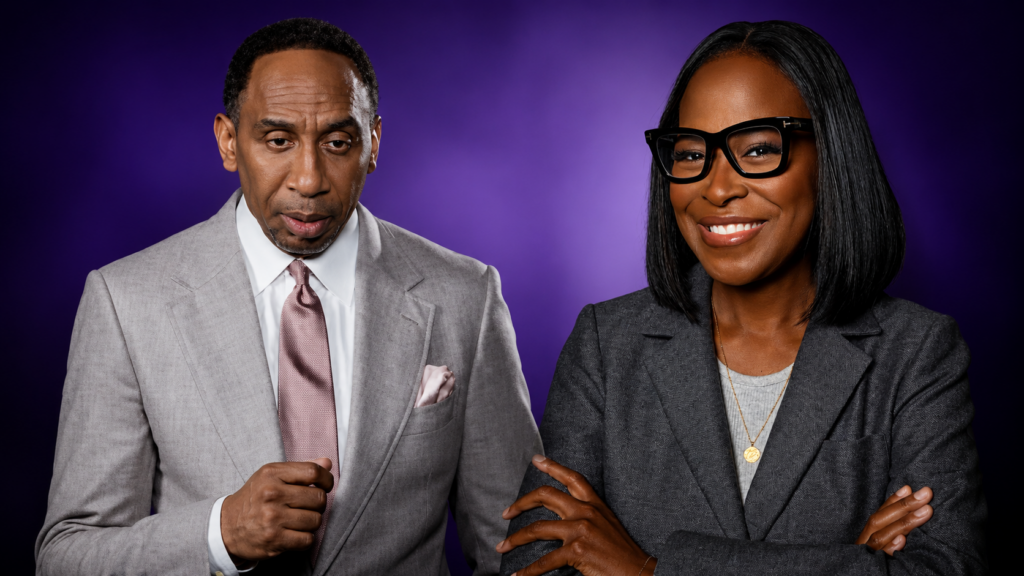
Finally, this leaves us with NABJ’s process. Could the same issues have been addressed without putting that relationship at risk on day one? In reviewing the public reporting on this subject, I have found no evidence that NABJ President Errin Haines or NABJ leadership met with Stephen A. Smith before presenting him with the Thumbs Down Award. Stephen A. publicly asked why no one had reached out to him before the meeting and why no one had had a conversation first. That is intriguing, because NABJ is made up of journalists. Journalists will always insist that people and institutions be given a chance to respond before serious allegations are made public. Allowing someone to respond doesn’t allow the subject of an investigation to veto your story. It allows the opportunity for context, a response, and fairness before deciding to levy public judgment.
Additionally, considering Stephen A.’s past with NABJ, it would have made sense from an institutional perspective to sit down with him. Leadership could have told him directly that they felt his commentary had gone too far, listened to his side, and still moved forward with their public denouncement if they felt he wasn’t accountable for his actions. Starting with diplomacy wouldn’t have meant NABJ threw their principles out the window; it would have meant that the organization understood that a valuable relationship was on the line and warranted an attempt to protect it. Relationships are institutional assets, and yes, sometimes principles mean you need to risk those assets. However, responsible leadership should know what they’re risking before deciding to do that, especially when the relationship in question pairs a Black professional organization with one of the most influential media companies in America.
Then There Is the Roland Martin Question
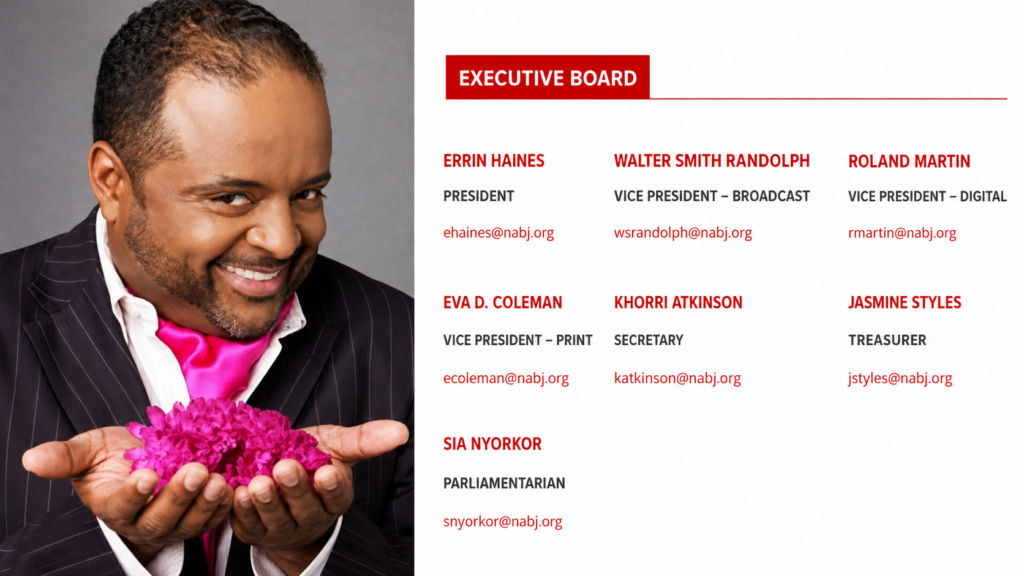
Yet another problem involves clarity on the selection process by NABJ. Roland Martin had NABJ President Errin Haines on his show, Roland Martin Unfiltered, to explain where NABJ stands after the backlash ensued. Now, Roland Martin is no outsider to journalism organizations covering NABJ: the organization lists him as its Vice President–Digital, making him a member of NABJ’s executive leadership. Roland Martin has also publicly clashed with Stephen A. on political commentary in the past. That doesn’t mean Roland Martin had anything to do with Stephen A. receiving the award. In fact, I have seen no proof that Roland Martin was involved in the nomination, deliberation, or ultimate decision to approve the award. Pointing fingers without proof would be a huge mistake on my part.
However, that is why clarity from NABJ would dismiss much of the unfounded speculation. NABJ could easily answer some simple questions about its selection process. Who nominated Stephen A. Smith? Who reviewed his nomination? Who was involved in the deliberation process, and who ultimately decided to approve Stephen A. Smith? Those are all fair questions to ask. It is also fair to question if Executive Board members were involved in the selection process and what role, if any, Roland Martin played. If Roland Martin had no involvement, then NABJ can state that and take him out of the equation. But here’s the thing: Those are valid questions, but they shouldn’t be the story. The story is what happens to Black institutional power when one of the most high-profile Black voices in mainstream media further distances himself from an organization meant to represent Black journalists while his network continues to create and empower another high-profile personality who is white.
Who Actually Pays the Price?
Let’s say Stephen A. doesn’t want anything to do with NABJ anymore. Though it may seem like Stephen A. is being punished, organizational repercussions rarely work that cleanly since Stephen A. would retain ESPN, his massive platform, his podcast, business interests, his friendships, and millions of dollars. Meanwhile, NABJ would be tasked with figuring out if they can replicate access and national media attention that having First Take broadcast from its convention created. If First Take doesn’t come back, ESPN scales back its convention footprint and another Black ESPN personality doesn’t have Stephen A.’s pull or desire to keep that relationship alive, the long-term institutional repercussion may land harder on NABJ than the member they wanted to punish. That doesn’t mean NABJ shouldn’t uphold their standards for the cameras at ESPN. It means punishment and repercussions don’t always fall on the same person, and an organization can call someone out publicly and learn weeks later they’ve impacted their own standing.
A White Face Can Fill the Vacuum
Meet Pat McAfee. I’m glad he has been successful. I’m not raising this point to throw shade at McAfee or point out that he did something wrong. I mention him because his rise to prominence showcases how swiftly corporations can pivot power. ESPN doesn’t need another Black person to elevate Stephen A.’s platform so they can later give another person more influence. If McAfee provides executives with the ratings and dollars they desire, ESPN can keep elevating him without having to find Stephen A.’s Black replacement. Imagine what the institutional consequence could look like if we allow this to continue. Stephen A. grows more irrelevant to NABJ; First Take can’t secure expo booths at NABJ conventions as it used to; and ESPN can continue elevating McAfee to arguably the most recognizable face on the network. By that point, ESPN may have lost very little because they still have one of the most marketable superstars that will attract billions of eyes.
Meanwhile, Black journalism may have lost access to something far more valuable to replace. Black journalism may have lost a Black man’s willing access into the circle where he was able to gain enough influence at ESPN to help bring one of the largest sports-media companies in America into our fold. This would be a negative racial consequence whether it was planned by NABJ, ESPN, McAfee, or Stephen A., and that’s exactly why we should view this as an unintentional consequence instead of a conspiracy.
The Next NABJ Convention Will Tell Us More Than Social Media
But the true battleground of this controversy won’t take place on Twitter. It won’t be decided by who had the better argument on television. It won’t be measured by who got more likes or who got applauded when their award was presented. Future NABJ conventions will matter more than this one because we’ll get to see if the institutional partnerships that existed before this controversy will look the same going forward. Keep an eye on whether Stephen A. returns to NABJ. Keep an eye on if First Take returns. Keep an eye on whether ESPN continues to allow NABJ to sell cameras, personalities, and production resources. Keep an eye on if another Black ESPN personality will have enough clout to keep that relationship going or increase it. Now we’re talking about tangible results that will tell us far more about the impact of this controversy than posturing on social media ever will.
If Stephen A. returns and ESPN continues to send cameras and platforms into the future, fears of long-term damage to the institution will have been greatly exaggerated. Any legitimate argument has to allow for that possibility because accountability and business relationships aren’t mutually exclusive if both sides feel that relationship is worth maintaining. If Stephen A. refuses to return, if First Take goes away, and if ESPN stops sending resources while Pat McAfee continues to get bigger and bigger, then I hope we stop pretending like those things don’t matter to Black journalists. We’ll instead have to question if trying to hold one successful Black man accountable also played a role in diminishing a valuable relationship between Black journalists and one of the biggest powers in sports media.
As a Black Journalist, I Have to Ask the Hard Questions
I’m writing this as a Black journalist and publisher who has covered politics, government, policing and race-related issues for 15 years. I’m also coming at this as a journalist who knows our job often requires us to ask tough questions, even when they’re uncomfortable and even when an organization we generally admire is forced to answer them. We hold government, corporations and politicians to high standards of transparency. Shouldn’t we hold our own organizations to the same level of accountability?
It’s why I still have questions about NABJ’s decision to honor Stephen A. Smith. Was there a documented conversation with Stephen A. about his behavior beforehand? Who nominated him? Who voted and participated in the discussion and what, if any, influence did NABJ Vice President–Digital Roland Martin have? I’m not throwing accusations. I want answers. Here are legitimate questions about process and transparency. But I also have to wonder if NABJ took into consideration what else may be lost. Yes, Stephen A. Smith is a known commodity when it comes to Black journalists and celebrities skating around the topic of police brutality. But he also holds enough institutional power to bring First Take, ESPN’s cameras and national coverage into NABJ’s convention.
Accountability for his actions is one thing. Understanding the power and ability of that relationship is another. It’s why I can’t applaud this moment simply because a Black organization held one of its own accountable. I have to question it through the lenses of power, access and ultimately what the outcome will be. If Black journalism comes out of this stronger with its relationships intact and its power amplified, then NABJ made a decision that could have the proper consequences. But if the relationship between Stephen A. and NABJ is irreparably damaged, ESPN turns its cameras around and Pat McAfee continues to become the friendly face of the network, we’ll have to decide if Black journalism won the argument but lost valuable institutional power. Journalism is about holding people accountable, even if those people are us. The real question isn’t if NABJ had good intentions, it’s if Black journalism has more power when this is all said and done.

[…] time NABJ is attacking Stephen A. Smith,” wrote Damon K. Jones for Black Westchester. “Today, ESPN is giving Pat McAfee more visibility and opportunity. McAfee is white. He’s also quickly becoming one of ESPN’s biggest stars. NABJ is not […]