


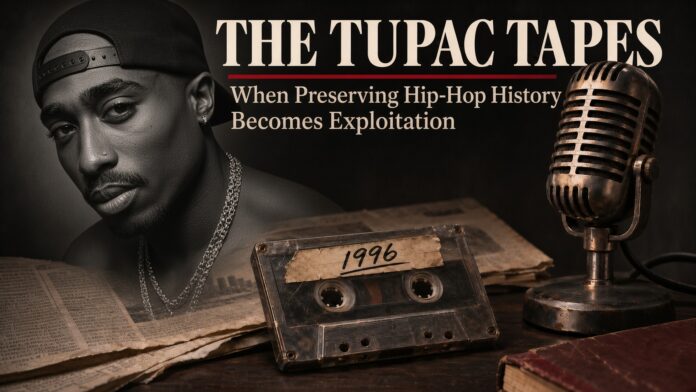






Thirty years after Tupac Shakur’s death, radio personality Angie Martinez has released previously unheard portions of her 1996 interview with the legendary rapper through Netflix’s four-part series, The Tupac Tapes with Angie Martinez. While many celebrate its release as a significant moment in hip-hop history, we must ask ourselves an uncomfortable question: Are we preserving history or exploiting the dead at the expense of the living?
Martinez explained that she withheld parts of the interview because she believed their release could escalate violence, damage relationships, and intensify the East Coast–West Coast rivalry. That was arguably a responsible journalistic decision. However, if the material was deemed damaging thirty years ago, what makes it ethically acceptable today? Time may have changed the circumstances, but it has not eliminated the potential for harm.
Perhaps the person most vulnerable to that harm is Faith Evans. Tupac repeated his controversial allegation that he had a sexual relationship with Evans while she was married to Christopher Wallace, better known as the Notorious B.I.G. Evans has consistently denied the allegation. The existence of a recording does not establish the truth of what was said. It simply shows that someone said it.
Did Angie Martinez consider Faith Evans’ son, Christopher Jordan Wallace, before releasing these recordings? How would a son feel hearing another man make such intimate allegations about his mother while his deceased father is dragged back into a decades-old controversy? Now, through Netflix and social media, the entire world is hearing and debating these allegations. Did anyone consider the emotional consequences for him and his family?
Tupac and Biggie are both dead, but Faith Evans and her children are alive. They must bear the consequences of a controversy neither deceased man can clarify or resolve. Faith is a mother, an accomplished recording artist, and a woman whose dignity should not be collateral damage in the entertainment industry.
As a newspaper publisher, I understand the difference between what interests the public and what is genuinely in the public interest. Editorial responsibility requires careful consideration of accuracy, relevance, context, and consequences. Having the legal right to publish something does not automatically make it morally responsible to do so.
Equally concerning is the decision to frame Tupac’s recorded statements with commentary from contemporary media personalities. While some participants knew Tupac personally, others offer interpretations without necessarily having had a personal relationship with him. Tupac cannot challenge their assessments, explain his intentions, or defend himself against their characterizations. He cannot respond to how his words are edited, packaged, or interpreted.
Even E.D.I. Mean, a member of Tupac’s Outlawz who was present at the original interview, has stated that the series does not include the full recorded conversation. Although he did not accuse the producers of manipulating Tupac’s words, his observation raises legitimate questions about editorial selection and historical context.
The entertainment industry has built a profitable business around Black trauma, conflict, and tragedy. Three decades after two talented young Black men lost their lives, their rivalry remains a marketable commodity. Streaming platforms attract audiences, commentators generate content, and the public consumes the controversy, while surviving family members are left to deal with the emotional consequences.
Where is the same enthusiasm for Tupac’s political consciousness, his criticism of institutional racism, his understanding of poverty, and his call for successful Black artists to reinvest in their communities? Why does Black dysfunction remain more marketable than Black empowerment?
Tupac was intelligent, politically aware, emotionally complex, and imperfect. He was only 25 years old when he died. None of us knows how his perspectives might have evolved had he been given the opportunity to mature, heal, and reflect on his experiences.
This is not an argument for censoring history. Historical preservation has tremendous value, but it carries an ethical responsibility, particularly when the people involved cannot defend themselves and their families must live with the consequences.
Angie Martinez may believe she is honoring hip-hop history, but the public has every right to question the methods, motivations, and potential harm of this project. After thirty years, hip-hop should have matured beyond treating the destruction of Black relationships and the humiliation of Black women as entertainment.
If we truly respect Tupac’s legacy, we should demand more than another chance to monetize his anger. If we respect Faith Evans and her children, we should recognize that their dignity is worth more than streaming numbers.
History deserves preservation. The dead deserve dignity. And the living deserves fairness.

A multifaceted personality, Damon is an activist, author, and the force behind Black Westchester Magazine, a notable Black-owned newspaper based in Westchester County, New York. With a wide array of expertise, he wears many hats, including that of a Spiritual Life Coach, Couples and Family Therapy Coach, and Holistic Health Practitioner. He is well-versed in Mental Health First Aid, Dietary and Nutritional Counseling, and has significant insights as a Vegan and Vegetarian Nutrition Life Coach. Not just limited to the world of holistic health and activism, Damon brings with him a rich 32-year experience as a Law Enforcement Practitioner and stands as the New York Representative of Blacks in Law Enforcement of America.