



There are certain instances in which Black political history should be kept from being rewritten, repackaged, or conveniently borrowed in order to justify someone else’s political agenda. The fact that Rev. Al Sharpton referred to the late Congresswoman Shirley Chisholm when he was introducing Rep. Alexandria Ocasio-Cortez at the 2026 March on Washington is one such instance.
On August 28, 2026, The Hill made the comparison with the headline “Sharpton compares Ocasio-Cortez to Chisholm at voting rights march”. The report states that Sharpton told the crowd, “I know people; I was Shirley Chisholm’s youth director”, going on to say that Chisholm “had the same fire and vigor as this beloved sister of mine”, when referring to Ocasio-Cortez.
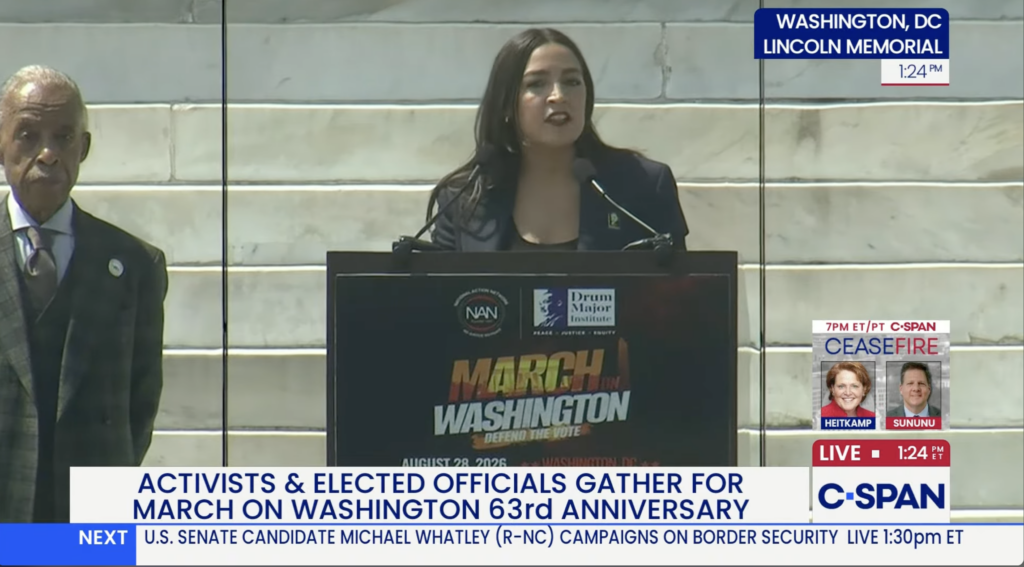
To be exact, Sharpton didn’t say that AOC was “the next Shirley Chisholm”. However, since he is a well-known black civil rights leader who had personal dealings with Chisholm and refers to her by name, her history and political spirit when he introduces another politician at a March on Washington, the symbolism is significant.
The comparison that I oppose is one which, in my view, reduces the special character of Black political history by putting the AOC side by side with Chisholm. It is a demeaning thing to do to Black women who in fact had to break down political barriers when both their race and sex were being used against them.
SHIRLEY CHISHOLM WASN’T SIMPLY A POLITICIAN WITH “FIRE AND VIGOR”
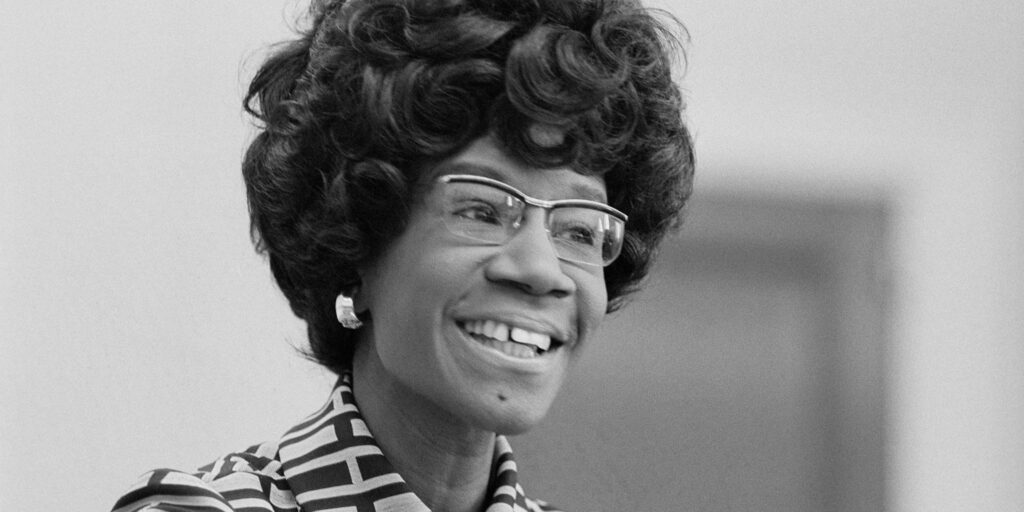
The reason why Shirley Chisholm was historically significant was not because she delivered passionate speeches. Upon her election to Congress in 1968, she became the first Black woman to be elected to the United States Congress; at that time the Civil Rights Act had only just been passed, the Voting Rights Act had been passed four years earlier, and Dr. Martin Luther King Jr. had been assassinated that same year.
Entering a political system in which a Black woman attaining congressional power was in itself a revolutionary step, Chisholm then in 1972 became the first Black candidate to seek the presidential nomination of a major American political party and the first woman to attempt to secure the Democratic presidential nomination. She faced racism, sexism, resistance from the political establishment, and opposition from those who might have been expected to support her.
The slogan ‘Unbought and Unbossed’ meant more than just being a brand.
That is the kind of history that Sharpton referred to when he introduced AOC. Hence the issue is not whether AOC has ‘fire and vigor’; the issue is why it was necessary at all to introduce her using the name and symbolism of Shirley Chisholm.
WHAT HAS AOC DONE FOR BLACK POLITICAL POWER?
Alexandria Ocasio-Cortez has been a member of Congress since January 2019. She is not any longer a political newcomer, has built up a very large national following and has become one of the most well-known politicians in America’s progressive movement. Those are her legitimate achievements, but they are AOC’s achievements.
Given that Black Americans are gathering around the legacy of the March on Washington, it is entirely reasonable for them to ask Sharpton: What specific actions has Alexandria Ocasio-Cortez taken to promote Black political power that justify referencing Shirley Chisholm’s legacy?
Demonstrate to us the legislation, the initiatives, the congressional priorities, and the political campaigns which specifically deal with the historical disadvantages experienced by Black Americans. Demonstrate the record regarding the strengthening of Black institutions, the expansion of Black political representation, the protection of Black homeownership, the improvement of access to capital, or other actions taken to advance Black political and economic power.
There’s also reason to look behind those numbers in AOC’s district itself. Although census data suggests the district’s median household income hovers around $67,500, a closer look reveals a substantial disparity between white and Black families. White household incomes come in at about $87,035, while black households trail at about $54,846; a difference of over $32,000 per year. Black households make up approximately 16 percent of households in Ocasio-Cortez’s district. To be clear, one elected official can’t be held solely responsible for all these figures, but they’re certainly relevant when considering a symbolic comparison between AOC and Shirley Chisholm after her tenure. It feels strange to start invoking Shirley Chisholm when black families living in the district that Ocasio-Cortez claims to represent are making over $32,000 less than their white counterparts.
Let’s make comparisons to history, sure, but first show progress on what can be measured about the black Americans you already have representation over.
Show us the receipts.
THIS ISN’T THE FIRST TIME I’VE QUESTIONED SHARPTON’S PLATFORM
My worries extend past the AOC. Sharpton had also publicly supported Zohran Mamdani and marched with him in Lower Manhattan. Once more, the issue I have is not whether Sharpton has the right to form coalitions with Mamdani, the AOC, or anyone else. Of course he does. What I am asking is what Black America gains from such relationships, and why Black civil-rights history is continually used as the basis for lifting up politicians who represent wider progressive coalitions.
The importance of that question to me increased after Mamdani had won; in his victory speech he stated that “New York will remain a city of immigrants: a city built by immigrants, powered by immigrants, and now, as of tonight, led by an immigrant.”
Undoubtedly, generations of immigrants have made enormous contributions to New York City, and their history should be acknowledged. But that is not my history. My grandparents were not immigrants; I am descended from people who were enslaved in America. My ancestors did not come to this country as immigrants; instead, they were introduced into an American system of slavery which took away their freedom and control over their own labour.
It is important to consider that when politicians tell the story of who founded New York and America, where do Black Americans fit in that account? Where is the place of the enslaved Africans whose labour contributed to the building of colonial New York? And where are the generations of Black Americans whose labour, military service, sacrifices, activism, and political struggle have been responsible for shaping this city and nation?
The African Burial Ground, located just a short distance from Wall Street in Lower Manhattan, holds the remains of both free and enslaved Africans who lived in colonial New York. The fact that their graves are there serves as a tangible indication that Black history in this city extends back over many centuries.
When Mamdani describes New York as a “city built by immigrants”, I perceive a history which does not fully apply to my own experience. I am not asking people to undervalue the immigrant story; rather, I am insisting that the history of the descendants of those who were enslaved in America should not be erased in order to tell the immigrant story. It is possible to respect the role of immigrants without viewing Black Americans as just another immigrant group.
Which is why I keep coming back to Sharpton’s position. If politicians are to be given access to the symbolism, stages, institutions, and moral authority which have been created by the Black freedom struggle, then there must be an expectation of reciprocity and historical respect.
Instead of merely displaying the people who marched alongside Al Sharpton, show us what benefits they have brought to Black America.
WHAT ABOUT BLACK WOMEN WHO IN FACT CREATED POLITICAL HISTORY?
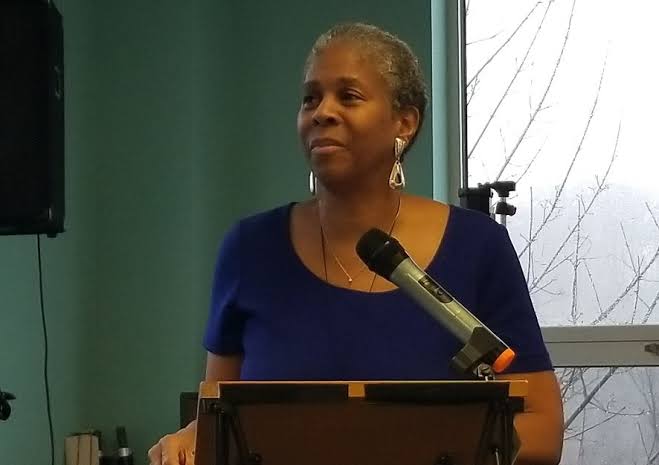
Shirley Chisholm is not the only Black woman whose political career merits recognition; in New York, Dr. Lenora Fulani made political history in 1988 by becoming the first woman and the first Black person to appear on the general-election ballot in all 50 states.
She achieved this outside the realm of America’s two-party system by establishing an independent political movement at a time when obtaining ballot access across the country was a massive organizational effort. It makes no difference whether or not one agrees with all the positions that Fulani has taken when it comes to recognizing that achievement. History does not demand ideological agreement before admitting that a barrier has been overcome.
Shirley Chisholm opposed the Democratic establishment using the slogan “Unbought and Unbossed”. Lenora Fulani challenged the two-party establishment by means of independent politics. Fannie Lou Hamer stood up to the Democratic Party establishment at a time when Black Missourians were being denied meaningful representation. Barbara Jordan was the first Black woman from the South to be elected to Congress.
They didn’t need someone else’s historical identity to be linked to them; they created their own history.
Rather than always linking Black political pioneers to today’s political figures, our leaders should focus more on teaching the younger generation about the Black women who actually made these breakthroughs.
SHARPTON SHOULD KNOW BETTER
What is so frustrating about Sharpton’s comments is that he knew Chisholm; indeed, when young he had spoken publicly about working with her and about seeing the racism and sexism that she experienced during her presidential campaign.
He therefore knows better than most people the obstacles that Shirley Chisholm had to face. The historical significance of referring to her when introducing AOC at the March on Washington remains, whether or not Sharpton intended to state that the two were exactly equivalent.
Which is why he ought to have been more careful.
The fact that Shirley Chisholm was Black was not incidental to her political career; it was essential to the barriers that she overcame. She was elected at a specific time within a certain Black struggle for freedom, a period when Black political representation was still being争取d.
It is not an argument that Latino politicians cannot advocate on behalf of Black Americans or that Black Americans should not take part in coalitions. We ought to work with people from all different communities when our interests are the same. However, forming a coalition does not mean that history has to be erased.
It is entirely acceptable to celebrate AOC’s Puerto Rican heritage and all the historic political achievements she may eventually secure; in fact, that is exactly the point. AOC has her own history to establish.
STOP LENDING OUT BLACK POLITICAL HISTORY
Black America’s history is now one of the most important sources of political symbolism in the United States. Politicians from all sections of the political spectrum refer to Dr. King. Various movements make use of the language from the Civil Rights Movement. Political leaders call upon figures from Black history such as Rosa Parks, Harriet Tubman, Fannie Lou Hamer, Malcolm X, and others to give current causes a moral basis.
One should take lessons from Black history, but it is one thing to learn from our history and another to apply our historical symbols to current political movements.
Our history should not be treated as a costume and our heroes不应 be used as political props; black political leaders ought to be among the first to protect that distinction.
It is particularly important when politicians gain access to platforms that are linked to the Black freedom movement because, before they borrow our heroes, our symbols, and our stages, we ought to inquire into what those politicians have actually done to advance Black political power.
MALCOLM X WARNED US ABOUT THE FOX
Malcolm X cautions Black America as to the difference between the wolf and the fox, saying that the wolf displays his teeth while the fox smiles before entering the henhouse. His warning concerning the white liberal was not an appeal to trust the conservatives, but rather a warning to Black people not to confuse political friendship with their own Black political interests.
The warning still has relevance. If Black leaders give politicians access to our events, to our civil-rights history, and to the legacy of figures such as Shirley Chisholm, we ought always to consider what Black America is getting in return. Forming a coalition is one matter; handing over our political history and our power is something else.
Is Al Sharpton letting the fox into the Black political henhouse? We shall see.